
Introduction: The Twilight of Mass Production and the Triumph of Mass Personalization
Introduction: The Twilight of Mass Production and the Triumph of Mass Personalization
The modern B2B market is undergoing a fundamental and extraordinarily dynamic transformation. The traditional Make-to-Stock model, built on long, repetitive production runs and predictable demand, is irreversibly giving way to flexible on-demand manufacturing. Business customers today expect the level of service familiar from the B2C sector — full order personalization, the freedom to configure products, and lightning-fast lead times. This phenomenon, known as mass personalization, is forcing modern enterprises to completely redefine their existing operational processes and supply chains.
For Chief Operating Officers (COOs) and heads of production, this market evolution represents an enormous logistical and technological challenge. Legacy IT systems that functioned reliably for years in a stable, predictable environment are now becoming critical bottlenecks. The absence of smooth, automated data flow between the sales department and the production floor leads to costly delays, specification errors, and communication chaos. As a result, a professional ERP implementation in a manufacturing company has ceased to be merely an optimization option and has become an absolute prerequisite for survival and competitive advantage.
Full digitalization of manufacturing processes today requires the deployment of a coherent, intelligent ecosystem. Effective manufacturing process automation is not possible if an advanced MES system for production and MRP production planning do not communicate in real time with the modules responsible for sales and ERP warehouse management. Meanwhile, a modern CRM and sales automation solution enables the instant translation of highly non-standard B2B requests for quotation into concrete, actionable production orders, minimizing the risk of errors.
In the face of these unprecedented technological changes, choosing the right software has become a key strategic decision for every management board. In this article, we will conduct a comprehensive and reliable ERP 2026 comparison, analyzing the most important trends shaping the business solutions market. We will examine how to identify the best ERP system for manufacturing 2026 — one that will genuinely support companies in the era of mass personalization. We will also look at dedicated solutions for other sectors, analyzing both expansive enterprise platforms and the optimal, affordable ERP system for SMEs that will allow smaller players to compete effectively in modern commerce and services.
Make-to-Order in the Digital Age: Why Legacy ERP Systems Can't Keep Up
The shift to the Make-to-Order (MTO) model ruthlessly exposes every weakness of outdated IT systems. The key architectural differences between the traditional management model and the flexible approach required in 2026 come down to the fundamental way in which information is processed. Older platforms were designed with stable mass production (Make-to-Stock) in mind, where product structures are rigid and processes are planned in long, unchanging cycles. A modern, best ERP system for manufacturing 2026, by contrast, must be built on an event-driven architecture and dynamic data structures. This requires seamless communication between modules so that every change to an order — no matter how minor — automatically and flawlessly updates schedules at every level of the organization.
The absence of this systemic flexibility has a drastic and direct impact on the rising operational costs of businesses. In legacy software, every customization forces the creation of new material indices and multi-level bills of materials (BOMs) from scratch. A prime example is a large machinery manufacturer that relied for years on a rigid, monolithic system. That company was losing the lion's share of its operating margin solely due to the need to manually recalculate construction variants. Every modification of machine parameters by a B2B customer meant hours of work for engineers, painful delays in quoting, and a significant risk of costly human error at the pricing stage.
Rigid data structures are equally destructive when it comes to MRP production planning. Legacy algorithms cannot dynamically allocate substitutes or recalculate material requirements in real time when the priorities of personalized orders suddenly shift. As a result, procurement departments order raw materials late or build up unnecessary stock surpluses. Instead of managing resources with precision, organizations are forced into manual, chaotic workflow management — completely negating the benefits of digitalization.
To avoid such scenarios, modern manufacturing process automation demands software that treats variability as the market standard. Full integration of flexible MRP with a modern MES system for production enables instant correction of shop-floor orders. Looking ahead to 2026, maintaining inflexible, lagging solutions is a straightforward path to losing competitive ground to more agile players.
CRM and CPQ: Where Sales Automation Meets Technology
In the era of mass personalization, traditional quoting methods are becoming a bottleneck that effectively stifles business growth. Complex products require precise pricing and multi-stage technical verification — which, in the classical model, ties up engineers and dramatically extends response times. The answer to this growing challenge is CRM sales automation combined with advanced Configure, Price, Quote (CPQ) systems. This is precisely where innovative technology meets the day-to-day work of a sales representative, completely revolutionizing B2B processes.
The key advantage offered by a modern CRM for sales integrated with a CPQ module is the complete independence it gives the sales department from engineers during the quoting process. Using an intuitive interface, a sales representative can independently configure highly complex machines, industrial equipment, or custom-made furniture. The system works in the background to verify the product's structural logic, select the appropriate components, and instantly calculate the final margin. As a result, sales staff can focus on building relationships with clients rather than spending valuable hours on internal technical consultations.
In modern IT ecosystems, the CRM sales pipeline integrates smoothly and naturally with variant pricing systems. When a sales opportunity moves into the quoting phase, CPQ mechanisms automatically generate a bill of materials and a cost estimate based on current raw material prices. Eliminating technical errors at the B2B customer quoting stage thus becomes a market standard. The software simply will not allow a quote containing mutually exclusive parameters to be generated and sent — something that was once a genuine nightmare for manufacturing companies.
Integrating a CRM with a CPQ system is not merely an operational convenience — it is, above all, an iron guarantee that what we sell can actually be manufactured and will deliver the projected profit.
The most direct and measurable result of deploying this technological duo is a radical reduction in the time from request for quotation to production order confirmation. One leading manufacturer of window and door joinery managed to cut the time required to prepare a complex quote from three business days to just a few minutes. When a customer accepts the quote, the integrated system immediately transforms it into a ready-to-execute order that goes directly to the shop floor. This comprehensive automation of manufacturing and sales processes builds a powerful competitive advantage in today's extraordinarily demanding market.
B2B E-Commerce as a Digital Extension of the Production Floor
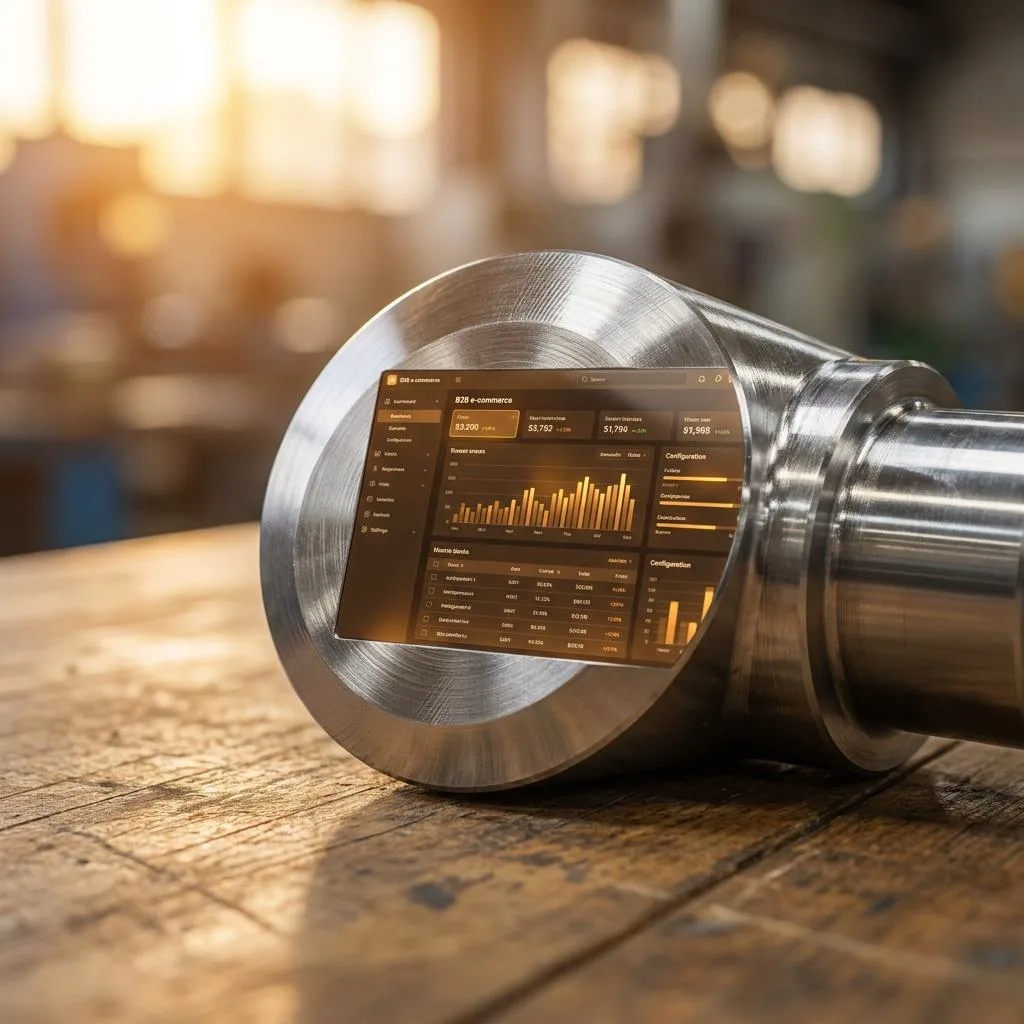
In an era of mass personalization and rising expectations from business customers, the role of traditional sales platforms is undergoing a dramatic shift. Modern B2B e-commerce has ceased to be merely a digital product catalogue and has become a fully fledged digital extension of the production floor. We are witnessing a clear, irreversible trend toward shifting the burden of order handling onto advanced self-service platforms. Self-service B2B portals are not just a convenience for partners — they are, above all, a strategic way to relieve customer service departments. Instead of exchanging dozens of emails and manually transcribing specifications, sales representatives can focus on technical consulting and relationship-building, while routine transactions are processed entirely automatically by the customers themselves.
For this model to function flawlessly, however, a company's IT infrastructure must be built on absolute data consistency. A modern ERP system for commerce and e-commerce must communicate in real time with both the physical warehouse and the dynamic production schedule. When a business customer configures a complex order in the portal, they expect an immediate response. The real-time online verification of material availability and lead times becomes paramount. In a fraction of a second, the system must analyze not only the stock levels of finished products, but also raw material availability, the current load on production workstations, and delivery lead times from external subcontractors.
In this context, precise ERP warehouse management emerges as the absolute foundation of credible and profitable e-commerce. Without flawless, second-by-second inventory updates, a B2B portal becomes a genuine threat to the company's reputation — risking the acceptance of orders that cannot be fulfilled with available resources. A prime example is a leading manufacturer of specialized industrial components that, thanks to deep integration between its B2B shop and its production system, reduced the time required to confirm non-standard orders from two days to just a few seconds. The moment a customer clicks "Place Order," advanced manufacturing process digitalization enables automatic raw material reservation and the instant generation of a shop-floor work order, eliminating human error.
When analyzing a reliable ERP 2026 comparison, it becomes clear that the boundary between online sales and back-office operations is dissolving entirely. When selecting the optimal technology solution, COOs and CIOs must treat e-commerce and manufacturing as a single, inseparable ecosystem in which information flows freely, building an unshakeable competitive advantage.
A Reliable ERP 2026 Comparison: Monoliths vs. Composable Architecture
The technology landscape in 2026 is dominated by a fundamental clash between two philosophies of building business software. On one side stand traditional, monolithic All-in-One systems; on the other, modern Composable ERP architecture. Monoliths offer a closed ecosystem in which a consistent interface and a single service contract theoretically simplify the management of the entire organization. Unfortunately, in an era of rapid market change, this architectural rigidity becomes a form of technical debt that severely hampers a company's operational development.
Composable architecture, built on an API-first approach, allows organizations to flexibly select the best-in-class modules that suit their needs (the so-called best-of-breed approach). Rather than relying on a mediocre warehouse module hard-baked into a monolith, a company can integrate an advanced WMS from an independent vendor. The main drawback of this approach is the need to manage multiple vendors and higher competency requirements for internal IT teams. Nevertheless, the unprecedented flexibility and the ability to scale individual business areas independently more than compensate for these initial challenges.
Selection Criteria: The Best ERP System for Manufacturing 2026
For COOs and CIOs evaluating the best ERP system for manufacturing 2026, architectural openness becomes an absolutely critical criterion. In modern factories, software must exchange data instantaneously with machinery (IoT), manufacturing execution systems (MES), and advanced planning and scheduling tools (APS). An open API ensures that the business will not be locked in technologically when, in a few years' time, the need arises to adopt a new market innovation. Scalability in the Composable model means that expanding the machine park no longer requires a costly, high-risk reimplementation of the entire ERP core.
Integration Challenges: B2B Services vs. Manufacturing and Commerce
The choice of architecture must also precisely account for the specific industry context of the organization. A modern ERP system for B2B services focuses primarily on agile project management, contract profitability, and optimal allocation of human resources. In a modular architecture, a service company can easily add specialized billing tools or an advanced CRM, creating a perfectly tailored working environment. Manufacturing and trading companies, on the other hand, face a far more complex operational challenge that requires the synchronization of multiple independent processes.
They must seamlessly combine shop-floor management with multichannel sales and complex warehouse logistics. A prime example is a large manufacturer and distributor of building materials that, thanks to a Composable architecture, integrated its financial core with an external B2B e-commerce platform and a dedicated delivery route optimization system. In a monolithic approach, such deep integration would have required years of costly programming and laborious testing. In a microservices-based ecosystem, the company gained a powerful competitive advantage in just a few months — proving that the future belongs to fully flexible solutions.
The Closed Data Loop: From the B2B Cart to the MES System
The moment a business customer clicks "Place Order" on an e-commerce portal is no longer simply the end of the sales process. In a modern enterprise, it is merely the beginning of a fascinating, fully automated data journey that creates what is known as a closed information loop. Manufacturing process automation reaches its highest level here, because the integrated system completely eliminates the need to manually transcribe parameters. In a fraction of a second, the complex specification approved in the virtual cart is transformed into a fully fledged production order, immediately visible in the factory's master schedule.
A key element of this technological puzzle is the way in which an advanced MES system for manufacturing (Manufacturing Execution System) receives data directly from the online configurator. Instead of waiting for a technologist to prepare drawings and bills of materials, the software independently generates the product structure (BOM) and a precise routing. Parameters selected by the customer in a web browser — such as non-standard dimensions, material type, or a specific finish — are directly translated into machine language and instructions for shop-floor workers. This radically shortens production preparation time, minimizing what is known as lead time.
Consistent digitalization of manufacturing processes means the definitive end of the era of paper-based document flow — something that is particularly critical when fulfilling special and one-off orders. When a work order arrives at the appropriate workstation, the operator no longer searches for a folder of printouts. Instead, an industrial touchscreen panel displays interactive step-by-step instructions, 3D models, and precise machining parameters generated on the basis of the original order from the B2B platform. If engineers introduce a sudden change to the process in the meantime, the update appears on the screen immediately, effectively preventing the production of defective parts.
The ideal information flow is one in which the data entered by the customer at the quoting stage becomes a direct instruction for the machine at the end of the process, with no human intervention whatsoever.
A prime example of the effectiveness of this model is a leading manufacturer of personalized ventilation systems that integrated its B2B portal directly with its MES software. Previously, processing an unusual order from a distributor and delivering instructions to the shop floor took an average of two business days. Now, thanks to seamless data exchange, CNC machines receive ready-to-run machining programs just minutes after the customer has paid for their cart. This IT architecture dramatically cuts operational costs and guarantees absolute conformity between the finished product and the customer's expectations.
Affordable ERP for SMEs: How to Optimize Implementation Costs
For Chief Financial Officers (CFOs), digital transformation is above all a budgetary challenge. The search for savings often leads to typing "affordable ERP system for SMEs" into a search engine. It is important to remember, however, that a low initial license price can be the biggest trap of all — one that conceals substantial implementation and ongoing maintenance costs. The key to success is a thorough analysis of the total cost of ownership (TCO) over a minimum five-year horizon. Subscription-based (SaaS) models become a strategic ally here. They convert unpredictable capital expenditure (CAPEX) on server infrastructure into predictable operating costs (OPEX). The cloud eliminates the hidden costs of updates, security, and maintaining an in-house IT support team — representing an enormous financial relief for the SME sector.
Another aspect of budget optimization is the project methodology itself. Traditional, months-long "Big Bang" implementations carry enormous risks of cost overruns. A modern, step-by-step ERP implementation in a manufacturing company, delivered using an Agile methodology, allows these risks to be drastically minimized. Rather than waiting a year for an entire system to be deployed, the organization first launches its critical modules — for example, warehouse management or finance. The rapid return on investment (ROI) from the early phases can partially fund subsequent transformation stages. This approach allows errors to be corrected on an ongoing basis and avoids costly rework later in the project.
An excellent confirmation of this strategy is the case of a mid-sized custom furniture manufacturer that faced the need to digitalize its on-demand production. The company moved away from costly on-premise systems in favor of a flexible cloud-based solution. By choosing a modular architecture and paying only for the resources actually used, the business optimized its IT budget by nearly 40% compared to its original projections. Moreover, thanks to balanced scaling in the SaaS model, the CFO gained full cost transparency and the assurance that system expenditure would grow proportionally to the company's actual revenue growth — effectively safeguarding its financial liquidity.
Change Management and Neutralizing Employee Resistance
Even the most technologically advanced ERP-class system implementation will end in costly failure if we ignore the most important element of any organization – the human factor. The statistics are unrelenting: it is resistance to change, not software bugs, that is the most common cause of digital transformation failures. The key to success lies in skillfully managing the mood at the critical intersection of the office and the shop floor, where anxiety about new technology tends to run highest.
The Psychology of Change: Why Are Employees Afraid of Digitalization?
To manage change effectively, one must first understand its psychological underpinnings. Experienced shop floor workers, master craftsmen, and foremen often perceive new IT systems as a direct threat. They fear that process automation in manufacturing will render their years of experience and unique knowledge obsolete. The fear of losing their position – or of having their digital skill gaps exposed – paralyzes initiative and breeds natural resistance. Rather than seeing the system as a tool that makes their daily work easier, they perceive it as a cold-hearted mechanism for strict control and surveillance by management.
Internal Communication and the Quick Wins Strategy
The solution to this problem is developing a radically transparent internal communication plan. From day one, employees must understand why the company is implementing the new system and what specific benefits it will bring to their individual roles. An extremely effective tactic is showcasing so-called Quick Wins.
If a CNC machine operator sees that the new system means they no longer have to spend several minutes at the end of each shift manually filling out paper job cards, their attitude toward the technology will improve dramatically. Communication grounded in facts and practical improvements effectively cuts through corridor gossip.
On-the-Job Training and Change Ambassadors
Another pillar of resistance neutralization is the right approach to staff education. Generic, multi-hour presentations in conference rooms must be categorically abandoned in favor of practical, focused on-the-job training sessions. Each employee must learn to operate the specific module assigned to them – on their own device, whether that is a warehouse scanner or an MES reporting panel.
It is worth identifying change ambassadors throughout this process. Rather than imposing new procedures from the top down, identify the informal opinion leaders within individual teams. For example, at one large metalworking plant, it was the most respected, senior foremen who were trained first. When it was they – rather than external IT consultants – who began explaining the new software to their team members, trust in the system increased dramatically and anxiety about the innovation was reduced to virtually zero.
Conclusion: Readiness for 2026 and a Process Audit
The year 2026, fast approaching, is setting entirely new standards in the area of business software. As our ERP 2026 comparison has shown, the era of rigid, monolithic systems is inevitably drawing to a close, giving way to flexible Composable architecture. Manufacturing, trading, and service companies alike face the need to redefine their approach to technology. The goal is no longer simply to record business events, but to build intelligent ecosystems that respond to market anomalies in real time.
Key trends — such as the deep integration of B2B e-commerce platforms with MES-class systems and advanced predictive analytics — are becoming today's market standard rather than an innovative curiosity. Organizations that ignore this technological race will very quickly feel a decline in their competitiveness. Those that invest in the best ERP system for manufacturing 2026 or modern ERP for commerce and e-commerce, on the other hand, will gain unprecedented operational agility. The future belongs to companies capable of seamlessly weaving dispersed data into a single, coherent information loop.
Conscious Leadership in the Age of Digital Revolution
Implementing such advanced solutions is never purely an IT project. It is, above all, a profound business transformation that demands exceptionally conscious leadership. The roles of COOs, CFOs, and CIOs have evolved. Today, senior management can no longer simply delegate software selection to the technical department. They must actively shape the vision of how the digitalization of manufacturing and commercial processes will translate into the achievement of the company's strategic objectives.
Experience shows that the success of any implementation depends primarily on management's commitment to change management. A prime example is a leading automotive components manufacturer where close collaboration between the COO and CIO enabled a seamless transition from a legacy monolith to a modular architecture. These leaders understood that the new technology would force hundreds of employees to change their established habits. From the very outset, they therefore prioritized transparent communication, explaining to staff how the new system would simplify their day-to-day work and reduce the volume of repetitive tasks.
Process Audit: A Critical Step Before Choosing a System
Before an organization begins reviewing proposals and inviting vendors to present, however, it must take one absolutely fundamental step: a thorough review and optimization of its existing ways of working. Implementing modern software on top of inefficient, outdated procedures is a straightforward path to failure. Digitizing chaos simply means the organization will make mistakes faster and at greater cost. That is why it is so important to conduct an in-depth business process audit before making any investment decisions.
Such an audit should ruthlessly expose every bottleneck, manual system workaround, and instance of data siloing. It is worth involving not only senior managers in this process, but above all frontline key users — shift supervisors, warehouse staff, and B2B customer service specialists. They hold the most valuable knowledge about where current procedures break down. Mapping the actual value flow makes it possible to precisely define the functional requirements for a new IT ecosystem.
The decision to implement a new ERP system should always be preceded by a critical analysis of your own organization. The best software in the world cannot fix a fundamentally broken business process.
Plan Your Path to Operational Excellence
2026 will not forgive technological neglect, yet at the same time it will open enormous opportunities for organizations that are well prepared for change. If your company is planning to implement a new platform, do not succumb to the pressure of quickly selecting the first solution that appears in a ranking. Regardless of whether you are interested in a comprehensive enterprise system or a low-cost ERP system for SMEs, the methodology remains the same. The foundation of success is always thorough internal preparation.
We encourage management to pause for a moment and look at their organization from a bird's-eye view. Plan an initial process audit now, before reaching out to implementation firms. Engaging independent expert consultations at an early stage can save millions, protecting the business from project overestimation or the selection of a mismatched architecture. Contact our advisors to jointly map your processes and prepare your organization for a safe, highly profitable digital transformation. Let us build together a technological advantage that stands the test of time.


