
The Twilight of the Analogue Era: Why Paper Is Holding Your Business Back
In the age of Industry 4.0, where predictive algorithms and IoT are becoming the norm, the sight of a warehouse worker with a clipboard and pen may seem like an innocent relic of the past. From an operations director's perspective, however, that image should be a red flag. Maintaining analogue document workflows in an environment that demands agility is like trying to win a Formula 1 race in a car from the 1990s – technically possible, but doomed to fail against modern competition.
Traditional management methods, built on the physical flow of information, have ceased to be merely "less efficient." They have become an active brake on enterprise scalability. The problem lies not in paper as a medium, but in the processes it imposes: linear, slow, and prone to disruption.
Hidden Costs That Don't Show Up on Your Paper Bills
Many managers mistakenly equate the costs of "paperwork" with spending on office supplies and archiving. That, however, is only the tip of the iceberg. The true costs are hidden in time and data quality. Every form filled in by hand on the production floor must be physically delivered to the office and then re-entered into the ERP system. This creates two critical problems:
- Information delay (Time-to-Insight): Management decisions are made based on historical data rather than current reality. By the time a report reaches the director's desk, the situation on the production floor may have changed dramatically.
- Vulnerability to human error: Manual data entry (re-keying) carries an error rate of 1–4%. Over the course of a year, this translates into thousands of incorrect records, which can lead to erroneous orders, downtime, or quality issues.
Operational Risk and Lack of Transparency
The absence of a real-time digital process trail creates so-called operational "black holes." When a document circulates between departments in physical form, its status is invisible to the rest of the organisation. For an operations director, this means a loss of control over bottlenecks. It is difficult to optimise a process whose flow cannot be measured without engaging additional analytical resources.
Furthermore, analogue processes are extremely difficult to audit. In the event of a complaint or quality inspection, reconstructing the decision trail requires sifting through physical archives – something that, in critical situations, can paralyse an entire department.
Towards a Digital Operational Ecosystem
The solution is not simple digitalisation through document scanning – that merely preserves old patterns in a new format. Modern management requires a shift to an integrated digital ecosystem. We are talking about an environment in which data is entered once (often automatically by machines or via low-code applications) and immediately becomes available to all process stakeholders.
Eliminating paper is the first step towards building a data-driven organisation, where the flow of information is as smooth as the flow of materials on a production line. It is the foundation on which advanced automation can be built and artificial intelligence algorithms can be deployed – topics you will read about in the sections that follow.
The Anatomy of Inefficiency: Where Traditional Process Management Fails Most Often
When analysing processes in manufacturing and logistics companies, a clear dissonance emerges: production technology often outpaces information-flow technology by entire decades. Even the most state-of-the-art machinery loses efficiency when managed using methods from the previous century. Where exactly does the value chain break down?
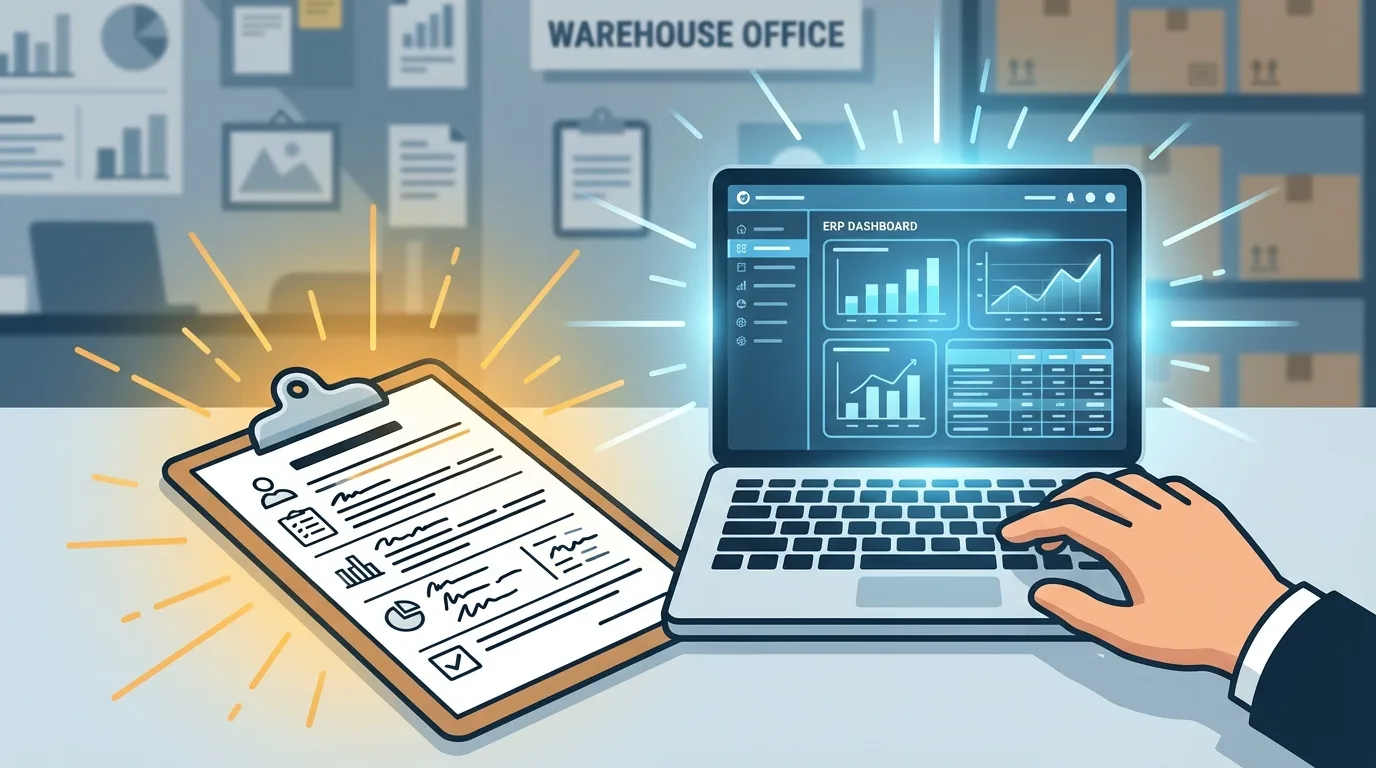
The Failure Point at the Interface: Paper vs. ERP
The critical failure point is the moment data is transferred from the physical world to the digital one. Manually re-entering data from paper forms into an ERP system is a classic example of resource waste that generates measurable losses – and the issue goes far beyond the costly hours spent by administrative staff.
Every mistake made when entering a product index or unit count triggers a cascade of consequences: from incorrect stock levels and unnecessary raw material reorders, to a production line stoppage caused by missing components that were "theoretically" supposed to be in inventory.
Information Silos and Decision Paralysis
Traditional, analogue document workflows create hermetically sealed data silos within an organisation. Information about a machine breakdown, an absent employee, or a delayed delivery – recorded only in a paper shift report – reaches management with significant delay. In a dynamic operational environment, a few hours' lag is an eternity.
The result is a lack of synchronisation between key departments:
- The sales team promises customers delivery dates that production cannot meet given its current workload.
- Logistics plans shipments based on outdated data on order-picking status.
Lack of Real-Time Order Status Visibility
For the Operations Director, the greatest ongoing challenge is "operational fog." Without digitised processes and the use of Process App-type applications, answering the simple question "what stage is the key order at?" requires a physical walk-through of the shop floor or a series of phone calls. The absence of real-time visibility makes it impossible to proactively manage risk or quickly reallocate resources to wherever they are most needed at any given moment.
Low-Code as the Foundation of Operational Agility
In a reality where the pace of market change demands continuous adaptation, the traditional software development model becomes a bottleneck. This is where Low-Code platforms enter the picture. This is not merely a technical novelty for developers – it is a strategic asset for Operations Directors. In its simplest terms, this technology enables the building of sophisticated business applications through visual interfaces and ready-made components, drastically reducing the need for manual coding.
Why does Low-Code change the rules of the game in operations? Until now, every process modification – even a trivial one, such as adding a field to a quality control form or changing a cost-approval workflow – required a lengthy IT development cycle. Waiting for available developer resources stifled innovation, forcing operational departments to create workarounds in spreadsheets.
The key benefit here is a radical reduction in the time it takes to implement changes – in other words, Time-to-Market. The low-code approach frees an organisation from dependence on rigid IT department schedules. Dedicated process applications (Process Apps) can be built in days rather than months, precisely addressing the current challenges of the production floor or warehouse. This is operational agility in its purest form, enabling an immediate response to new market requirements.
It is also worth dispelling concerns about the quality of such solutions. Professional Low-Code platforms systematically reduce technical debt. Rather than creating complex, bespoke "patches" on ERP systems, solutions are built on a standardised, modular architecture. This structure ensures scalability and security while giving managers a tool for continuous process improvement – without the risk of destabilising the company's core system.
Artificial Intelligence in the Service of Operations: From OCR to Prediction
While Low-Code platforms provide a flexible framework for digital processes, Artificial Intelligence becomes their nervous system. For an operations director, however, the critical skill is distinguishing media hype from genuine business value. In the context of operations management, the goal is not futuristic visions but pragmatic cognitive automation – one that relieves employees of the burden of repetitive analytical tasks, making optimal use of the synergy between artificial intelligence and low-code platforms.
The first line of defence against document chaos is the evolution from basic OCR to Intelligent Document Processing (IDP). Modern algorithms do not merely "see" text on a scanned invoice, goods-received note, or quality protocol – they "understand" it. These systems automatically extract key data – such as batch numbers, expiry dates, and product codes – and feed it into the digital workflow with near-perfect accuracy. This eliminates the data-entry bottleneck and drastically reduces the incidence of human error.
Once data is in the system, AI takes control of information logistics through automatic task classification and routing. Rather than waiting for a manager to manually assign tasks, the algorithm analyses the content of a submission – for example, an urgent complaint or a machine breakdown report – and immediately directs it to the appropriate specialist, assigning the correct priority. This reduces response times from hours to minutes.
At the highest level of digital maturity, predictive algorithms come into play. By analysing historical flow patterns and seasonality, AI supports demand planning with a precision that traditional spreadsheets cannot match. The system can provide advance warning of a potential stock-out or anticipate an order surge, enabling management to proactively adjust schedules and resources before the problem even arises.
Perfect Synergy: How Combining AI and Low-Code Creates Intelligent Process Apps
The true operational revolution occurs at the intersection of these two technologies. While Low-Code platforms provide the essential structure, interface, and speed of deployment, Artificial Intelligence fills that framework with the capacity for analysis and decision-making. Together, they enable the creation of a new class of business tools: Intelligent Process Apps. In this ecosystem, Low-Code acts as the digital circulatory system, efficiently distributing information, while AI serves as the brain, interpreting data in real time.
For the Operations Director, a key aspect of this synergy is the democratisation of advanced technology. Modern Low-Code platforms offer ready-to-use AI components available on a drag-and-drop basis. This means that to implement advanced analysis in a warehouse process, a company does not need to hire a costly team of data scientists. Image recognition, text classification, and anomaly detection algorithms become standard building blocks from which business teams (so-called Citizen Developers) can independently build solutions precisely tailored to the specific needs of their facility.
Let us translate this into a concrete operational example: an application for reporting breakdowns on a production line. In the traditional approach, an employee simply fills in a form. In an Intelligent Process App, built-in AI immediately analyses the attached photo of the damaged component. The system performs an automatic preliminary diagnosis, categorises the fault, and even checks the availability of spare parts in the inventory system – all before the ticket reaches the technician. This eliminates the manual verification step by the dispatcher and drastically reduces downtime, transforming the system from a passive log into an active operational assistant.
The Digital Warehouse: Eliminating Errors in Logistics Processes
In internal logistics, paper-based documentation presents a barrier that even the best-trained team cannot overcome. The transition to digital ecosystems is not a matter of aesthetics – it is a hard operational necessity. Deploying dedicated Low-Code applications on handheld terminals allows for the complete elimination of printed pick lists, replacing them with interactive interfaces that guide workers step by step through every stage of the process.
The key change is the automation of goods receipt and dispatch. Instead of manually checking off items, the warehouse operative scans barcodes while the system validates the delivery against the purchase order in the ERP system in real time. The application immediately blocks any attempt to receive an incorrect product code or wrong quantity, eliminating mistakes at their source – before they become a costly accounting or production problem.
True optimisation, however, begins where basic digitalisation meets algorithms. In the picking process, AI-assisted systems determine optimal collection routes. The algorithm analyses the locations of all items on the pick list and sequences the collection order to minimise the distance travelled. For the Operations Director, this means not only faster order fulfilment, but also reduced worker fatigue and higher productivity per man-hour.
The end result is a dramatic reduction in inventory errors. Thanks to mobile Low-Code applications, every warehouse movement is recorded at the moment it occurs. This enables a shift from burdensome periodic stocktakes to a model of continuous inventory. The accuracy of stock-level data, in turn, allows safety buffers to be safely reduced, freeing up tied-up working capital.
Production Optimisation: Managing an Order from Raw Material to Finished Product
When raw materials leave the warehouse and arrive on the production floor, traditional document workflows often create a so-called "information black hole." Paper job cards mean that data on the actual progress of orders reaches management systems with a delay of many hours. Digital transformation in this area involves replacing physical documentation with interactive operator panels that become the central point of contact between the worker, the machine, and the IT system.
The implementation of digital job cards enables monitoring of OEE (Overall Equipment Effectiveness) in real time. Operators no longer waste time filling in paper fields; instead, they report operation statuses – from changeovers to breakdowns – via simple touchscreen interfaces. For the Operations Director, this means a shift from historical analysis ("what went wrong yesterday?") to proactive management. Low-Code systems immediately visualise efficiency drops, enabling intervention before micro-stoppages begin to affect delivery deadlines.
A key advantage of digitalisation is also the automation of production batch tracking (Traceability). Linking consumed raw materials to finished products happens in the background, with no cumbersome paperwork involved. In the event of an audit or customer complaint, the full product genealogy is available at a single click, drastically reducing operational risk and the cost of any potential product recalls.
It is worth emphasising that modern production demands agility. Low-Code platforms enable the rapid reconfiguration of processes without costly involvement from external IT vendors. When a manufacturing technology changes or a new quality control requirement emerges, modifying the digital workflow takes hours rather than weeks. As a result, the production facility is not a prisoner of a rigid MES system, but an agile organisation capable of rapidly adapting to market changes.
Data Quality and the Elimination of Human Error: Validation Mechanisms
In the operational world, where decisions must be made in split seconds, data quality is the highest-value currency. Every analytical system is only as good as the information fed into it – in line with the "garbage in, garbage out" principle. Traditional reporting methods leave too much room for interpretation, from illegible handwriting on job cards to typos in critical material codes. Low-Code platforms address this problem at its root by introducing rigorous data validation at the point of entry. Replacing free-text fields with predefined drop-down lists, sliders, or automatic readings pulled from machines makes errors virtually impossible. The system will simply block the process if a form does not meet the defined business rules.
Modern process management goes a step further, however, integrating machine learning mechanisms directly into forms. Automatic anomaly detection by AI acts as an invisible protective shield for databases. Algorithms compare entered values in real time against historical patterns and technical standards. If an operator accidentally enters a pallet weight or cycle time that statistically deviates from the norm, the system will immediately request verification or reject the entry. This prevents situations in which a single human error cascades into disrupted production planning for days to come.
For the Operations Director, these technical improvements translate into invaluable integrity of management data. Reports generated at the end of a shift become a faithful reflection of fact rather than a collection of rough estimates requiring manual "cleaning" in Excel. By enforcing data accuracy at the point of entry, management can focus on drawing conclusions and optimising operations – rather than verifying the reliability of their own reporting systems.
Accelerating Information Flow: From Event to Decision
In the traditional operational model, information about a critical production event often reaches decision-makers when it is already too late for effective intervention. Working with paper or isolated spreadsheets is, in practice, post-mortem management. Digitalising processes with Low-Code platforms and AI changes this dynamic, transforming the enterprise into a living organism that responds in real time. Instead of analysing reports about problems from last week, management gains visibility into the situation here and now.
The key to this change lies in intelligent notifications and escalation paths. The system does not merely record a machine stoppage or a sudden shortage of raw materials – it immediately directs an alert to the relevant maintenance teams or planners. Moreover, if the issue is not addressed within a defined timeframe (SLA), algorithms automatically escalate the ticket to a higher level of management. This ensures that minor incidents do not escalate into serious crises simply because information got stuck in someone's inbox.
Technology also enables the effective elimination of decision-making bottlenecks through the automation of approval processes. Requests to purchase spare parts or release a production batch no longer need to wait for a physical signature. The business logic of process applications can automatically approve standard operations that fall within defined thresholds, while those requiring human attention are prioritised accordingly.
For the Operations Director, this means the end of being tied to a desk. Access to data on mobile devices makes it possible to monitor key performance indicators (KPIs) and approve decisions from a smartphone while standing directly on the production floor. Shortening the response time from when an event occurs to when a decision is made is the purest form of optimisation – one that builds competitive advantage in a dynamic market environment.
Integration with Legacy Systems: Low-Code as an Orchestration Layer
One of the most common obstacles to digital transformation in large enterprises is the problem of so-called "system islands." In many production facilities and logistics centres, the operational backbone consists of older ERP systems that – while stable and proven – are technologically closed off. For the Operations Director, the prospect of replacing them entirely is often synonymous with multi-million-euro costs, the risk of data loss, and months of paralysis. The modern approach using Low-Code platforms resolves this dilemma by acting not as a costly replacement, but as an intelligent orchestration layer.
Equipped with advanced APIs and libraries of ready-made connectors, these platforms can "communicate" with virtually any IT environment – from SAP to proprietary SQL databases – without any need to modify their source code. This enables an ERP extension strategy: extending the lifecycle of legacy systems by layering modern functionality on top of them. In this model, the ERP remains the untouched "system of record," guaranteeing accounting stability, while the Low-Code platform becomes the agile innovation layer, handling dynamic operational processes.
The key benefit here is the creation of a unified user interface (Unified UI) over multiple distributed systems. A warehouse worker or production team leader no longer needs to log in to three different applications and switch between windows to complete a single order. They are presented with one intuitive screen, while the platform automatically retrieves stock levels from the WMS in the background, updates statuses in the ERP, and sends data to the transportation system. For management, this means that process modernization can proceed in an evolutionary manner, eliminating errors caused by manually transcribing data between systems, while maintaining full business continuity.
Citizen Developer in Operations: How to Involve the Business in the Digitalization Process
The traditional model of innovation deployment — in which every business requirement must pass through the bottleneck of the IT department — is no longer sufficient in a dynamic operational environment. As Chief Operating Officer, Marek Kowalski knows all too well that waiting weeks for a single field to be added to a goods receipt form represents a real financial loss. The answer to this challenge is the concept of Citizen Development — a strategy that transforms subject-matter employees into creators of digital solutions.
Thanks to the intuitive interfaces of Low-Code platforms, shift managers, planners, and quality specialists can independently build and modify process applications. This represents a fundamental paradigm shift: no one understands the specifics of a problem on the production line better than the person who manages it on a daily basis. Leveraging this unique domain knowledge enables rapid solution prototyping and accelerates the deployment of improvements, eliminating the need to produce complex technical specifications that are often misinterpreted by developers.
Involving the business in the digitalization process is also a strategic way to relieve the burden on the IT department. Rather than handling minor process modifications, technical specialists can focus on critical infrastructure and cybersecurity. In this way, the age-old conflict over resources and priorities between operations and technology departments disappears.
For management, however, control remains a key concern. The democratization of software development must not lead to chaos (so-called Shadow IT). The modern approach is built on rigorous Governance. It is IT that defines the secure framework — a "sandbox" with defined access rights and security rules — within which Citizen Developers operate. This gives the Chief Operating Officer the agility of a startup, while at the same time providing assurance that the tools built by their team are stable, scalable, and compliant with the company's compliance policies.
Organizational Culture and Digitalization: Change Management
{ "content": "Organizational Culture and Digitalization: Change Management
Implementing technological innovation in an operational environment is a process in which the weakest link is rarely the software — most often, it is the human factor. For a Chief Operating Officer, the success of a transformation is measured not only by the number of automated processes, but by the degree to which they are accepted by the workforce. Employees accustomed to paper forms often perceive digitalization as a threat, fearing increased surveillance or — worse — job losses to AI. The key to overcoming resistance is transparent communication that positions new tools as support that eliminates frustrating routine, rather than as a monitoring system.
In this context, the User Experience (UX) of the deployed solutions plays a fundamental role. Complex, "clunky" enterprise-class system screens were for years the primary reason employees quietly reverted to the "reliable pencil." Low-Code platforms change these rules of the game, enabling the creation of interfaces that meet the standard of modern consumer applications. If the tablet on a forklift is just as intuitive as the smartphone used in personal life, the barrier to entry drops dramatically. A clear UI thus becomes the most effective tool for rapid technology adoption.
Equally important is building digital awareness through an appropriate training model. Rather than one-off, theoretical instruction sessions, it is worth investing in a continuous process in which operational employees have a genuine say in shaping the tools they use. Thanks to the flexibility of Low-Code, feedback they provide can be implemented almost immediately, fostering a sense of agency. This strategy not only accelerates the learning process, but transforms passive users into active ambassadors of digital change, permanently eliminating paper from circulation.
", "word_count": 248, "summary": "The section explains how, through the intuitive UX of Low-Code applications and by engaging employees in the tool-creation process, resistance to digitalization can be effectively overcome and paper eliminated from operational processes." }ROI and Measurable Results of Process App Implementation
The final decision to undertake digital transformation in the operational area is rarely driven by trends; for a Chief Operating Officer, what matters is the hard economic case. Implementing Process Apps on Low-Code platforms can deliver a return on investment (ROI) at a pace unattainable by traditional IT systems — however, this requires adopting the right measurement methodology. The calculation must go beyond obvious operational costs (paper, printing, archiving) and focus on the most expensive resource: specialist working time and the opportunity cost of errors.
Following the deployment of a digital ecosystem, the management dashboard should monitor three critical KPIs:
- Cycle Time: The actual time from process initiation to completion, eliminating document "idle runs."
- First Time Right: The percentage of processes completed without the need for corrections and costly rework.
- Internal Customer Satisfaction: The smoothness of collaboration at departmental interfaces (e.g., Warehouse–Production), measured by the absence of information bottlenecks.
To illustrate the scale of potential savings, let us consider a Case Study: Digitalization of Production Order Processing. In the traditional model, this process (completing a form, physically circulating signatures, manually transcribing data into the ERP) took an average of 30 minutes. At a volume of 800 orders per month, the company was losing 400 working hours to these activities. The deployment of a dedicated process application, integrated with the central system, reduced the handling time to 6 minutes per order.
The result? 320 hours recovered per month — equivalent to two full-time positions, which can be redirected to higher-value tasks. Adding to this the elimination of data transcription errors (a frequent cause of material losses), the project's ROI often turns positive within the very first quarter after go-live. This demonstrates that Low-Code and AI technology is not merely innovation — it is, above all, the most effective tool for cost optimization.
Security and Scalability in the Cloud
For a Chief Operating Officer responsible for business continuity, moving critical production and logistics data to the cloud often raises legitimate questions about security. It must be clearly emphasized, however: in today's reality, it is physical document circulation that poses the greatest risk of data leakage, destruction, or loss. Modern Enterprise Low-Code platforms, on which process applications are built, operate in accordance with rigorous security standards that frequently exceed the capabilities of on-premises server rooms.
Reputable cloud solution providers guarantee compliance with certifications such as ISO 27001 and SOC 2, ensuring data encryption (both at rest and in transit) as well as advanced access control mechanisms. A critical aspect for operations, however, is infrastructure scalability. During operational peak seasons, when the volume of warehouse orders spikes dramatically, on-premises systems often become overloaded. AI-powered cloud solutions automatically adjust computing capacity to current demand, guaranteeing smooth application performance without the need to invest in additional hardware that would sit idle for the rest of the year.
The final pillar is regulatory compliance (Compliance). Automating processes with Low-Code creates an unbroken audit trail (a digital record of actions). Unlike paper, the system logs every change, approval, or access to personal data — which is invaluable in the context of GDPR requirements and ISO audits. Digitalization not only protects data, but makes processes fully transparent and resistant to procedural errors, giving management the confidence that operations are conducted in full accordance with the letter of the law.
The Future of Operational Management: Hyperautomation
{ "content": "The Future of Operational Management: Hyperautomation
Looking at the horizon of the next 5–10 years, it is clear that the digitalization we are implementing today is merely the foundation for a far deeper transformation. We are entering an era that Gartner analysts have defined as Hyperautomation. This is not just another technology buzzword, but an inevitable direction of evolution for companies that wish to remain competitive in a dynamic market environment. Hyperautomation is the state in which everything that can be automated within an organization will be automated.
In an operational context, this means moving beyond simple rules of the "if X, then do Y" type. We are talking about the orchestration of multiple technologies — from Low-Code platforms, through Robotic Process Automation (RPA), to advanced Machine Learning (ML) algorithms and artificial intelligence. In such an ecosystem, business processes cease to be static pathways and become intelligent, autonomous entities.
From Automation to Autonomy
Imagine the warehouse or production line of the future. Systems will no longer merely report errors or delays — they will prevent them before they occur. Through AI predictive analytics, a Digital Twin of your operation will anticipate a machine failure based on micro-deviations in vibrations and autonomously schedule maintenance, ordering the necessary parts. In the event of supply chain disruptions, algorithms will autonomously recalculate optimal routes and suppliers, renegotiating terms in real time without requiring the procurement team to be involved in every transaction.
The key characteristics of the operations of the future are:
- Self-adaptation: Processes that learn continuously and optimize their own parameters without programmer intervention.
- Proactivity: Shifting from responding to crises to preventing them.
- Democratization of data: Access to analytical insights for every level of the organization in real time.
The Evolution of the Human Role: From Operator to Strategist
The vision of hyperautomation often raises concerns about the role of the human factor. For a Chief Operating Officer, however, it represents an opportunity to unlock the hidden potential of the team. The employee's role evolves from process operator (entering data, clicking "approve") to AI supervisor and strategist. People will remain in the decision-making loop (human-in-the-loop), but their attention will focus exclusively on:
- Resolving unusual exceptions that AI was unable to handle.
- Designing innovations and improving business logic.
- Building relationships and managing the soft aspects that algorithms are unable to replicate.
By deploying flexible Low-Code platforms today, we are not merely eliminating paperwork. We are building a digital backbone that will, in the future, allow AI modules to be seamlessly "plugged in." Companies that remain tied to rigid legacy systems or analog processes will be unable to benefit from the advantages of hyperautomation, falling further behind industry leaders who will make operational decisions in milliseconds rather than days.
", "word_count": 465, "summary": "A visionary section describing the transition from basic digitalization to hyperautomation, where autonomous AI-driven processes take over routine activities, transforming the human role into that of supervisor and strategist." } } }Summary: Your Roadmap to Digital Excellence
Digital transformation is no longer an optional addition to business strategy — it has become a prerequisite for survival in a dynamic market. As demonstrated in the preceding sections, eliminating "paperwork" is merely the tip of the iceberg of benefits that come with implementing Low-Code platforms supported by artificial intelligence. The true value lies in regaining control over processes, radically reducing response times to market changes, and unlocking the intellectual potential of your team.
Why "Now" Is the Best Time to Invest
Many Chief Operating Officers hold back on digitalization decisions, fearing costly, months-long IT implementations that paralyze day-to-day operations. This thinking is rooted in outdated paradigms. The modern Low-Code approach changes the rules of the game:
- Speed of deployment: Process applications (Process Apps) are built in days or weeks, not months.
- Flexibility: The system grows and evolves with your company, eliminating the risk of technical debt.
- Democratization: Thanks to intuitive interfaces, the IT department ceases to be a bottleneck and becomes a true business partner.
Delaying the decision in an era of hyperautomation means ceding ground to competitors who are already optimizing their margins through AI algorithms.
Strategic Steps in the Transformation — Where to Begin?
You do not need to digitalize an entire factory or warehouse in a single day. The key to success is a small-steps strategy that delivers quick returns on investment (ROI) and builds trust in technology within the organization.
- Conduct a process audit (Process Mining): Identify areas where the flow of information is slowest or where the most manual errors occur. These are your candidates for the first implementation.
- Select a pilot process (MVP): Do not start with the core ERP system. Choose a supporting process that is cumbersome — such as the complaints workflow, machine fault reporting, or warehouse employee onboarding.
- Deploy, measure, and optimize: Use a Low-Code platform to quickly build a solution. Gather data, analyze results, and iteratively refine the process.
- Scale your success: Leverage the experience gained and ready-made modules to digitalize further operational areas.
Take the First Step Toward the Operations of the Future
Theoretical knowledge alone is not enough to drive real change. As an operational leader, you face the challenge of turning a vision into a functioning ecosystem. You do not have to do it alone. Our team of experts specializes in translating complex operational challenges into efficient, digital solutions.
We invite you to a free strategic consultation combined with a preliminary audit of your processes. During the meeting, we will jointly identify the "bottlenecks" in your organization and show you how, in as little as 30 days, you can deploy your first process application that will genuinely ease the burden on your team.
Do not let paper and manual processes hold back the growth of your company. Contact us today and start building a competitive advantage grounded in the technology of tomorrow.


