
Introduction: Process Transformation in SMEs
In today's rapidly changing business world, process optimization has become a key element of competitive strategy for small and medium-sized enterprises (SMEs). Faced with growing market pressure, these companies must continually adapt their operations to increase efficiency and reduce costs. The challenges associated with traditional management methods—such as paper-based documentation and fragmented information systems—lead to operational chaos, resulting in errors and delays. As a result, investment in process digitalization is becoming not just an option, but an outright necessity.
The introduction of artificial intelligence (AI) into process management enables the automation of routine tasks and intelligent workflow management. Examples of companies that have successfully implemented AI solutions demonstrate that they can significantly reduce task completion times and minimize the risk of human error. In the manufacturing sector, where precision and timeliness are critical, deploying such technologies allows businesses to rapidly adapt to changing customer needs, enhancing their competitiveness in the market.
It is worth noting that process transformation in SMEs not only brings operational benefits, but also has a direct impact on customer satisfaction. Customers now expect fast and efficient service, and businesses that can meet these expectations gain a competitive edge. By investing in modern solutions, SMEs can therefore not only survive, but thrive in the digital age.
Understanding AI and Its Application in SMEs
Artificial intelligence (AI) is a field of science focused on creating systems capable of performing tasks that require human intelligence. Within AI, we distinguish various subcategories, such as machine learning, which enables computers to learn from data and improve their performance without explicit programming, and natural language processing, which allows machines to understand and generate human language.
In the context of small and medium-sized enterprises (SMEs), AI offers a range of benefits, serving as an excellent example of how technologies enhance operational efficiency. First and foremost, automating routine processes allows teams to focus on more strategic tasks. For example, in the manufacturing industry, applying AI to production scheduling enables optimal resource utilization, leading to greater output and lower costs.
It is also worth highlighting the data analysis capabilities that AI brings. Through the right algorithms, companies can gain deeper insight into operational data, enabling more informed business decisions. For instance, one logistics company implemented AI systems to analyze delivery routes, reducing transportation costs by 20% within just a few months.
AI finds applications across a range of industries—from finance to sales—where it can help automate customer service through chatbots that respond to frequently asked questions. Companies that implement such solutions not only increase their competitiveness, but also raise the level of customer satisfaction. For example, a mid-sized e-commerce company that integrated an AI system for managing customer complaints saw a significant increase in customer satisfaction, which translated into higher sales over the long term.
Ultimately, understanding and implementing AI in SMEs is not merely a trend—it is a necessity that can significantly shape the future of a business. Investment in these technologies is essential for survival and growth in today's globalized market.
AI Use Cases in Process Optimization
Artificial intelligence (AI) is gaining increasing importance across various industries, including small and medium-sized enterprises seeking effective ways to optimize their processes. One example of AI application in manufacturing is the automation of quality control. At one automotive factory, AI-powered vision systems were installed to analyze every production component in real time. As a result, production defects were reduced by 30%, which not only improved the quality of the final product but also lowered costs associated with warranty claims.
In logistics, AI plays a critical role in optimizing delivery routes. For example, a major courier company implemented AI algorithms that analyze data on road traffic conditions, weather, and recipient locations. Using this information, the company was able to increase delivery efficiency by 25%, resulting in significant fuel savings and improved customer service. Customers began receiving packages in shorter timeframes, boosting their overall satisfaction with the service.
AI also supports sales and marketing processes. One e-commerce company deployed AI-powered chatbots to handle frequently asked customer questions. This solution not only reduced response wait times but also allowed the sales team to focus on more complex inquiries. As a result, the company saw a 20% increase in sales conversion within the first three months following the chatbot rollout.
Each of these cases illustrates how applying AI across different areas of SME operations can deliver measurable benefits. Investing in AI technologies not only increases operational efficiency, but also enables businesses to better adapt to evolving customer expectations and dynamic market conditions.
Implementing AI in SMEs: Key Stages
Implementing artificial intelligence in small and medium-sized enterprises (SMEs) is a process that requires careful planning and well-considered decisions. Below are the key stages that should be undertaken to successfully introduce AI into business processes.
1. Needs analysis and selection of appropriate AI solutions
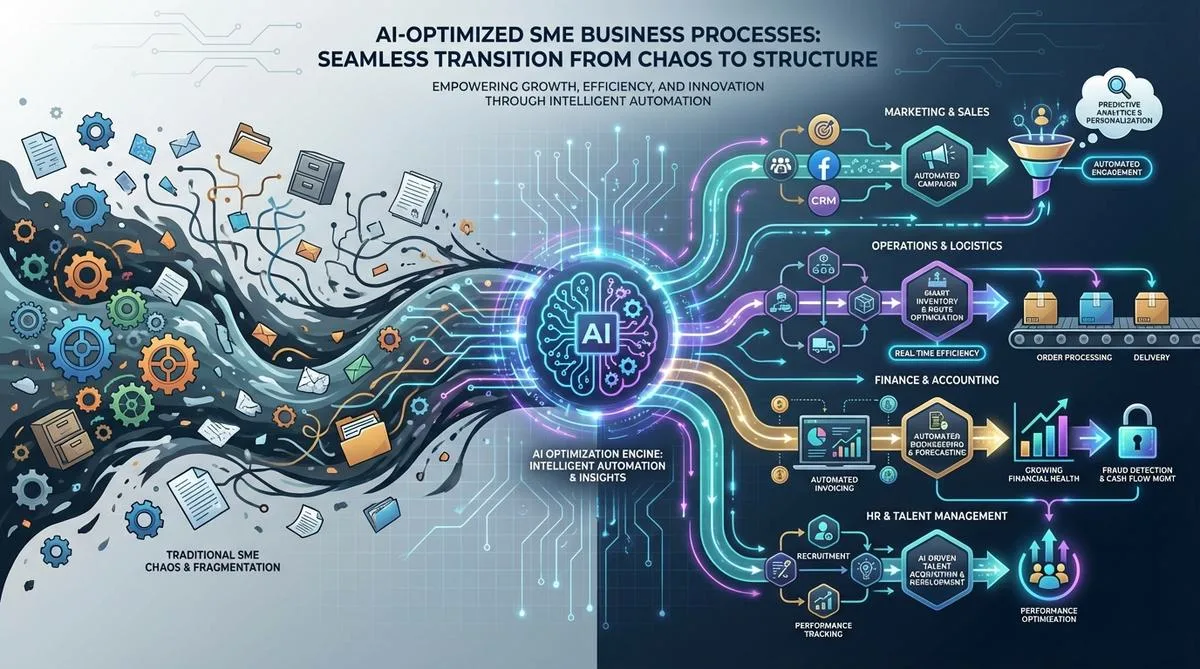
The first step is understanding the specific problems the company wants to solve. Before committing to advanced technologies, however, it is worth familiarizing yourself with the fundamentals of process management before implementing innovations. A detailed analysis of business processes should be conducted to identify areas that could benefit from automation or optimization through AI. For example, a manufacturing company may find that quality control demands significant time and effort. In such a case, it is worth considering AI-powered vision systems. It is equally important to identify the right tools and technologies that best match the organization's needs.
2. Implementation planning: budget, team, and timeline
Once needs have been defined, implementation planning can begin. A critical step is determining the budget the company is prepared to allocate for AI deployment. It is also advisable to form a project team consisting of employees from various departments to ensure a holistic approach to the rollout. Establishing a timeline that sets out specific stages and deadlines is essential for tracking progress. For example, the deployment of a customer service chatbot can be planned over several months, divided into testing phases and a full launch.
3. Monitoring results and optimizing activities
The final stage involves continuously monitoring the results and effectiveness of the deployed AI solutions. Data on performance, quality, and customer satisfaction should be collected on an ongoing basis to assess the effectiveness of efforts. If results fall short of expectations, it may be necessary to introduce optimizations or adjustments to processes. One example of this is refining AI algorithms based on user feedback, which enables the continuous improvement of the system.
Implementing AI in SMEs is a complex yet essential process that can significantly improve a company's operational efficiency and market competitiveness. It is crucial to approach this task with the appropriate level of care and flexibility, which will enable the achievement of the intended goals.
Challenges and Barriers to AI Implementation
Implementing artificial intelligence (AI) in small and medium-sized enterprises (SMEs) can encounter a range of challenges and barriers that may discourage decision-makers from investing in new technologies. A key issue is the lack of AI competencies and knowledge. Many SMEs do not have teams with the necessary skills, making it difficult to understand which specific solutions can deliver the greatest benefits. In such situations, it is worth considering collaboration with external experts who can advise on best practices and provide the knowledge needed for AI implementation.
Another significant challenge involves concerns about costs and return on investment. SMEs often operate on limited budgets, meaning any investment in new technologies raises questions about its viability. It is worth emphasizing, however, that AI can lead to substantial savings over the longer term by automating routine tasks and optimizing processes. To minimize risk, it is advisable to start with small pilot projects that allow effectiveness to be evaluated without major financial outlay.
Equally important is building a culture of innovation within the organization. Many SMEs may struggle with resistance to change, which hinders the introduction of modern solutions. It is essential for management to engage employees in the transformation process by explaining the benefits of implementing AI. For example, an organization might arrange training sessions to help employees understand the value of AI and build confidence in new technologies.
Finally, SMEs should also pay close attention to data-related issues. Implementing AI requires access to high-quality data, which can be a challenge—particularly for companies that lack standardized processes for collecting and managing information. Investing in the right data management tools may prove to be critical to the success of an AI project.
Conclusion: The Future of AI in SMEs
In the face of rapidly evolving market conditions, artificial intelligence (AI) is becoming an essential tool for small and medium-sized enterprises (SMEs) that wish not only to survive, but to grow in an increasingly competitive environment. Implementing AI can contribute to significant improvements in operational efficiency as well as enhanced customer satisfaction. By automating processes, companies can focus their energy on innovation and long-term growth strategies.
It is worth emphasizing that AI is no longer a technology of the future—it is a tool that is becoming accessible to everyone, even to those who have had no prior experience with digitalization. Thanks to low-code solutions, SMEs can implement AI-powered systems with ease, enabling rapid adaptation to changing market needs. This means that businesses can more readily respond to shifts in consumer behavior, optimizing their operations in real time.
To implement AI effectively, it is critical that SMEs invest not only in technology, but also in the skills of their employees. Training and workshops on AI should become standard practice, ensuring that all team members can fully understand the benefits that modern solutions offer. For example, one manufacturing company that invested in employee training saw a significant improvement in operational efficiency, which translated into a 15% increase in profits within a year.
As AI continues to grow in importance, it is also essential to understand that this is not just about technology—it is about data. SMEs should strive to collect and analyze data in a way that enables better decision-making. This will allow them to identify trends and patterns that may be critical to the ongoing development of the business.
In light of the above, we encourage all SMEs to take action and consider implementing AI within their organizations. Investing in modern technologies is a step toward the future that can deliver tangible benefits. Our company offers support and resources to help guide you through a successful digital transformation. We invite you to get in touch for more detailed information or to schedule a consultation to discuss how AI can support the growth of your business.


