
Introduction: The Illusion of Control and the Hidden Costs of Paper-Based Production Management
Many production directors and operations managers start their day by reviewing yesterday's reports. They sift through stacks of paper job cards, manually completed summaries, and spreadsheets, convinced they have their finger on the pulse. This, however, is nothing more than a dangerous illusion of control.
Making critical business decisions based on data that was already outdated the moment an operator wrote it down leads to profound operational chaos. By the time a paper report travels from the shop floor to a manager's desk, a machine may have already been sitting idle for hours due to a breakdown, while a priority production order accumulates critical delays.
The Dangerous Information Gap
In the traditional production management model, an enormous and difficult-to-ignore information gap emerges. On one side, we have management and planners who rely on theoretical schedules. On the other, there is the physical execution of processes on the shop floor—a closed black box.
A lack of real-time visibility into machine utilization and work progress generates hidden yet very tangible costs. A large metal industry manufacturer recently identified that simply transcribing data from paper job cards into their ERP system was consuming dozens of employee hours per month, generating a multitude of human errors and delays in the process.
Time for Digital Transformation
Modern production management demands an immediate response to changing conditions. This cannot be achieved by relying on yesterday's incomplete information. The only effective way out of this deadlock is the complete elimination of paper and the transition to digital production reporting.
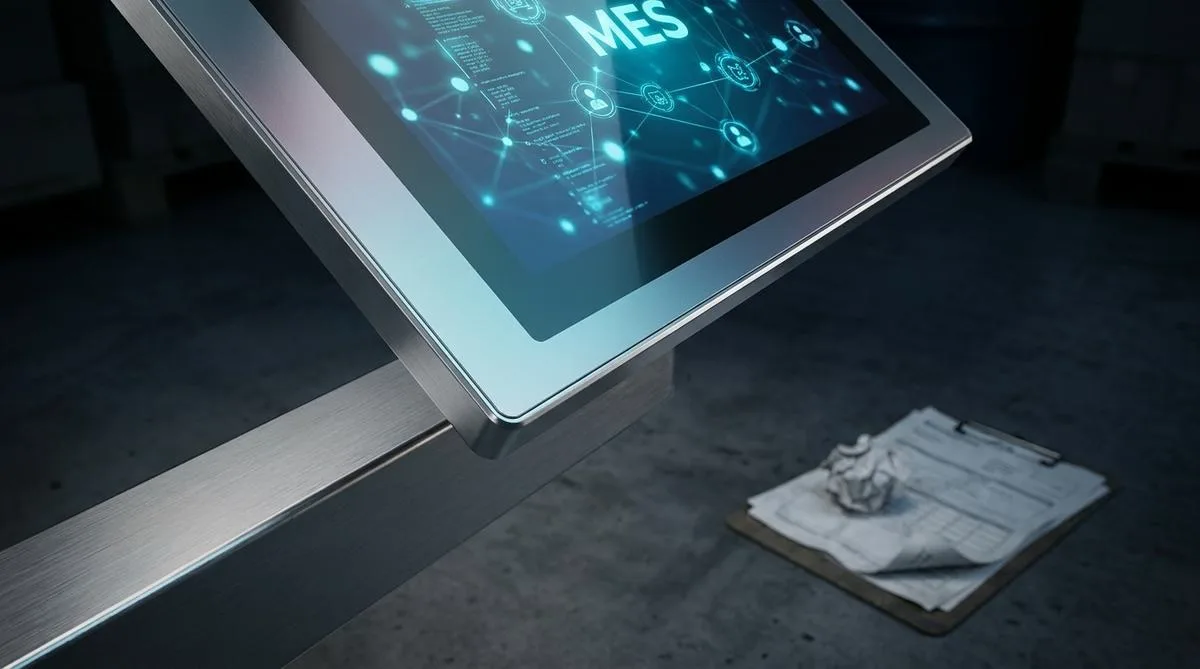
Implementing an integrated MES (Manufacturing Execution System) along with modern MES terminals directly at workstations is the cornerstone of regaining full control over the plant. These are precisely the tools that close the information gap, providing management with reliable real-time data and enabling proactive—rather than merely reactive—order management.
Why Paper-Based Production Reporting Is Destroying Your Plant's Efficiency
The traditional flow of paperwork on the shop floor is a silent killer of profitability. When production management relies on paper job cards, the plant is setting itself up for delays and imprecision from the outset. In today's dynamic market environment, waiting until the end of a shift to learn the status of an operation is a luxury no modern business can afford.
Human Error as a Hidden Operational Cost
Manually transcribing data from the shop floor into upstream systems is a process highly susceptible to mistakes. A tired operator filling out a report in a rush at the end of their shift frequently makes errors that later escalate through other departments. The consequences of this approach are easy to predict and extremely costly for the entire organization.
The most serious problems arising from paper-based document flow include:
- Illegible operator handwriting: This causes frustration among administrative staff and forces them to guess critical values, distorting the true picture of performance.
- Errors in material indices: Transposing just a single digit in a batch number can disrupt entire order management workflows, blocking reliable product traceability.
- Inaccurate operation times: Manually rounding machine and labor hours makes it impossible to accurately calculate OEE or produce precise cost estimates.
Decision Paralysis and Delayed Response from Support Teams
A lack of reliable real-time information dramatically increases response times to critical situations. When a machine breaks down and an operator must physically walk to the maintenance office or search for a foreman, precious minutes are lost. By the time a technician reaches the workstation, downtime has grown to a scale that directly threatens the on-time delivery of contracts.
The same is true of unexpected material shortages. The internal logistics team only learns of the need to supply raw material at the moment the machine has already come to a halt. An integrated MES system completely reverses this inefficient process, enabling the immediate request for assistance or materials directly from a digital panel.
Case Study: A Harsh Reality Check in the Metal Industry
The scale of this problem is perfectly illustrated by the case of a leading metal industry manufacturer. Before digitalization, production orders were settled exclusively on the basis of paper travelers. This process required the daily involvement of two additional administrative staff who spent hours entering data into the system.
"Paper-based production reporting extended the settlement time for each shift by nearly four hours, and warehouse discrepancies resulting from transcription errors reached double-digit percentages."
It was only the installation of industrial devices—such as an interactive MES terminal at every workstation—that made it possible to permanently eliminate this bottleneck. Data began flowing into the system without delay, freeing up managers' time and allowing them to focus on genuine process optimization rather than an endless battle against informational chaos on the shop floor.
The MES Terminal as the Digital Heart of the Shop Floor: From Data to Decisions
Transitioning from paper to digital documentation requires the right tools—ones capable of meeting the harsh realities of an industrial environment. An MES terminal is far more than just a touchscreen mounted next to a machine. It is a critical communication hub that connects the physical manufacturing process with the digital world of enterprise management. It serves as the absolute foundation upon which modern production management is built, delivering reliable real-time data to management personnel.
Industrial Standards and Ergonomics
For IT hardware to perform reliably in the demanding conditions of a shop floor, it must meet specific parameters. A modern MES terminal is characterized by high resistance to dust, moisture, vibration, and extreme temperature fluctuations. An intuitive user interface, designed with maximum ergonomics in mind, is just as important as physical durability. Having the device available directly at the production cell means the worker never needs to leave their station to submit or retrieve critical information, which drastically reduces operational time waste.
A New Paradigm for Operator Work
Implementing this solution completely transforms the existing paradigm of an operator's work. Instead of laboriously filling out job cards by hand at the end of a shift, the worker makes just a few intuitive taps on the screen. That is all it takes for the central system to instantly update the status of individual production orders. This continuous, digital production reporting completely eliminates delays and human error, guaranteeing the highest level of data accuracy.
For a shift manager, this finally means the end of guesswork and gut-feel decisions. They can see exactly which machines are currently running, what the reasons for any stoppages are, and whether the planned production schedule is being executed as intended. Effective order management becomes straightforward, because decisions are grounded in hard, reliable facts flowing directly from the production line.
A Digital Assistant Supporting Quality
It is worth emphasizing clearly that the interactive panel enables fully two-way communication. An integrated MES system transforms the device into a personal digital assistant for every operator. From a single screen, the worker gains instant access to always up-to-date workstation instructions, quality checklists, and complex technical drawings in high resolution.
This accessibility of knowledge eliminates the risk of producing a batch of parts based on an outdated revision of engineering documentation—something that generates enormous material losses for many machine and component manufacturers. Whenever a technological question arises at the workstation, a reliable answer is literally at the operator's fingertips.
"Replacing traditional binders of documentation with interactive terminals at machines is a milestone for quality control. Above all, it gives management the assurance that every operator is working with the correct, approved version of the process documentation, which immediately reduces the number of costly internal defects."
Real-Time Production Order Management
Real-Time Production Order Management
For operations directors and shift managers, the so-called "information dead zone" has long been one of their greatest challenges. Traditional production management often resembled navigating in fog—managers would only learn of delays or breakdowns at the end of the day, when paper job cards finally arrived on their desks. An integrated MES system connected to a network of workstation devices permanently eliminates this problem, introducing radical transparency into manufacturing processes.
No More Guesswork—Time for Hard Data
Through direct communication with the shop floor, production orders are monitored with second-level precision. An operations director no longer needs to leave their office to check whether a critical order for a strategic customer will be delivered on time. On a virtual dashboard, they can see the exact status of every technological operation, the progress against the production norm, and the current workload at each cell. This centralized order management enables the rapid reallocation of human and machine resources when sudden business priorities arise.
Instant Identification of Bottlenecks
A key aspect of what makes an MES terminal transformative is its uncompromising and immediate production reporting. The moment an anomaly occurs—whether it is a major breakdown (macro-stoppage) or a few minutes of waiting for a forklift (micro-stoppage)—the operator immediately categorizes the problem on the screen. This information reaches the relevant teams—such as the maintenance department or internal logistics—in a fraction of a second. Furthermore, workers continuously report defective units along with the precise root cause, preventing further processing of damaged components.
"Eliminating the delay in information flow is the greatest value added by digitalization. When a shift manager sees a drop in efficiency in real time, they can react immediately—saving the OEE metric and preventing cascading delays across subsequent shifts."
Automated Settlement and Auditing
It is also worth noting the complete elimination of manual work auditing. Modern systems independently count produced parts by pulling signals directly from machine controllers (PLCs). The system automatically records the actual machine operating time and compares it against technological standards. As a result, the planned production schedule is continuously validated against indisputable, objective data, and managers gain confidence that performance indicators reflect the actual state of the shop floor—not the creative accounting of paper reports.
Dynamic Production Scheduling vs. Shop Floor Variability
In many plants, managers still spend long hours building complex plans in spreadsheets. Such a static production schedule looks perfect on a computer screen in the quiet of an office. Reality, however, is merciless in its verdict. A single unplanned machine breakdown, a delayed raw material delivery, or the sudden absence of a key operator is all it takes to render a painstakingly prepared plan completely useless. Variability on the shop floor is inevitable, and a lack of flexibility in planning leads to chaos, delays, and frustration across the entire team. Manually recalculating the dependencies between operations after every incident consumes valuable time and creates enormous risk of error.
Real-Time Feedback Loop
The answer to these challenges lies in integrating high-level planning with real-time data flowing directly from production cells. When an MES terminal registers an unforeseen stoppage, the system immediately relays this information to the planning engine. Thanks to this feedback loop, production management reaches an entirely new level. The system is capable of automatically updating the entire production schedule in real time, accounting for new variables. It shifts subsequent production orders, analyzes the availability of alternative machines, and immediately notifies planners of the need to make a decision. This dynamic approach makes order management proactive rather than reactive.
Intelligent Process Optimization
An advanced MES system does not merely react to problems—it actively optimizes processes. Continuous production reporting enables:
- Automatic grouping of orders with similar technological parameters.
- Minimization of the time required for changeovers and machine cleaning.
- Precise prediction of delivery dates for key B2B customers.
As a result, operations directors gain confidence that machines are running in the most optimal sequence, and every change to the plan is grounded in hard, objective data from the shop floor.
The Practical Dimension of Flexibility
An excellent example of this approach in action is the implementation at a leading manufacturer of plastic components for the automotive industry. Previously, the company was losing hundreds of hours per month to complex injection mold changeovers caused by suboptimal sequencing. After implementing dynamic scheduling combined with workstation terminals, the situation improved dramatically. Full data visibility allowed the system to intelligently group orders requiring the same raw material and processing temperature.
The result was a nearly 30% reduction in changeover times and a significant increase in overall machine availability.
"The ability to instantly adapt a plan to actual shop floor conditions is not a luxury—it is a necessity in today's highly competitive manufacturing environment. Those who rely on yesterday's data lose the battle for margin."
People at the Heart of Digitalization: How to Get Operators on Board with MES?
People at the Heart of Digitalization: How to Get Operators on Board with MES?
Even the most advanced algorithms optimizing a production schedule will not deliver the expected results if we overlook the most important link in any plant—the human being. Implementing new technology on the shop floor frequently encounters resistance from frontline employees. Understanding their perspective and managing change effectively is the absolute foundation of a successful digitalization initiative.
Breaking Down Fears of Surveillance
Operators' most common concerns stem from a fear of being monitored and a sense that the new MES system will be complicated to use. Workers often view touchscreens as a micromanagement tool designed solely to catch them making mistakes. It is the role of a skilled manager to reframe this narrative. It must be clearly communicated that modern production management is intended to make their daily work easier—not to track their every move.
Ergonomics and an Intuitive Interface
The key to overcoming technological resistance is thoughtful interface design. An industrial MES terminal must be tailored to the demanding conditions of the shop floor and to the ergonomic needs of the operator. This means using large, intuitive buttons that can be operated even while wearing protective gloves. Messages displayed on screen must be as clear as possible, and the data entry process should require a minimum number of taps.
An End to Bureaucracy and Fast Support
When the interface is user-friendly, workers quickly recognize the real benefits. First and foremost, digitalization means a definitive end to tedious, paper-based bureaucracy. The manual, time-consuming production reporting that follows every shift becomes a thing of the past. Instead of filling out stacks of documents, the operator confirms the completion of an operation with a single touch of the screen, saving significant time and energy.
In addition, the system provides workers with clear guidance. All production orders, along with up-to-date process documentation and instructions, are available directly at the workstation. Moreover, in the event of a breakdown or quality issue, the operator no longer needs to leave the machine and search the entire shop floor for a foreman.
With just one button on the terminal, they can immediately summon a technician from the maintenance department or a quality controller. At one large metal industry manufacturer, introducing this feature reduced the response time of support teams by more than 40%. Operators quickly realized that managing orders through the system gave them a sense of security and genuine support in crisis situations.
"A successful MES implementation does not end with server installation. True success is achieved the moment an operator regards the workstation terminal as their best assistant—not as an electronic supervisor."
With this approach, digitalization ceases to be perceived as a top-down obligation and becomes a natural, welcome element of everyday work on a modern shop floor.
The Integrated Production Module: Synergy Between the Office and the Machine Floor
While an ergonomic, operator-friendly MES terminal forms the foundation of successful shop-floor digitalization, its true power only becomes apparent in a broader architectural context. Modern production management requires seamless, two-way communication between the machine floor and the office. An integrated production module serves here as the central nervous system, connecting dispersed data into a single, coherent information environment.
Breaking Down Data Silos – Integration with ERP and WMS
In many plants, the production, warehouse, and planning departments still operate in information silos isolated from one another. Implementing an integrated system eliminates this problem at its root. Information flowing in from workstation terminals is instantly synchronized with the upstream ERP system and the warehouse management system (WMS).
For example, at a leading manufacturer of plastic components, automatic integration meant that warehouse staff receive notifications about raw material requirements several minutes before an actual changeover begins. Meanwhile, the sales department can monitor order fulfillment progress in real time, which dramatically improves customer service quality and enables proactive communication.
Full Traceability in the Digital Workflow
Another key aspect of architectural synergy is full traceability. A digital information workflow ensures that every instance of production reporting is strictly linked to a specific raw material batch, machine, and operator. From the moment material is received in the warehouse through to the release of a finished product, the system records every step of the manufacturing process.
As a result, production orders become fully transparent. If a quality defect is detected, the production director is able to trace the entire history of a part within a matter of seconds. This eliminates the need to spend hours searching through paper archives and allows for the immediate quarantine of a potentially defective batch before it leaves the facility.
A Single Source of Truth
The most significant change brought about by an integrated MES system is, however, a profound transformation of organizational culture. Building an environment based on a single, shared source of truth definitively ends the age-old disputes between departments. When the production schedule and ongoing order management are grounded in the same objective data from the machines, there is no longer any basis for mutual accusations of delays and errors.
"An integrated IT architecture ensures that every employee — from machine operator to production planner to Chief Operating Officer — is looking at the same picture of reality, updated in real time."
This level of transparency builds trust within the organization. It allows managers to focus on genuine process optimization and strategic planning, rather than spending valuable hours laboriously cross-checking conflicting reports from disparate, disconnected sources.
Summary: Regain Control of Your Shop Floor and Take the First Step Toward Digitalization
Today's market realities leave no room for error, and basing critical business decisions on outdated data is a fast track to losing your competitive edge. As we have demonstrated throughout the sections above, production management relying solely on paper job cards and scattered spreadsheets generates enormous informational chaos. Chief Operating Officers and plant managers can no longer afford a situation in which they learn about machine breakdowns, material shortages, or delays with a lag of several hours — or even several days. The digital transformation of the shop floor has ceased to be a buzzword from industry conferences and has become an absolute foundation for survival, cost optimization, and safe business scaling in the demanding B2B sector.
The MES Terminal and Integrated Management as the Cornerstone of the Modern Factory
The only proven and effective way to eliminate frustrating reporting delays is to implement tools that automate the flow of information at the very source. A modern MES terminal located directly at the operator's workstation is not merely a rugged touchscreen — above all, it is a gateway to full operational transparency. It is precisely this terminal that enables production reporting to happen in real time, relieving skilled workers of the tedious obligation of manually completing paper documentation.
When precise machine data flows into the system without any delay, planners can continuously and accurately update the production schedule. This eliminates highly undesirable situations in which the next shift begins work by attempting to decipher the illegible notes left by its predecessors. An integrated MES system connects the dots between a dispersed machine park, the raw materials warehouse, and the customer service department, creating a single, coherent environment in which every employee operates from the same objective truth about the status of plan execution.
From Reactive Fire-Fighting to Full Operational Predictability
The transition from analog chaos to digital order management is a change that is nothing short of revolutionary for the organizational culture of any plant. Instead of wasting invaluable time searching for missing documents or reconciling discrepancies between different systems, management can finally focus on genuine process optimization and manufacturing cost reduction. Production orders are monitored at every individual stage of their lifecycle, enabling an immediate response to any deviation from the established standard.
"Implementing a digital information flow is not only a necessary investment in modern software — above all, it is a strategic investment in the peace of mind of the management team and the long-term security of the entire supply chain."
A compelling real-world example comes from a leading manufacturer in the metal machining industry, which, prior to digitalization, was losing an average of two hours per shift simply collecting and transcribing data from paper job cards into Excel. After integrating the digital production module with the overarching system, the company not only recovered hundreds of man-hours per month, but — more importantly — gained the unique ability to provide highly accurate quotes for new contracts, based on actual historical machine cycle times.
Your First Step Toward a Paperless Factory — Download the Free Expert Resource
Understanding the urgent need for change is only the beginning of the journey toward operational excellence. We know from years of experience that for many production directors, the prospect of completely abandoning deeply ingrained team habits can seem daunting and overwhelming. That is why, to make this process as straightforward as possible and help you structure your implementation strategy, we have prepared a dedicated, highly practical expert resource that will guide you through this critical transformation stage, step by step.
We warmly encourage you to download our free e-book and checklist entitled: "5 Steps to Completely Eliminating Paper Reports from the Shop Floor". Inside, you will find a battle-tested action framework that will allow you to quickly identify the biggest information bottlenecks in your plant, properly prepare your team for the upcoming technological changes, and plan a safe migration of data to the digital environment. This is an absolute must-read for any manager who wants to effectively modernize their operational area without risking disruption to business continuity.
See the System in Action — Schedule a Free, Personalized Demo
Theory, articles, and guides are an excellent introduction to building awareness, but absolutely nothing replaces seeing for yourself how modern technology can solve your most pressing business challenges in a fraction of a second. Now that you know that an integrated production module is a proven key to regaining control of your shop floor, the time has come to put those promises to the test in practice. You do not need to buy a pig in a poke or guess whether a given interface will work within the unique specifics of your industrial plant.
Take the decisive step toward full digitalization and eliminate informational chaos once and for all. Fill in the short contact form below and schedule a free, fully personalized demo of our production module and MES system. Our technical experts will be delighted to show you live how the terminal's error-free reporting process works, how the schedule updates dynamically and automatically, and how the system instantly captures costly micro-stoppages. Let us prove that complete control over production and stress-free team management are within your reach. Reserve your slot today and join the ranks of true Industry 4.0 leaders!


