
Introduction: The Hidden Cost of Paper Traveler Cards on the Production Floor
Many managers still believe that a sheet of paper is the cheapest and simplest medium for information. In reality, in a dynamic manufacturing environment, this supposedly free piece of cellulose generates enormous hidden costs. Paper-based document flow is an illusion of control that stifles plant efficiency every single day and swallows thousands in delays and poor decisions.
Production planners and shop floor managers pay the highest price for this outdated system. Their daily work often resembles fighting fires blindfolded. Frustration grows with every passing minute as they must build their schedules on stale data from the previous shift. When a machine breaks down or priorities suddenly change, the paper-based plan becomes completely useless, and updating it manually consumes precious hours.
The core problem is the severe delay in information flow between the office and production cells. By the time a printed traveler card, technical drawing, or specification physically reaches the shop floor, the situation has often already changed. Workers execute orders based on outdated instructions, generating defects and wasting raw materials. Meanwhile, feedback reporting relies on manual data entry that reaches the ERP system with delays of many hours — or even several days.
This information chaos strikes directly at business relationships. Without real-time visibility into the actual status of a production order, it becomes impossible to keep B2B customers informed in a timely and reliable manner. When a key client calls to ask about a delivery date, the answer requires a physical walk across the shop floor and a hunt for missing documents at workstations.
"In modern manufacturing, the absence of real-time data is the shortest path to losing your competitive edge and the trust of your most important customers."
It is time to recognize that eliminating paper is no longer a technological novelty — it is an absolute business necessity. Moving to digital production management is the only way to regain full control over manufacturing processes.
The Walking Planner Syndrome: Why Updating a Schedule Takes So Long
In many mid-sized manufacturing companies — those specializing in CNC machining or assembly, for example — the planning process still relies on the physical circulation of documents. This phenomenon gives rise to what is known as the walking planner syndrome. Instead of optimizing processes at a desk, the specialist spends the lion's share of their shift walking the shop floor in search of paper traveler cards and asking operators for progress updates. It is an absurd situation in which a highly skilled employee essentially acts as a physical data courier.
The problem intensifies dramatically when unforeseen events occur, such as a critical machine failure or a sudden shortage of raw materials in the warehouse. In the traditional, paper-based production management model, responding to such incidents involves delays with devastating consequences. It often takes dozens of minutes for news of a stoppage to reach the office, and then additional hours are consumed collecting all the scattered cards. Only then is it possible to cancel old work orders and manually recalculate the entire shop floor schedule from scratch.
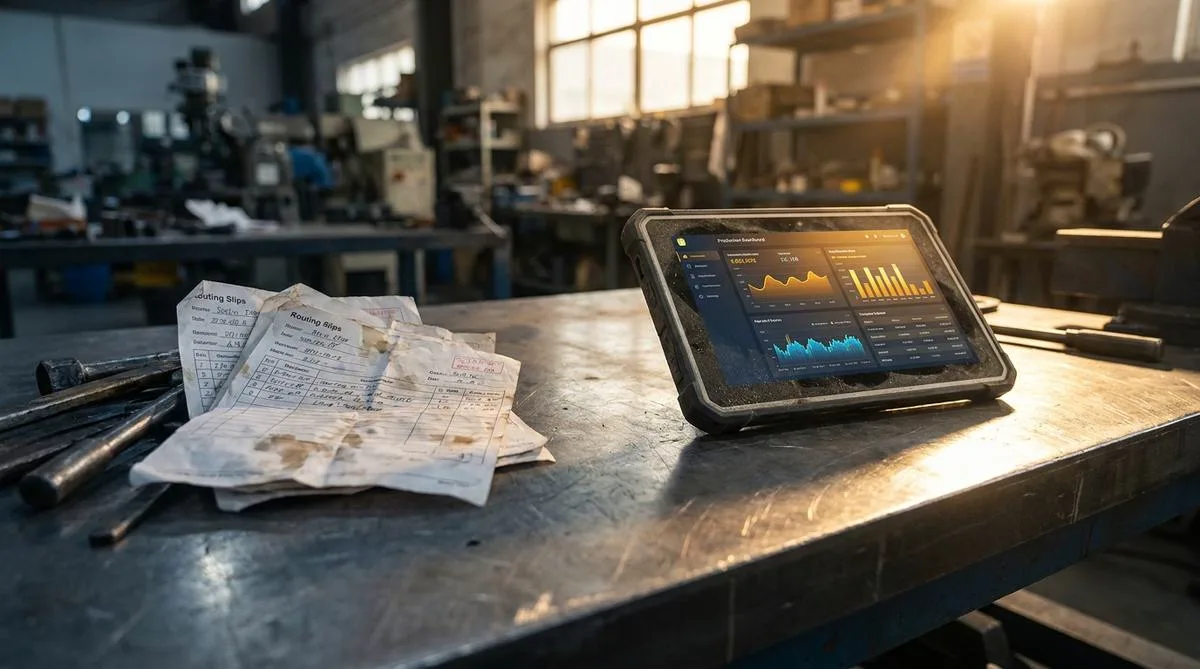
The next — and enormously costly — stage of this archaic process is transferring the collected information into the company's internal systems. Manually transcribing data from grease-stained, crumpled traveler cards into spreadsheets is a veritable breeding ground for problems. Planners must decipher illegible, handwritten notes from machine operators every single day. Under such conditions, human errors in reading produced quantities or reporting defects are virtually inevitable, and a single typo can corrupt inventory records for days.
Incorrect input data means the entire newly built plan rests on false assumptions. At one CNC machining company, it was found that transcribing data from traveler cards alone took the planner nearly two hours every day. That is valuable time that could have been devoted to strategically implementing improvements and reducing manufacturing costs. Instead, the team's energy was consumed by constantly correcting mistakes and putting out fires.
"Planning production on paper is not management — it is a continuous, delayed reaction to the past. You cannot effectively run a plant when you are looking exclusively in the rear-view mirror."
The walking planner syndrome makes it abundantly clear that a lack of digitalization is the bottleneck of every growing business. As long as paper circulates across the shop floor, production scheduling will remain a slow process — burdened with enormous risk of error and completely unable to cope with the dynamics of market change.
The Turning Point: A Case Study of a Mid-Sized CNC Machining and Assembly Plant
The Scale of the Problem: Thousands of Sheets and Information Chaos
To fully understand the destructive impact of paper-based documentation on profitability, it is worth taking a close look at the situation of a rapidly growing manufacturing plant. The company specialized in precision CNC machining and advanced component assembly. On the surface, business was thriving and the order book was bursting at the seams. Yet beneath that growth, a massive operational problem was building — one that threatened the stability of the entire enterprise.
At peak times, several hundred active orders were being executed simultaneously on the shop floor. In practice, this meant thousands of sheets of paper circulating every day between the technology office, the warehouse, and production cells. Traveler cards, printed technical drawings, handwritten defect reports, and paper bills of materials created an unmanageable physical mountain of documents. Losing or damaging even a single process card resulted in an immediate, multi-hour work stoppage at the affected machine.
Rising Overtime Costs and Poor Resource Allocation
This information chaos had very tangible negative financial consequences for the entire plant. The lack of real-time production visibility meant management was unable to effectively manage the machine fleet. Poor allocation of both human and machine resources became an unfortunate daily reality. Highly skilled CNC operators frequently waited for work assignments or raw material deliveries, while urgent orders from key customers piled up at other workstations.
To rescue threatened deadlines and make up for delays caused by the archaic, paper-based management system, the company was forced to regularly schedule additional shifts and weekend work. Rising overtime costs began to aggressively erode the margins earned on the most lucrative contracts. Instead of investing in modern technologies, the plant was burning through its budget in a continuous cycle of firefighting organizational crises.
The Critical Moment and Growing Pressure from Clients
The true turning point in the company's story, however, proved to be the mounting pressure from key international clients. B2B customers demanded not only absolute on-time delivery, but also full transparency in the manufacturing process and significantly faster, more predictable lead times. They expected precise material lot tracking and near-real-time order progress reporting. With paper-based information flow, this was physically impossible to achieve.
"Management was confronted with a brutal truth: our existing paper-based management system was no longer merely inconvenient. It had become the primary brake on our growth — one that was genuinely threatening the loss of our most important clients and multi-million-dollar contracts."
This was an absolutely critical moment for the company's future. It became clear that without the immediate digitalization of production processes and the implementation of a modern MES system, the company would be unable to meet market standards. The paper-based document flow was completely blocking business scaling, and every new contract signed only deepened the internal chaos on the shop floor. For management, there was only one possible decision — a complete and uncompromising elimination of paper from planning and production processes.
A Digital Revolution on the Production Cell: Implementing an MES System
The answer to the growing operational crisis was a comprehensive MES implementation — and the Process App module in particular. Almost overnight, bulky physical document folders began disappearing from the shop floor. In their place, modern interactive reporting panels appeared at every workstation. This was a true breakthrough that brought production management into an entirely new, digital dimension, giving management the real-time control they had long sought.
The End of Dirty, Lost Documentation
For years, paper traveler cards were the daily reality for CNC machine operators. Documents covered in grease, damaged, and all too often completely lost were a plague on the entire plant. The digital environment implemented through the MES instantly eliminated this problem. Instead of hunting for missing pages or asking technologists for details, workers now have a clear screen in front of them. A few clicks are all it takes to get instant, digital access to always up-to-date technical drawings, the digital BOM, and detailed assembly instructions.
This completely eliminated the risk of producing parts based on outdated document revisions. Any changes made by the engineering department are immediately visible on the production cell, which drastically reduced the rate of defects and costly quality errors.
Breaking Down the Technology Barrier Among Operators
Many managers worried about how the workforce would react to such a drastic change. Those concerns proved entirely unfounded. The key to success was deploying an exceptionally intuitive interface for machine operators that effectively eliminated the technology barrier. The application was designed with maximum simplicity in mind — large buttons, clear messages, and logical navigation meant that even employees with many years on the job mastered the system in just a few hours.
"The biggest surprise wasn't the technology itself, but how quickly our operators could no longer imagine working without it. The digital panel became their best assistant — not just another burdensome obligation."
The first effects of this transformation were noticeable almost immediately. The time needed to start a work order was dramatically reduced, and production reporting became a smooth, natural part of the workflow. Instead of filling out paper reports at the end of a shift, operators report progress in real time, feeding the system with invaluable data. It is precisely this seamless exchange of information that laid a solid foundation for rapid production scheduling at subsequent stages.
The Digital BOM and Integrated Schedule as the Foundation of Flexibility
Deploying interactive reporting panels on the shop floor is just the tip of the iceberg in the digital transformation process. The true technological revolution — the one that reduced plan update times from several minutes down to just a few seconds — happened at the data management level. The foundation of this flexibility was the migration of product structures and process routes directly into the digital environment, creating an inseparable link between the planning process and the physical execution of orders.
One Central Source of Truth for the Entire Plant
In the traditional, paper-based production management model, the technology, planning, and production departments often operate in isolated information silos. Moving to an MES created a single, central source of truth that technologists, planners, and operators all access in real time. When an engineer modifies a process or changes a part tolerance, that information is instantly updated throughout the entire system.
There is no longer any need to print new traveler cards, physically swap out documentation at workstations, or risk an outdated revision reaching the shop floor. This transparency dramatically reduces communication errors and machine stoppages caused by a lack of precise instructions.
Automatic Generation of Digital Bills of Materials (BOMs)
Another key aspect of the transformation was digitizing the product structure. The digital BOM (Bill of Materials) is no longer just a static table in a spreadsheet. The system now automatically generates digital bills of materials and precisely calculates material requirements for each production batch.
When a new order enters the system, the algorithms immediately verify material availability in the warehouse and reserve the appropriate quantities for a specific order. Planners no longer need to manually calculate requirements or waste time on tedious inventory checks. The entire process, which previously took long hours, now runs in the background — ensuring continuity of work and optimized stock levels.
Direct Linking of Operations to Production Cells
For real-time production scheduling to be possible, it was essential to integrate the process routes with the plant's physical resources. The digital environment enables the direct linking of specific technological operations to the appropriate machines, tools, and employee competencies.
"Only when the system knows precisely which operation must be performed at which cell and how long a changeover will take can we truly speak of agile planning. It is this deep integration that enables lightning-fast responses to breakdowns and the insertion of urgent orders into an already tight schedule."
Thanks to this integrated approach, the MES independently suggests optimal routing paths for parts through the shop floor. In the event of a sudden CNC milling machine failure, the planner can transfer operations to an alternative machine with a single click. The integrated schedule automatically recalculates new lead times, refreshes material requirements, and immediately sends updated instructions directly to the operators' panels.
From Several Minutes to 3 Seconds: The New Standard for Plan Updates
The transition from paper-based document circulation to a fully integrated digital environment delivers its most spectacular results in the area of scheduling. In the traditional model, every unforeseen situation on the shop floor required the planner to laboriously recalculate the entire schedule by hand. Today, thanks to the MES implementation, that same process has been reduced from several minutes to just three seconds — completely transforming the daily work of the entire team.
Automatic Response to Stoppages and Deviations
In a dynamic manufacturing environment, deviations from time standards are a daily occurrence. A broken tool, a delayed raw material delivery, or a sudden CNC machine breakdown can ruin even the best-prepared plan. A modern MES eliminates this problem by acting like an intelligent organism that automatically responds to reports coming in from production cells.
When an operator reports an unexpected stoppage on the panel, the algorithms immediately analyze its impact on subsequent orders. The system independently identifies bottlenecks and shifts related operations along the timeline, while maintaining full technological consistency. There is no longer any risk of a delay on one machine causing chaos at later production stages, with the manager only finding out after the fact.
Instant Scenario Simulation — No Calculator Required
Another revolutionary change is the ability to instantly test different production scenarios. In the past, when a key customer called asking for a rush order to be expedited, the planner had to arm themselves with a calculator, a spreadsheet, and considerable patience.
"Before we implemented the MES, inserting a priority order mid-week meant stopping all other planning work for a good hour. We had to manually check whether we would still meet the other deadlines and whether we had enough material."
Today, a single click is all it takes to run an advanced what-if simulation. The system verifies machine availability, raw material stock, and employee competencies in a fraction of a second, then generates an updated schedule. The result is immediately visible on screen, enabling fast, well-informed business decisions based on hard data.
Freeing Up Resources and Shifting to Optimization
Dramatically reducing plan update times has enormous consequences for the efficiency of the entire plant. Above all, the planner stops being a "firefighter" putting out daily blazes and becomes a true analyst and strategist. The hours saved can be devoted to optimization activities such as improving machine fleet utilization, reducing changeover times, or conducting more thorough OEE analysis.
What is more, automation eliminates the risk of human error that is inevitable when working under stress and time pressure. As a result, the manufacturing company gains not only unprecedented flexibility, but also the certainty that every generated plan is one hundred percent feasible and optimized for the shop floor's current capabilities.
Quality Control and Real-Time Defect Reporting
Eliminating paper-based document flow is not only a massive time saver in scheduling — it is also an absolute revolution in quality management. In the traditional, paper-based production model, information about a defective part often reaches the relevant department with a delay of many hours. Such a lag is a direct path to generating serial defects that dramatically drive up the company's operating costs.
Moving this process to a digital environment completely changes the rules of the game. Implementing digital quality control forms directly on workstation panels makes it possible to enforce technological discipline without compromise. A CNC machine operator or assembly worker cannot begin the next operation until they have entered the required measurements into the MES. The software verifies in a fraction of a second whether the submitted values fall within the specified tolerances, preventing human errors and oversights.
"Eliminating paper inspection cards meant we no longer had to guess whether parts had been measured according to the instructions. The system simply does not allow mistakes — it guides the worker step by step through the entire dimensional verification process."
The key aspect of digitalization, however, is the speed of response to emerging deviations. The moment the system detects an anomaly — or an operator independently reports a defect — a rapid escalation procedure is triggered. Automatic notifications reach the mobile devices of the maintenance department and quality controllers within just one second of the report being submitted. This allows specialists to appear at the production cell immediately, diagnose the problem, and implement corrective actions.
This working model guarantees the complete elimination of delays in scrap reporting. The lightning-fast response prevents situations in which a poorly configured machine produces defective parts for half a shift before anyone notices. As a result, the manufacturing company avoids the costly need to repeat entire material batches — saving not only raw materials but also valuable machine time.
What is more, all digital defect reports are continuously archived and categorized in a central database. The production manager thus gains a powerful analytical tool. Instead of sifting through stacks of paper traveler cards, they can analyze the most frequent causes of defects on a single screen and make strategic optimization decisions that genuinely improve the plant's profitability.
Summary: Calculate What Paper Is Costing You and Schedule a Free Demo
Digitalizing production processes is no longer so much an innovation as an absolute necessity for companies that want to remain competitive in a demanding market. As the case study presented here demonstrates, replacing traditional paper traveler cards with a modern MES delivers immediate, measurable results. The shift from manual, time-consuming planning to automated scheduling reduces plan update times from several minutes to just a few seconds — a monumental saving that frees up valuable resources in the planning department.
Time savings, however, are only one side of the coin. Equally significant are the financial benefits resulting from a dramatic reduction in defects and machine downtime. A digital BOM and electronic work instructions ensure that operators always work with absolutely up-to-date process data. This eliminates the risk of costly mistakes caused by illegible handwriting or the loss of critical documentation somewhere on the shop floor.
Moreover, real-time reporting enables maintenance and quality control teams to respond instantly. Instead of waiting until the end of a shift to learn about a problem, management has full, transparent visibility into exactly what is happening at every production station at any given second.
Hidden costs you may not be aware of
Many production managers and business owners are unaware of the enormous financial burden that maintaining a paper-based information flow places on their operations. The cost is not limited to purchasing reams of paper, folders, or toner for industrial printers. The real, hidden losses lie in the working hours of highly qualified specialists.
Instead of strategically optimizing production flow and increasing efficiency, a planner wastes valuable hours every day manually transcribing data from dirty, crumpled routing cards into company spreadsheets. Add to this the time shift supervisors spend physically distributing work orders to individual CNC machines or assembly stations.
"The transition to digital production management is a pivotal moment — the point at which a company stops guessing and starts basing its strategic decisions on hard, reliable data flowing directly from machines in real time."
On a day-to-day basis, these may seem like insignificant minutes, but over the course of a month or a year, we are talking about hundreds or even thousands of wasted hours. Every such hour represents a specific, measurable cost to the business — one that directly reduces the profitability of contracts and blocks the potential for scaling operations.
Get the calculator and quantify your losses
To fully understand the scale of this issue within your facility, we have prepared a dedicated analytical tool: a free Time Savings Calculator — How Much Is Paper-Based Documentation Costing You on the Shop Floor? It is a simple yet incredibly powerful tool that allows you to verify, in just a few minutes, how much money your company is irreversibly losing every month due to a lack of digitalization.
All you need to do is enter some basic data about your organization. The calculator will ask you to specify the number of production employees, the average time operators spend manually completing reports, and an estimate of how many hours planners lose verifying and re-entering data. The tool also factors in average hourly rates in the industry.
Based on these inputs, the system will generate a personalized, clear report. You will see in black and white just how much optimization potential lies dormant in digitalizing your processes and implementing a modern MES system. For many management teams, the result of this calculation proves to be a genuine turning point.
Take the first step toward modern manufacturing
Understanding the costs is just the beginning of the journey toward improving your facility. If you want to see what eliminating paper and achieving instant scheduling looks like in practice, we invite you to get in touch directly with our experts. We offer the opportunity to schedule a free, completely no-obligation MES system demonstration (demo), tailored specifically to the characteristics of your industry and your machine park.
During a live online meeting, we will show you how the ProcessApp environment handles the challenges you face every day. We will walk you through, step by step, how to migrate your BOM to a digital environment, how intuitive the operator panel looks on the shop floor, and how the system actually reduces the update of an entire production plan to the few seconds mentioned earlier.
Implementing MES-class software is a strategic investment that pays for itself much faster than you might expect. The average return on investment (ROI) when going fully paperless is often just a matter of months. Join the ranks of manufacturing industry leaders who have long since left behind the headaches of outdated documentation.
Do not let outdated management methods hold back the growth of your business. Download our free savings calculator, analyze your costs, and then schedule a free system demonstration. You can also click the link to watch our latest video on YouTube, in which we provide a detailed demonstration of the digital production planning process. It is time for manufacturing without paper, without delays, and without compromise.


