
The End of the Mass Era: Why Hyper-Personalization Is Forcing a New ERP Architecture
For decades, the foundation of industrial profitability was mass production. Scale enabled cost optimization, and standardization simplified supply chain management. Today, however, we are witnessing a fundamental paradigm shift. B2B market expectations have evolved from acceptance of standardized solutions toward full product customization.
Business customers now demand specifications perfectly tailored to their unique operational processes. The response to this market trend is the concept of Lot Size One — unit production executed at mass scale. In practice, this means a factory's ability to manufacture a single, highly personalized product while maintaining costs and lead times comparable to traditional serial production.
Achieving such agility is absolutely critical for maintaining high margins and profitability in a modern manufacturing facility. However, it requires flawless and instantaneous information flow between the engineering department, sales, and the shop floor. This is where the greatest technological challenge emerges: traditional, legacy ERP systems become a critical bottleneck for the entire operation.
The monolithic architecture of older IT solutions was designed with static production plans and infrequently changing bills of materials (BOMs) in mind.
When the need arises to dynamically manage hundreds or even thousands of unique material indexes every day, legacy systems simply cannot keep up. Consider a leading manufacturer of industrial machinery that must adapt every component to the specific requirements of a particular contract. In outdated software, every modification forces the manual creation of new indexes, drastically extending production preparation time and generating the risk of costly errors.
The best ERP system for manufacturing in 2026 must be built on a flexible, modular architecture. Only deep digital transformation of manufacturing will enable the automatic reconfiguration of processes for every non-standard order. Transitioning to modern platforms is the only way to compete effectively in the reality of hyper-personalization and the approaching Industry 5.0.
The CRM Sales Funnel as the Digital Ignition for the Autonomous Factory
In the era of Industry 5.0, the boundary between the sales department and the shop floor is disappearing entirely. Traditionally, the process of handing off an order from a sales representative to an engineer resembled a game of telephone, full of misunderstandings and costly delays. Today, the modern CRM sales funnel is becoming the true digital ignition for the entire factory. Instead of isolated information silos, we are seeing a smooth, uninterrupted stream of data that initiates the manufacturing process in a fraction of a second after a B2B customer accepts a quote.
The key to this deep integration is advanced CPQ (Configure, Price, Quote) configurators embedded directly within the sales system. At the moment a sales representative and a customer are selecting product options together, advanced engineering calculations are taking place in the background. The best ERP system for manufacturing in 2026 can receive this aggregated data in real time and automatically generate ready-to-execute production orders and precise bills of materials (BOMs). This architecture means the complete elimination of manual data re-entry between the sales and engineering departments, drastically reducing the risk of human error and operational bottlenecks.
The greatest added value of this integrated process is the automatic translation of a customer's business requirements into precise technical machine parameters. The customer purchases the desired "output of 100 units per minute" and "compatibility with biodegradable film," and the connected ecosystem flawlessly converts this into specific part indexes, motor torque values, and PLC controller algorithms. True digital transformation of manufacturing, viewed in this light, allows engineers to focus on innovation and optimization rather than laboriously decoding notes from the sales department.
The effectiveness of this approach is well illustrated by the example of a leading packaging machinery manufacturer that chose to pursue such deep data flow integration. By connecting an advanced CPQ tool in their CRM with a modern management system, the company reduced the time from order placement to the physical start of production on the shop floor by as much as 70%. Instead of weeks spent approving CAD drawings and manually creating routing sheets, orders enter the execution phase almost instantly.
This unprecedented operational fluidity is the absolute foundation on which autonomous production rests. The synergy between the sales front-end and the production back-end is no longer a technological novelty — it is a strategic necessity for every management team striving to maximize profitability and radically shorten time-to-market.
Industry 5.0 in Practice: The Symbiosis of Operator and Artificial Intelligence
The Fourth Industrial Revolution dominated the narrative with a vision of fully automated, unmanned factories (so-called dark factories). However, Industry 5.0 redefines this approach, placing not the machine but the human being at the center of attention. Rather than pursuing the complete elimination of the human factor, the new paradigm is built on close symbiosis between the operator and advanced artificial intelligence algorithms. It is precisely the flexibility, creativity, and adaptability of the human mind — supported by the immense computational power of AI — that holds the key to effective production in the reality of Lot Size One.
In an environment where every product leaving the production line has a unique specification, the cognitive load on shop floor workers increases dramatically. This is where the modern ERP system steps in, serving as an intelligent assistant. Instead of leafing through hundreds of pages of paper-based instructions, the operator receives personalized, contextual guidance in real time. The best ERP system for manufacturing in 2026 not only manages resources but actively reduces the risk of assembly errors by offering invaluable cognitive support for highly individualized orders.
A breakthrough in this interaction is the use of wearable technology powered directly by data from ERP-class software. Augmented reality (AR) allows digital schematics and 3D models to be overlaid directly onto the physical components of a machine. Step by step, the system visually guides the worker through the most complex stages of assembly. Advanced voice interfaces, meanwhile, enable hands-free communication with the database.
An operator equipped with smart glasses and a voice recognition system can confirm the completion of an operation, report an anomaly, or order a missing component in a fraction of a second — without ever taking their hands off the work.
This deep integration of the human with the factory's digital ecosystem is the foundation of the future. Artificial intelligence continuously analyzes progress, anticipates potential mistakes, and dynamically adjusts the pace of prompts to match the experience level of the individual worker. In this way, we preserve the invaluable flexibility of human craftsmanship while eliminating errors through the relentless precision of algorithms.
Autonomous Production: From Order to Real-Time Line Reconfiguration
True autonomous production begins where the traditional divide between the business layer (IT) and the operational layer (OT) ends. Historically, company management systems and machine controllers operated in isolated environments, which necessitated manual entry of settings and created delays. Today, thanks to the Industrial Internet of Things (IIoT), this divide is disappearing entirely. Direct integration of IT systems with the execution layer is becoming the cornerstone of modern industrial facilities.
The technological leap lies in two-way, instantaneous communication. The best ERP system for manufacturing in 2026 does not merely plan orders — it communicates directly with programmable logic controllers (PLCs) and SCADA systems. When the next unique product in the Lot Size One model arrives on the line, the central software autonomously transmits a complete set of new machine operating parameters. This happens in fractions of a second, entirely without operator intervention, eliminating the risk of errors from manually transcribing specifications.
This phenomenon is referred to as dynamic machine changeover, driven directly from the order level within the ERP system. Consider a leading manufacturer of advanced electronic components whose assembly line must transition smoothly between different variants of printed circuit boards. Modern architecture means that machines self-adjust their soldering temperature, feeder speeds, and clamping force based on the digital twin of a specific order. Line reconfiguration takes place in real time, "on the fly," enabling the value stream to remain continuous.
In this ecosystem, artificial intelligence plays a central role by taking control of scheduling. AI algorithms continuously analyze incoming orders, optimizing their sequencing to minimize the need for drastic changes in physical parameters between cycles. Intelligent management of micro-stoppages — brief technical interruptions for calibration — saves hundreds of hours per month. The system knows precisely which orders to group into sequences so that changeover takes milliseconds instead of minutes.
The ability of the ERP system to autonomously control the physical parameters of machines is the ultimate step toward full digital transformation. It is the transition from reporting what has happened to actively shaping what is happening on the shop floor.
This deep integration of the IT and OT layers ensures that unit production becomes just as cost-effective as serial production. Eliminating communication delays between software and the shop floor is a strategic advantage that will define the industry leaders of the coming decade.
An Intelligent Supply Chain for Unit Production
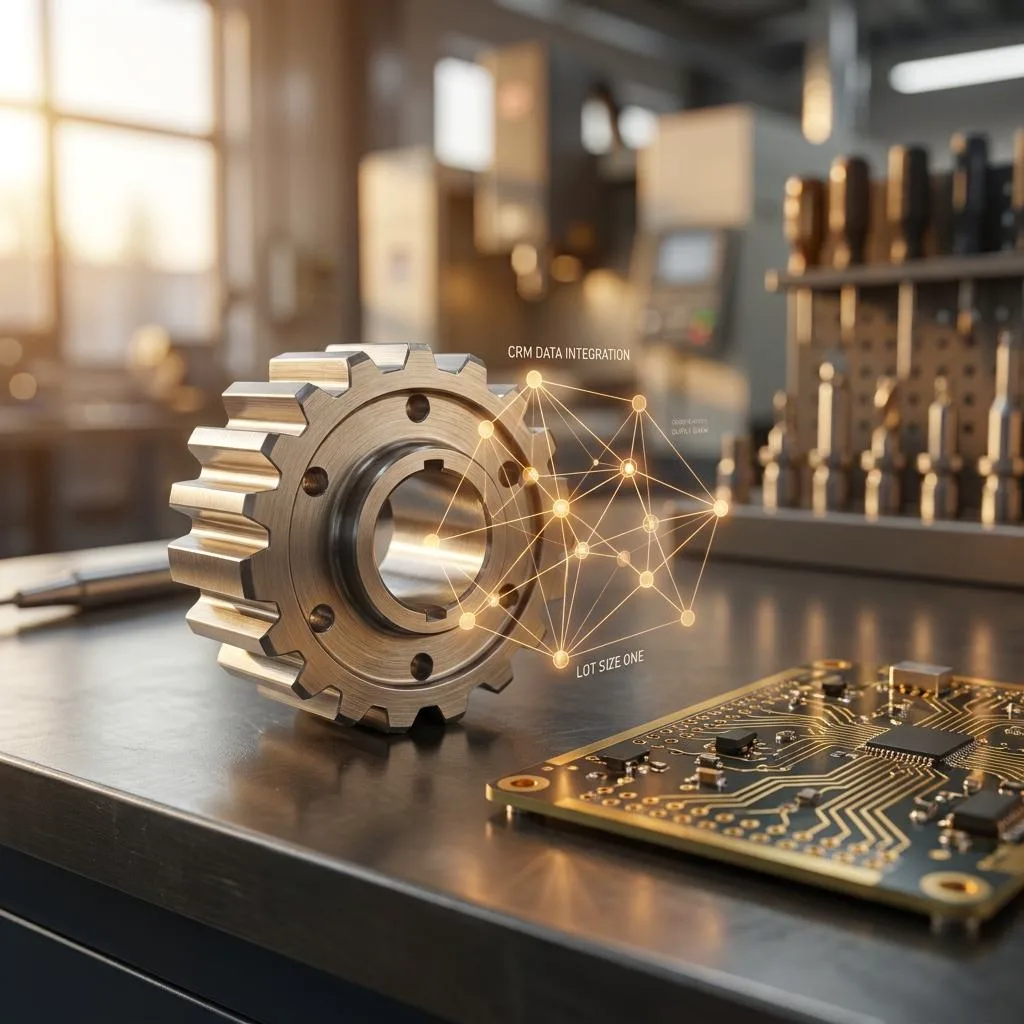
In the era of advancing hyper-personalization and Lot Size One manufacturing, traditional supply chains face unprecedented logistical challenges. Producing unique, highly individualized products requires rapid access to non-standard components that would be economically unjustifiable to keep in continuous stock. It is precisely in this area that the best ERP system for manufacturing in 2026 demonstrates its strategic advantage, transforming reactive procurement departments into proactive logistics optimization centers. The future of ERP lies in the ability to precisely anticipate material requirements long before a contract is formally signed.
The foundation of this logistics revolution is predictive procurement, fed in real time by data from the sales department. Modern management systems do not wait passively for a final production order to be generated. Instead, artificial intelligence algorithms continuously analyze the CRM sales funnel, rigorously assessing the probability of closing individual sales opportunities. If advanced negotiations with a key customer enter a decisive phase, the system automatically reserves machine capacity and prepares preliminary requisition lists based on historical customer behavior.
This mechanism takes on particular significance in the context of sourcing entirely non-standard materials. When the product configurator identifies the need for a specific rare metal alloy or a dedicated electronic circuit, the system immediately initiates an automated request for quotation (RFQ) process. Digital inquiries are instantly distributed to a pre-selected base of qualified suppliers without any human intervention. Algorithms then compare incoming offers against price, delivery time, and supplier reliability, recommending the optimal choice to the buyer.
This deep integration drastically reduces the risk of tying up working capital in rarely used inventory. In the traditional model, companies often stockpiled unusual parts "just in case," leading to the accumulation of costly dead stock. An intelligent supply chain ensures that specific components are ordered precisely in a Just-in-Time model, tightly synchronized with the dynamic production schedule.
The effectiveness of this innovative approach is confirmed by the experience of a leading European manufacturer of specialized agricultural machinery. Implementing predictive procurement coupled with a CRM platform allowed the organization to reduce slow-moving inventory levels by more than 40%, while simultaneously cutting the lead time for non-standard orders by three weeks. This powerfully demonstrates that digital transformation of manufacturing requires building a flexible ecosystem that seamlessly connects suppliers with the shop floor.
Agile Quality Control: AI Verifies Unique Specifications
In a production environment dominated by the Lot Size One concept — where every product leaving the line has a unique specification — traditional quality control methods become completely inadequate. The classic approach, based on static templates and spot-checks, cannot meet the demands of mass personalization. Modern facilities must replace rigid quality standards with dynamic criteria that are continuously pulled from the manufacturing management system. The best ERP system for manufacturing in 2026 must deliver precise guidelines for each individual unit in real time.
The key to this revolution is the concept of the Digital Twin, whose foundations are established as early as the CRM sales funnel stage. When a customer configures their order, the system automatically generates a virtual model of the product with all of its unique parameters. This digital template then passes to the operational layer, becoming the absolute reference point for agile quality control. Instead of relying on universal instructions, inspection stations receive the exact specification for a specific order from the ERP system in a fraction of a second before the part appears on the line.
Physical verification is based on advanced vision systems integrated with artificial intelligence algorithms. The use of machine learning enables the instant detection of even the smallest anomalies in personalized orders. Industrial cameras scan the product from multiple angles, while AI models compare the image of the physical object with its digital counterpart in the database in real time.
Artificial intelligence integrated with the ERP system not only verifies dimensions or color but can assess the correct assembly of non-standard components, eliminating human error at the final stage of production.
A prime example is a leading European manufacturer of specialized packaging machinery that implemented integrated vision-based inspection. Each machine consists of thousands of unique parts selected for a specific customer. The vision system, fed by data from the ERP, scans assembled modules and instantly detects missing bolts, incorrectly routed cables, or the use of an incorrect metal alloy. If the artificial intelligence detects a discrepancy with the digital twin, the line is automatically halted and the operator receives precise information about the location and nature of the defect.
What is particularly significant from the perspective of operations directors, the process does not end with detection alone. Every identified anomaly feeds into a central knowledge base within the ERP system. This creates a closed information loop that serves the continuous improvement of the product configuration process. Algorithms analyze recurring assembly issues and can automatically suggest design changes to engineers, or block risky component combinations at the configurator level within the CRM system.
Profitability in the Lot Size One Model: Dynamic Quoting and Cost Prediction
The transition to the Lot Size One model is not only an enormous engineering challenge — it is above all a powerful test of the entire enterprise's profitability. In the era of advancing hyper-personalization, traditional pricing methods based on historical averages, spreadsheets, and rigid price lists lose all relevance. The best ERP system for manufacturing in 2026 must serve as an intelligent firewall, protecting the company's margin from the very earliest stage of preliminary customer negotiations. This means a radical shift in the financial paradigm: from post-factum pricing to highly precise real-time cost prediction.
The key mechanism behind this shift is the deep, two-way integration of advanced product configurators with the central financial and operational system. When a customer independently modifies product parameters in a sales portal, or when a sales representative builds a complex quote feeding the CRM sales funnel, modern ERP algorithms work continuously in the background. Within fractions of a second, they run a full simulation of the entire manufacturing process for that one unique unit. The system actively blocks the ability to approve a quote if the calculated operating margin falls below the strategic minimum set by company management.
The true technological innovation, however, lies in the system's ability to identify and immediately quantify hidden costs that are routinely overlooked in standard calculations. Manufacturing trends for 2026 demand that the final price account not only for basic raw materials and direct labor, but also for highly variable environmental factors. Predictive algorithms precisely factor in the time required for physical machine changeover to accommodate non-standard dimensions, the microscopic wear on specialized cutting tools, and even the elevated logistics costs of micro-deliveries for non-standard, rarely used components.
Effective digital transformation of manufacturing requires every product variant, no matter how small, to have its own precise financial digital twin before the machines on the shop floor are physically started.
The effectiveness of this innovative approach is well illustrated by the example of a large European manufacturer of premium office furniture. For years, the company struggled with a serious margin erosion problem on complex special orders. The costs of non-standard veneers, unusual fittings, and frequent, unplanned assembly line stoppages systematically ate into the projected operating profit. The implementation of a modern ERP ecosystem with a built-in dynamic cost prediction module completely reversed this negative business trend.
The new system began automatically adding opportunity costs to quotes in real time — costs arising from disruptions to the standard serial production rhythm. As a result, sales teams gained a powerful tool that instantly showed how even the smallest modification to a desk would affect its ultimate profitability. The manufacturer consequently increased the profitability of special orders by as much as 22% within just one year. This powerfully demonstrates that operational flexibility need not mean financial compromise, provided technology can price it accurately.
Strategy for 2026: How to Prepare Your Facility for the Arrival of Intelligent ERP
Implementing technological innovation in an industrial facility is a process that requires precise planning months in advance. To fully leverage the potential of the best ERP system for manufacturing in 2026, Chief Operating Officers (COOs) and CIOs must begin preparations today. Simply purchasing modern software does not guarantee success if the organization is not ready for it from an infrastructural and cultural standpoint. The autonomous production that is fast approaching requires the creation of solid foundations that will enable the seamless integration of advanced algorithms into the day-to-day operations of the factory.
Digital Readiness Audit: The Foundation of a Successful Transformation
True digital transformation of manufacturing begins with a rigorous audit of the current state of IT infrastructure and the quality of the data being collected. Before artificial intelligence can begin optimizing processes, it must receive reliable input data. The first priority must be to thoroughly clean up the CRM sales funnel, removing duplicate records, outdated sales opportunities, and incorrect customer specifications. It is precisely this data that will in future serve as the starting point for predictive material requirements planning and machine scheduling. If the ERP system is fed chaotic information from the sales department, it will generate incorrect production orders.
Another equally important step in the audit is verifying how open your machinery fleet is to external communication. Modern management software must exchange data seamlessly with devices on the production floor. CIOs should carefully analyze whether existing PLC controllers, IoT sensors, and MES systems have open application programming interfaces (APIs). Implementing advanced solutions will be impossible if machines remain isolated technological islands, unable to report their status in real time. The example of one of Europe's leading automotive component manufacturers shows that early standardization of communication protocols on the shop floor reduces the implementation time of a new ERP system by nearly thirty percent.
Industry 5.0 and Organizational Culture: People at the Heart of Innovation
Even the most advanced technologies will fail if they meet with resistance from the workforce. The concept promoted by Industry 5.0 places enormous emphasis on the synergy between humans and intelligent machines. Unlike the previous industrial revolution, which focused almost exclusively on full automation, the new approach restores the worker to the role of primary decision-maker. Machines and algorithms are designed to support operators by providing them with processed data and recommendations, but it is the human who makes the final, strategic decisions.
The boards of manufacturing companies must invest time and resources in building a culture of innovation. This means communicating upcoming changes transparently and organizing workshops that familiarize teams with new tools. Shop floor operators, planners, and buyers must understand that the future of ERP does not mean job cuts, but rather the elimination of tedious, repetitive tasks. Once operators realize that artificial intelligence will relieve them of the burden of manual data entry, they will naturally become ambassadors of digital change. It is worth establishing cross-functional implementation teams that include not only IT specialists, but above all experienced production employees.
Strategic Technology Partnership: The Key to Seamless Data Flow
The choice of software vendor is a decision that will shape a plant's development for the next decade. Manufacturing trends for 2026 clearly indicate that the traditional approach of purchasing off-the-shelf software is becoming a thing of the past. Today's industry leaders are looking not so much for code vendors as for strategic technology partners. Such a partner must have an in-depth understanding of manufacturing process specifics and the concept of seamless data flow — from the first customer contact all the way to the release of the finished product from the warehouse.
A key selection criterion should be the integrator's experience in bridging business and industrial environments. The right technology partner can design an architecture in which data from the sales platform, CAD/PDM engineering systems, and shop floor machines flows together without the slightest disruption. It is worth analyzing a prospective vendor's previous implementations, paying particular attention to how they handle non-standard manufacturing processes. Only close collaboration with experts will make it possible to avoid costly architectural mistakes at an early stage of the transformation.
Time to Take the Decisive Step Toward the Future
The transition to next-generation software is not an evolution — it is a strategic leap into the future that requires proper preparation and trusted advisory support.
Preparing your plant for the arrival of intelligent management systems is a process that cannot be put off. The competition is already optimizing its processes and building infrastructure to meet the demands of hyperpersonalization and autonomous factories. Don't let technological limitations hold back the growth of your business. Take the first step toward building a fully integrated, intelligent manufacturing environment that will give you a competitive edge in the years ahead.
Contact our experts today and schedule a free technology consultation. See firsthand, during a dedicated demonstration, how deep integration of a modern CRM system with advanced ERP software can revolutionize the operational efficiency of your plant. Together, we will conduct a preliminary audit of your infrastructure and outline a safe, cost-effective roadmap for your digital transformation.


