
Introduction: The End of the Optimization-at-All-Costs Era in Favor of Hyper-Resilience
Over the past decade, operations directors and production leaders have focused on one overriding goal: maximizing efficiency. The traditional approach, rooted in the early phases of the fourth industrial revolution, promoted optimization at all costs. Today, however, in the face of unprecedented market volatility, this paradigm is evolving rapidly. The relentless pressure to cut costs and maximize volume is giving way to strategies centered on building operational hyper-resilience and long-term sustainable development.
Instability in global supply chains has ceased to be an anomaly and has become the new, permanent operational standard. Leading manufacturers in the automotive sector and top electronics distributors have learned firsthand that finely tuned OEE (Overall Equipment Effectiveness) metrics lose their relevance when critical components suddenly run out. In this new reality, production planning software must offer far more than rigid, algorithmic order scheduling.
From Industry 4.0 to the Industry 5.0 Vision
We are witnessing a historic transition from the Industry 4.0 paradigm—oriented toward pure machine efficiency—to the concept of Industry 5.0. This new vision places resilience to disruption, sustainable resource utilization, and human-machine synergy at its center. Artificial intelligence in manufacturing fits perfectly into this context, evolving from a purely analytical tool into a proactive strategic advisor.
Navigating market uncertainty requires tools that not only respond to change, but are capable of simulating it in advance and effectively neutralizing it.
Looking at manufacturing trends toward 2030, the role of advanced IT systems will undergo a complete transformation. Modern AI production scheduling and digital twins will enable companies to adapt instantly to sudden supply disruptions or demand fluctuations. In this article, we examine how these innovative technologies are shaping the future of the manufacturing industry and why adapting to them is a prerequisite for survival in the years ahead.
From Industry 4.0 to 5.0: A Paradigm Shift in Modern Factory Management
The fourth industrial revolution dominated the past decade, focusing on digitalization, connectivity, and the mass deployment of IoT sensors. For many chief operating officers (COOs) and production managers, this meant above all a giant leap in access to information about machine fleet performance. In hindsight, however, it is clear that simply collecting machine data is no longer enough. Having interactive management dashboards that merely report historical downtime or the current OEE metric will not protect a plant from a sudden supply chain breakdown. Industry 4.0 gave us process visibility, but it is Industry 5.0 that gives us the capacity for intelligent, proactive adaptation under conditions of continuous uncertainty.
The definition of Industry 5.0 in the context of operational management goes far beyond automation alone. It represents a strategic shift of emphasis—from the machine itself to the human supported by advanced algorithms, and from relentless cost optimization to sustainable development and resilience. Within this new paradigm, production planning software evolves from a passive order-scheduling tool into a proactive decision-making ecosystem. These systems no longer merely aggregate data; they independently interpret it, simulate various scenarios, and recommend the best courses of action before a critical problem ever materializes on the shop floor.
Integrating ESG Goals with Day-to-Day Scheduling
One of the most groundbreaking aspects of the fifth industrial revolution is the inseparable connection between business objectives and environmental, social, and corporate governance (ESG) requirements. Modern AI production scheduling no longer optimizes plans solely for the shortest lead time or the lowest changeover cost. Today's artificial intelligence algorithms can factor in real-time electricity consumption, the carbon footprint of individual operations, and raw material usage optimization in order to drastically minimize production waste.
For example, a large European packaging manufacturer uses advanced analytics and digital twins not only to plan material flow. It uses them to sequence orders so that the most energy-intensive processes take place during hours of greatest availability of cheap renewable energy. This is a perfect illustration of how artificial intelligence in manufacturing supports the achievement of carbon-neutrality strategies at the operational level, combining environmental responsibility with hard economic calculation.
Looking at manufacturing trends toward 2030, the role of the operations director is undergoing a complete redefinition. Digital transformation leaders are no longer looking for systems that simply execute tasks faster and cheaper. They are looking for intelligent platforms capable of perfectly balancing profitability, flexibility, and ecological responsibility—creating modern factories ready for the unpredictable challenges of the years ahead.
Cognitive AI Production Scheduling: The End of Isolated Data Silos
For many operations directors and CIOs, the greatest pain point of traditional APS (Advanced Planning and Scheduling) systems is their inherent reactivity. Classic production planning software typically relies on rigid, isolated data silos that do not communicate with one another in real time. As a result, a meticulously constructed schedule becomes completely obsolete mere minutes after it is approved, the moment even the slightest deviation occurs on the shop floor. The transition from static, island-based IT systems to cognitive artificial intelligence algorithms is a genuine revolution that definitively puts an end to this phenomenon.
Heuristics Give Way to Machine Learning
The fundamental difference between traditional heuristic algorithms and advanced machine learning lies in the capacity for dynamic adaptation. Traditional ERP and APS systems operate on the basis of pre-defined business logic rules, rendering them helpless in the face of unpredictable, multidimensional variables. Cognitive AI production scheduling, by contrast, continuously analyzes tens of thousands of data points drawn from various integrated sources.
These systems are capable of independently drawing conclusions from historical process anomalies, flawlessly identifying hidden patterns that are entirely invisible to the human eye. As a result, cognitive production planning software can predict future disruptions with considerable accuracy before they actually affect the operational continuity of the entire plant.
Preventive Rescheduling and the Elimination of Micro-Failures
Cognitive artificial intelligence transforms production management from a purely reactive process into a highly predictive instrument for the strategic minimization of operational risk.
Rather than passively waiting for a machine failure report, artificial intelligence analyzes subtle fluctuations in device telemetry in real time. The system can identify the risk of a micro-failure on the basis of minimal changes in temperature, vibration, or voltage drops. It then autonomously performs preventive rescheduling of the entire order queue, safely routing work around the at-risk production cell.
A compelling demonstration of this approach's effectiveness is the transformation undertaken by a large food manufacturer. For years, the company struggled with chronic micro-stoppages on its key packaging lines. These were caused by difficult-to-predict fluctuations in natural raw material quality and asymmetric wear on mechanical components. Traditional planning methods led to drastic drops in overall efficiency and generated enormous material losses.
The deployment of cognitive data analytics completely transformed the situation. The intelligent system began correlating data from IoT sensors, incoming raw material parameters, and historical machine error logs in real time. As a result, artificial intelligence in manufacturing enabled proactive value stream management. Algorithms automatically slowed line speeds or redirected critical batches to alternative machines before a line blockage could occur, eliminating unplanned downtime and stabilizing the supply chain.
Energy Optimization and Carbon Footprint: New Software Priorities Toward 2030
Over the coming decade, production planning software will undergo a fundamental transformation in terms of resource management. Energy costs and CO2 emissions will cease to be the exclusive domain of annual sustainability reports and will become key, dynamic decision variables in day-to-day scheduling. For production directors and CIOs, this means the need to implement systems capable of analyzing and optimizing electricity consumption in real time at the level of individual work cells. Artificial intelligence in manufacturing will play a critical role here, continuously balancing order delivery deadlines against the avoidance of steep costs during peak energy hours.
Dynamic Adaptation to Tariffs and Renewable Energy Availability
Modern AI production scheduling toward 2030 will be tightly integrated with the energy market. Algorithms will automatically shift the most energy-intensive processes—such as heat treatment or metal smelting—to night hours or weekends, when cheaper tariffs apply. Furthermore, advanced systems will take into account the local availability of renewable energy sources (RES). Imagine a large plastics processing plant whose IT system independently ramps up production on sunny days, maximizing the utilization of its own photovoltaic array. Such flexibility enables not only enormous financial savings, but also independence from interruptions in the central grid supply.
Carbon Footprint Tracking at the Individual Order Level
Another breakthrough trend is the shift from macro-estimates to micro-level emissions accounting. The new generation of production software will enable the tracking and reporting of carbon footprint with precision down to the individual order—or even a specific component. Digital twins of machines will monitor the exact consumption of electricity, gas, and compressed air at every second of a technological operation. This will allow operations managers to calculate the carbon cost for each end customer with precision. Leading automotive manufacturers already require their subcontractors to provide such detailed data in order to calculate the total carbon footprint of a finished vehicle.
The Impact of EU Directives and Regulatory Requirements (CSRD)
It should not be forgotten that this technological evolution is driven in large part by hard legal requirements. The EU's CSRD directive imposes extremely rigorous non-financial reporting obligations on companies. In response to these regulations, IT system providers for industry must completely rebuild their database architectures. Software must generate flawless, audit-ready emissions reports that demonstrate real reductions in environmental impact.
Incorporating energy and environmental variables into artificial intelligence algorithms is not a matter of image—it is a hard market and legal requirement that determines the competitiveness of European industry.
Looking at manufacturing trends toward 2030, systems that ignore this aspect will simply become obsolete. Achieving the goals set by Industry 5.0 will require digital transformation leaders to invest in tools for which sustainable development is a mathematical operational foundation—not merely a catchy marketing add-on.
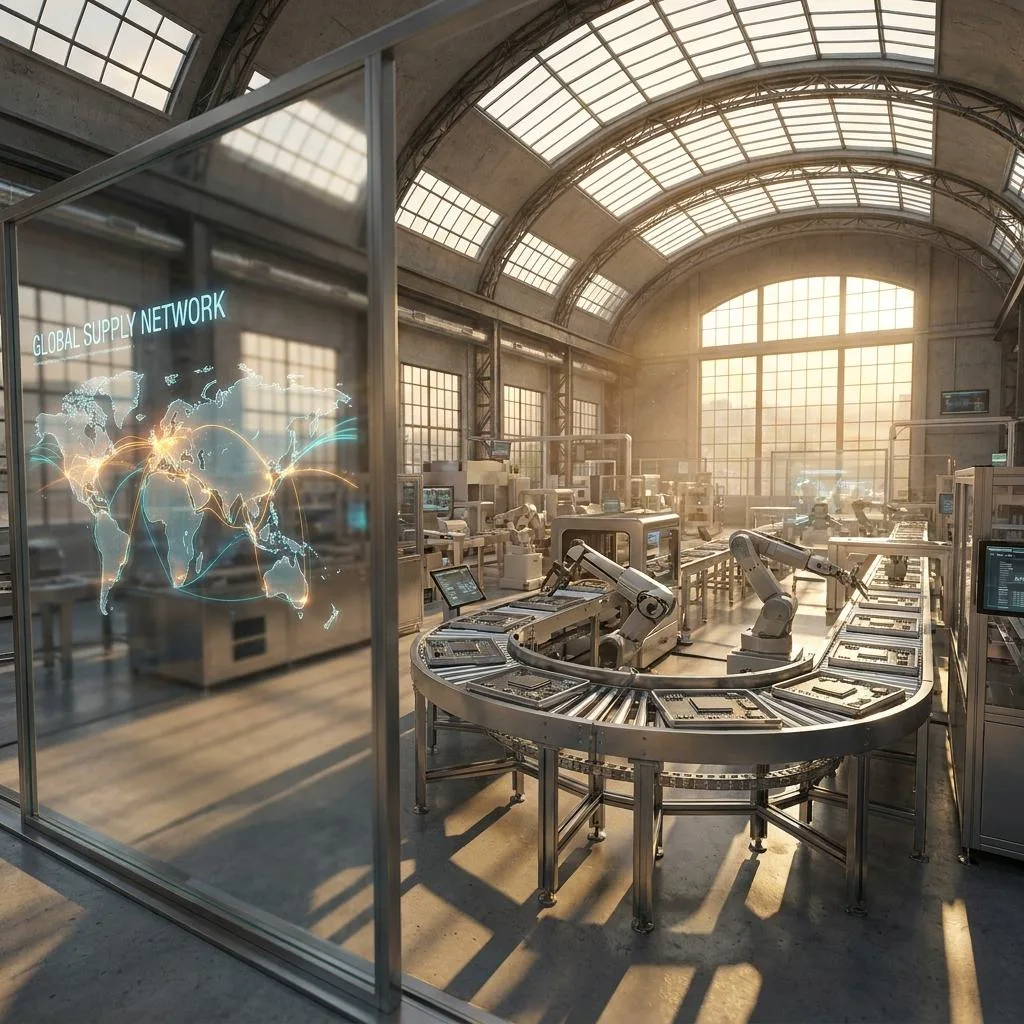
Hyper-Resilience to Supply Shocks: Dynamic Real-Time Reconfiguration
In today's highly globalized economic environment, supply chain continuity is under constant pressure. The memorable blockages of key seaports and the global semiconductor shortages brutally exposed the weaknesses of traditional operational management methods. Modern production planning software, powered by advanced artificial intelligence algorithms, offers a completely new approach to this problem, guaranteeing what is known as hyper-resilience to supply shocks. Rather than passively waiting for a delay report, these systems demonstrate the ability to respond autonomously to any anomalies in component deliveries before they affect the continuity of assembly line operations.
The foundation of this resilience is the deep integration of the production schedule with cloud-based logistics systems and supplier databases. Leveraging real-time transport tracking technologies (Real-Time Visibility), artificial intelligence in manufacturing continuously monitors shipment statuses. The system analyzes data from truck telematics systems and cargo vessels, and even factors in global weather forecasts and the current geopolitical situation. When the algorithm detects a risk of a critical raw material delivery missing its deadline, it immediately initiates advanced preventive measures.
Implementing the concept of Industry 5.0 means that the factory ceases to be an isolated island and becomes a fully integrated, responsive node in the global supply network, capable of proactive and immediate adaptation.
A key element of this evolution is multi-scenario What-If planning, executed in fractions of a second. For example, when a large European consumer electronics manufacturer receives a signal from its RTV system indicating a one-week delay in a ship carrying critical microprocessors, the artificial intelligence does not merely generate a simple alert for the planner. AI production scheduling instantly recalculates thousands of possible variants and performs a dynamic reconfiguration of the plan. The system autonomously reschedules orders requiring the missing component, while maximizing the production of other goods for which raw materials are already fully available in the local buffer warehouse.
Looking at manufacturing trends toward 2030, this unique ability to achieve seamless, continuous real-time reconfiguration will become an absolute market standard. Dynamic adaptation effectively eliminates costly machine downtime and drastically reduces operational stress on shop floors. Thanks to intelligent supply risk analysis, operations directors gain complete confidence that their plants are capable of maintaining optimal efficiency and high profitability, regardless of sudden disruptions in global logistics.
The Era of Augmented Intelligence: AI Production Scheduling as a Copilot for the Planner
The vision of fully automated factories in which algorithms completely replace human personnel continues to raise concerns among many operations managers. In practice, however, production planning software is moving in an entirely different direction. Rather than eliminating positions, we are entering the era of Augmented Intelligence. In this modern model, artificial intelligence is not an autonomous decision-maker, but serves as an advanced assistant—commonly referred to as a Copilot—working side by side with an experienced planner.
This concept is built on the synergy between machine computational power and human creativity. Algorithms take over the laborious, analytical processes of processing gigabytes of data from the shop floor. As a result, the human is freed from routine tasks and can focus on strategy, exception management, and higher-order process optimization. AI production scheduling thus becomes a tool that amplifies the intellectual and analytical capabilities of planning teams.
Conversational Interfaces and the Power of Natural Language
One of the most fascinating trends toward 2030 is the revolution in the way humans and machines communicate. Traditional, complex ERP and APS system interfaces are giving way to solutions based on natural language processing (NLP). This means that planners can issue commands to operational systems using simple voice or text commands that resemble ordinary conversation.
The adoption of conversational interfaces makes interacting with an advanced planning system as natural as speaking with a skilled colleague.
Imagine a scenario in which the lead planner asks the system: "What will be the consequences of a 48-hour delay in component delivery from a supplier for priority orders?" The intelligent Copilot analyzes thousands of dependencies in a fraction of a second and presents ready-made, alternative action scenarios. Solutions of this kind are already being successfully tested by leading automotive manufacturers, reducing crisis response times from several hours to mere minutes.
The Irreplaceable Role of Human Experience
Despite enormous computational capabilities, artificial intelligence in manufacturing still lacks what might be called "business intuition." The role of human intuition, empathy, and years of industry experience remains absolutely critical when verifying the complex scenarios generated by AI. A machine can identify the mathematically optimal schedule, but it is the human who understands the nuances of relationships with key customers or the informal dimensions of geopolitical conditions.
The concept of Industry 5.0, which will dominate the coming decade, places the human back at the center of production processes. Final approval of an AI-generated plan—especially in crisis situations—will always require human judgment. It is precisely this harmonious combination of flawless machine analytics and human wisdom that will define the competitive advantage of the most advanced factories of the future.
Macro Digital Twins (Macro-Twins): Simulating Entire Value Ecosystems
The concept of virtual replicas of physical assets is evolving at an unprecedented pace. Traditional digital twins have until now focused on optimizing individual machines, work cells, or, at best, isolated assembly lines. Looking ahead at manufacturing trends toward 2030, however, digital transformation leaders must prepare for the arrival of the Macro-Twin era. This powerful next-generation production planning software reaches far beyond the walls of a single factory, integrating an entire global value chain within a single simulation environment.
From Micro-Simulation to Macro-Operations Management
In the era of the Industry 5.0 paradigm, optimizing internal processes alone is decidedly insufficient to maintain a competitive advantage. Macro digital twins enable a seamless transition from micro-simulation to the modeling of entire business ecosystems. Modern systems factor in the real-time statuses of subcontractors, the inventory levels of buffer warehouses distributed across different continents, and the dynamic situation in external logistics. As a result, directors and operations managers gain a holistic, multidimensional view of the situation—one in which their own factory is just one of many interconnected nodes.
Identifying Hidden Bottlenecks in the Supply Network
The greatest efficiency losses today rarely originate at the machine itself. Most often, they are hidden at the interfaces between different companies within the supply network. Advanced artificial intelligence in manufacturing is capable of effectively analyzing these inter-operational gaps. Using Macro-Twins, the system can identify that a delivery delay from a second-tier supplier, combined with a strike at a key transhipment port, will halt an assembly line in exactly three weeks. AI production scheduling automatically recalculates these variables, proposing alternative sourcing routes or modifications to the production plan before the problem becomes critical.
Advanced Predictive Analytics in Expansion
Macro-simulations are also a powerful strategic tool for executive boards and business development departments. Leveraging advanced predictive analytics enables the safe testing of production expansion strategies in a fully virtual environment. For example, a major manufacturer of components for the aerospace industry can simulate relocating part of its production to a different geographic region. The system will analyze the impact of that decision on transportation costs, order lead times, and the carbon footprint of the entire ecosystem.
Implementing Macro Digital Twins represents a strategic shift from reactive firefighting to the proactive design of resilient, global value networks — where every decision is backed by hard simulation data.
For modern manufacturing companies, the ability to precisely simulate the entire supply chain will become, by 2030, a fundamental benchmark of operational maturity. It will be an absolute prerequisite for surviving and scaling a business in a highly volatile global market.
Summary: How to Prepare Your Plant for Manufacturing Trends Toward 2030
The coming decade will bring unprecedented transformation in the way factory operations are managed. As we have demonstrated throughout this article, manufacturing trends toward 2030 are no longer based solely on straightforward automation, but on building intelligent, highly responsive ecosystems. Modern production planning software is becoming the central nervous system of every contemporary plant. Chief Operating Officers (COOs) and Chief Information Officers (CIOs) must prepare their organizations for the integration of concepts such as cognitive artificial intelligence, advanced macro-twins, and rigorous ESG reporting.
It is precisely these advanced technological elements that will define the paradigm of Industry 5.0 — one in which innovation collaborates harmoniously with human expertise and the surrounding environment. Achieving hyper-resilience against global supply shocks will no longer be regarded as a luxury, but will become an absolute condition for survival in a highly competitive manufacturing market.
Foundations of Transformation: Where to Begin Modernizing Your IT Architecture?
For the ambitious vision of an autonomous factory to become reality, organizations must take critical steps today. The foundation for any successful deployment of advanced algorithms is uncompromising, top-tier data quality. Artificial intelligence in manufacturing is, after all, only as effective as the information it is fed on a daily basis. Before implementing autonomous decision-making systems, we must eliminate information silos between the planning, procurement, maintenance, and sales departments without exception.
In operational practice, this means seamless integration of ERP- and MES-class systems with IoT platforms directly on the shop floor. A lack of reliable, standardized real-time data will cause even the most sophisticated AI production scheduling to generate incorrect or physically unachievable plans. For this reason, the short-term strategy for digital transformation leaders should rest on the following pillars:
- Comprehensive data audit: Verifying the accuracy of process times, routings, and actual inventory levels in current transactional systems.
- IT and OT convergence: Connecting IT infrastructure with operational technology to enable AI algorithms to be fed directly with valuable data from machines and sensors.
- Migration to cloud computing: Ensuring the scalability and computational power required to support digital twins and multi-variant scenario simulations.
- Education and change management: Preparing planning teams for a new role in which the AI system becomes their intelligent assistant, supporting day-to-day decisions.
Agile Implementation and Measurable Business Benefits
It is worth noting that modernizing IT architecture in a modern factory should not be carried out using a "big bang" approach — that is, attempting to implement every innovation at once. The best results are achieved by organizations that opt for a methodical, iterative approach. Agile innovation deployment enables rapid validation of business hypotheses and proof of value in a carefully selected, critical area of the plant.
For example, a large European automotive manufacturer began its digital transformation by deploying AI exclusively to optimize complex changeovers on a single key press-shop line. Only after achieving clear, measurable financial and time savings was the system safely scaled to the remaining departments and integrated with the global supply chain.
Waiting for the perfect moment to begin digital transformation is, in reality, a silent acceptance of business marginalization. Deploying advanced analytics in planning is an arms race — and market leaders left the starting blocks long ago.
Take the First Step: Map Your Processes and Unlock the Potential of AI
Preparing an integrated plant for the challenges of the coming decade demands managerial courage, but above all a precise action plan. Do not allow your manufacturing company to fall behind the rapidly shifting technological and market landscape. If you want complete confidence that your systems architecture will meet the demands of the future, the time for strategic decisions has come.
We encourage you to conduct an in-depth audit of your organization's current planning processes. Contact our experts to schedule professional process-mapping workshops. Together, we will assess the digital maturity of your plant, identify costly information bottlenecks, and develop a personalized AI implementation roadmap. Discover in practice how intelligent technologies can reduce operational costs and guarantee hyper-resilience. The future of manufacturing starts with an optimal plan — let's build it together, starting today.


