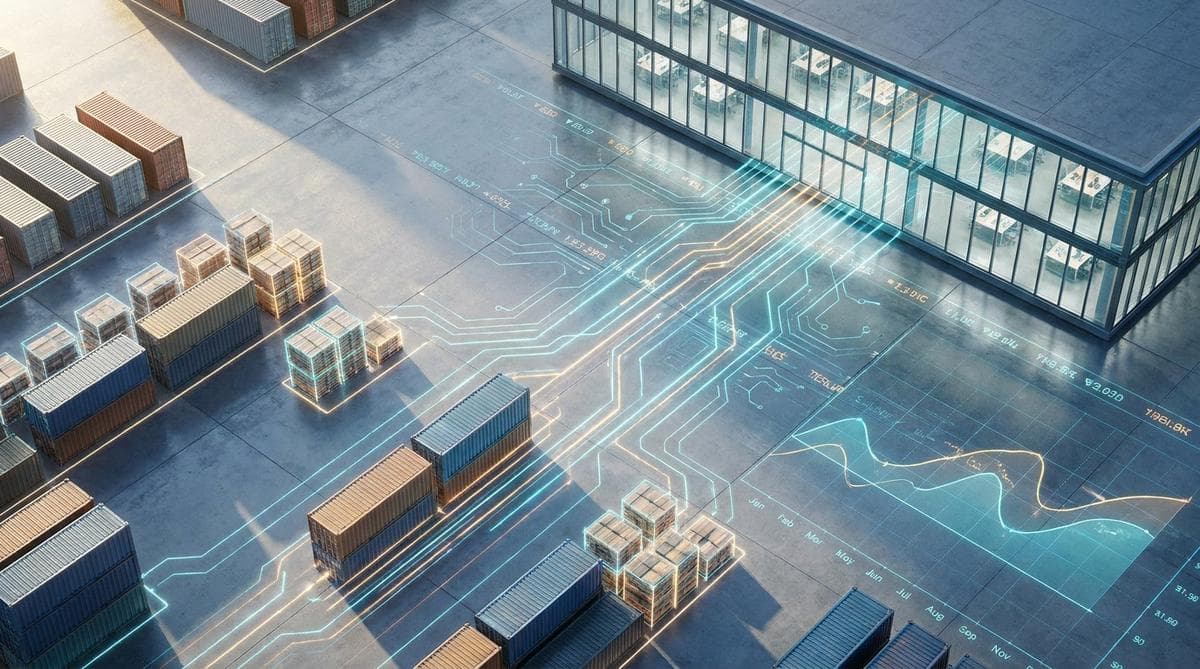
The black triangle of logistics: chaos between email, Excel, and the phone
For many logistics directors and supply chain managers at companies with 50 to 250 employees, every working day begins with fighting the same fires. Between an inbox overflowing with carrier quotes, dozens of versions of spreadsheets, and a constantly ringing phone, a phenomenon emerges that industry professionals call the black triangle of logistics. In this environment, precise logistics management becomes an illusion, and the team's actual working time is reduced to the tedious task of clicking through scattered data sources.
The symptoms of this operational fragmentation are visible at every turn and lead to direct losses:
- Duplicate inquiries and quotes: Dispatchers waste valuable hours manually comparing rates arriving simultaneously across email threads, messaging apps, and phone notes.
- No single version of the truth: Conflicting files — such as the legendary "Transport_Sheet_v4_final_revised.xlsx" — circulate between departments, causing discrepancies between the declared freight cost and the final invoice from the freight forwarder.
- A drastic drop in the OTIF (On-Time In-Full) rate: When information about a trailer delay gets stuck in an unread email, the customer service department only learns about the problem from an irritated recipient.
Many managers attempt to remedy the situation on the fly by creating ever more elaborate pivot tables and macros. In practice, however, this is nothing more than papering over operational debt. A complex transport operation built on makeshift office tools does not scale with growth in sales volume. Instead of building a competitive advantage, the logistics team becomes mired in information silos, losing control over margins and delivery punctuality.
Why point-solution TMS systems deepen information silos
When the chaos of spreadsheets becomes unbearable, the natural instinct for many operations directors is to invest in a dedicated, point-solution transport management system (TMS). On paper, this decision seems rational: freight forwarders gain a modern interface, a route planning module, and automated communication with freight exchanges. In practice, however, deploying isolated software very often leads to what is known as the specialist tools paradox. Rather than eliminating bottlenecks, the organisation simply shifts the problem to another part of the business structure.
The fundamental flaw of point solutions is their insularity. Although an individual dispatcher completes tasks more quickly, the rest of the company remains completely cut off from critical operational data. This phenomenon has serious consequences on multiple levels:
- Invisibility for the Customer Service department: Consultants managing key accounts still have no idea what stage an order is at. Instead of getting an instant answer from the ERP system, a customer service representative must call the logistics team, who in turn checks the status in the external TMS.
- Orders stuck in data exchange buffers: The traditional approach to connecting a standalone TMS with an ERP system relies on cyclic CSV file imports or error-prone API connectors. A minor discrepancy in the product index or a delay in the nightly synchronisation is enough to cause a transport order to get stuck in an error queue, preventing timely dispatch.
- An invoicing bottleneck and lack of profitability control: The finance department only learns the actual freight costs when it receives an invoice from the carrier. Without a real-time link between transport expenditure and a specific commercial document, immediate transport cost allocation is impossible, and the true margin on sales is distorted.
Modern logistics automation is not about adding another closed application — it is about eliminating architectural barriers. Only deep transport-ERP integration at the level of a shared database can eliminate artificial information silos and create a cohesive business ecosystem.
From sales order to dispatch: the automated order workflow
The true antidote to information silos and inefficient data synchronisation is direct transport-ERP integration at the level of a single relational database. In a modern business architecture, there is no room for manually transcribing shipment parameters from a customer order (CO) document into a freight forwarder's spreadsheet. The moment a sales representative approves a transaction, the system automatically generates a logistics requirement, initiating an immediate and error-free transport order workflow.
The key advantage of this approach is the complete elimination of human error when entering critical shipping data. Any mistake in dimensional parameters at the dispatch stage can result in a carrier refusing to load the goods or imposing severe contractual penalties. In an integrated environment, the system retrieves precise data directly from product master records and the commercial document in a fraction of a second:
- Net and gross weight, and cubic volume: Algorithms automatically calculate total weight, cargo volume (m³), and the number of pallet spaces (LDM), facilitating optimal planning of the trailer's loading space.
- Technical requirements and restrictions: Orders involving hazardous goods (ADR), the need to maintain a controlled temperature (refrigerated/isothermal), or the requirement for a tail lift are instantly flagged with special attributes, with no risk of them being overlooked.
- Time windows and pre-advice instructions: Detailed recipient guidelines entered by the sales representative are passed directly to the logistics dispatch record.
This kind of logistics automation also fundamentally changes the day-to-day work of the sales department and Customer Service. A sales representative no longer needs to send emails or call the dispatcher to ask: "When is the shipment for the customer in Poznań scheduled?" In their order view, they can see the full, live status of transport preparation — from the carrier allocation stage, through pre-advice, all the way to physical loading. Operational transparency becomes a reality, reducing customer handling time by several dozen percent.
Digital tendering and bidding: how to automate carrier selection
Traditional freight contracting often feels like a race against time. During peak shipping periods, logistics staff send out dozens of requests for quotation and then nervously refresh their inboxes, waiting for carriers to respond. This manual process creates a critical bottleneck, paralyzing the flow of goods from the warehouse and making it impossible to fulfil deliveries on time. The answer to this problem is full logistics automation based on a single, integrated dispatcher dashboard.
A modern transport operation uses a hybrid freight allocation model, combining predefined rate matrices with a dynamic bidding mechanism. In practice, the system operates according to strictly defined decision rules:
- Rate matrices for fixed lanes: For recurring high-volume routes, the system automatically assigns the load to a contracted partner based on previously negotiated line tariffs, eliminating the need for any manual arrangements.
- Dynamic bidding within a closed partner network: For irregular routes or sudden volume surges, the order goes to a digital mini-exchange. Vetted carriers bid on the rate within a defined time window (e.g., 15 minutes), ensuring a market price without delaying the shipment.
- Automatic documentation validation and compliance checks: Before the algorithm accepts the best offer, the system verifies the validity of the carrier's goods-in-transit liability (CMR) insurance, transport licence, and the up-to-date technical inspections of their fleet — all without any human involvement.
This approach drastically cuts freight booking times — from several hours to just a matter of seconds. Freight forwarders gain legal and financial certainty, and the partner selection process becomes fully transparent and auditable within a single central data environment.
A single source of truth: tracking shipment statuses without calling drivers
One of the most time-consuming tasks in a traditional logistics department is constantly answering the same recurring questions: where is my shipment? and what time will the unloading take place? In a fragmented environment, the answer requires a series of calls to the dispatcher, the carrier, and finally the driver. A modern transport operation within a single integrated system definitively eliminates this communication noise, replacing it with the concept of a Single Source of Truth.
When telematics data from vehicles and digital proof of delivery (e-PoD — electronic Proof of Delivery) flow directly into the order record within the master ERP system, the fulfilment status updates automatically. The freight forwarder no longer needs to act as an intermediary for basic information exchange, allowing them to focus on tasks with greater business value:
- Self-updating status for sales staff and customers: A customer account manager in the sales office can see the vehicle's precise GPS location and estimated time of arrival (ETA) in the same window where they monitor invoices. Instead of engaging the freight department, the system proactively generates email or SMS notifications directly to the goods recipient.
- Rapid escalation and management by exception: Instead of inefficiently fighting fires, logistics management gains a tool for predicting risks. If a traffic jam or stoppage is detected that threatens the agreed time window, the algorithm immediately triggers an escalation alert to the dispatcher — before an impatient customer raises a complaint themselves.
- Real-time digital e-PoD workflow: A recipient's signature captured on the driver's terminal automatically closes the transport order in the central database. The finance department no longer has to wait weeks for a paper CMR consignment note, which radically accelerates transport cost settlement and sales invoicing.
In this way, full operational transparency eliminates dozens of unnecessary phone calls per day, safeguarding the punctuality of the supply chain and building a professional image for a modern supplier.

Automated cost settlement: closing the gap between transport and accounting
The true test of business process cohesion comes when accounting documents from external carriers start arriving at the company. In a traditional, non-consolidated model, the finance department is forced to painstakingly verify every invoice against paper consignment notes and scattered email correspondence from freight forwarders. In an integrated ERP/BPM environment, manual verification gives way to an advanced 3-way matching mechanism operating on a single database.
The concept of automated reconciliation is based on the instant comparison of three key components: the original transport order, digital confirmation of service delivery (e.g., delivery status in the telematics system together with the e-CMR), and the electronic image of the carrier's invoice. If the financial and tariff parameters match the previously negotiated rate, the document is posted without any employee involvement. This standardisation means that transport cost settlement ceases to be a source of multi-week delays during the monthly close.
One of the biggest traps in logistics budgets is uncontrolled additional charges. An integrated transport management system eliminates this problem through the rigorous detection of unauthorised freight surcharges. Instead of uncritically accepting inflated invoices, the algorithms verify:
- Demurrage charges: The system compares pre-advised and actual departure times from the warehouse loading bay with the vehicle's GPS geolocation, rejecting unfounded carrier claims for alleged waiting time.
- Fuel and road surcharges: All BAF adjustments and motorway toll charges are automatically recalculated according to predefined indices from the date of loading.
- Urban access zone charges: Any special costs require prior incident registration by the driver and digital authorisation by the dispatcher.
The final, critical pillar is precise cost allocation (i.e., landed cost). By operating on shared data structures, the cost of each freight movement can be broken down proportionally across specific product lines, goods batches, or individual customer orders. This allows logistics directors and financial controllers to assess the true profitability of every commercial contract, protecting the operating margin from erosion caused by hidden delivery costs.
The benefits matrix: hard ROI metrics for the board
Investment in a modern transport management system integrated directly with the ERP structure cannot be treated merely as a technical improvement. For the company's board, what matters is a hard economic case and return on investment (ROI). Presenting a modernisation project requires moving away from general statements about employee comfort and towards precise financial and operational metrics that directly impact the company's EBITDA.
A compelling business case that a Supply Chain Manager can present to the steering committee rests on three pillars with an immediate impact on cash flow:
- A 30–50% reduction in transport administration costs: Eliminating repeated data entry, automating order generation, and doing away with phone-based freight booking frees up the team's capacity. For a company shipping several hundred loads per month, this translates into savings of hundreds of working hours annually — hours that staff can redirect towards strategic procurement negotiations instead of manually filling in forms.
- A reduction in late deliveries and the elimination of contractual penalties: Transparent transport operations and proactive time-window alert management (ETA) drastically improve the On-Time Delivery (OTD) rate. In relationships with retail chains, where strict penalty charges for missing unloading slots can consume the margin of an entire contract, reducing delays generates direct, tangible financial savings.
- Shortening logistics invoice processing times from weeks to minutes: Traditional transport cost settlement involves the laborious matching of paper CMR documents with carrier invoices. Thanks to digital e-PoD and the 3-way matching mechanism (order – delivery confirmation – e-invoice), the verification process is handled accurately and without any manual intervention. The finance team closes the month on time, avoiding the creation of inaccurate financial provisions for outstanding documents.
This consolidation of data demonstrates that deep transport-ERP integration is not a cost, but a highly profitable capital investment.
How to safely integrate logistics with the rest of the business: an action plan and checklist
For many supply chain directors, the greatest barrier to moving away from spreadsheets is not a lack of technology, but a well-founded fear of operational paralysis. In a dynamic manufacturing and trading environment, halting shipments for even a few hours generates enormous contractual penalties and a loss of trust among key business partners. However, transitioning from fragmented Excel tables to an integrated transport management system does not have to mean a high-risk revolution. A proven, process-driven approach makes it possible to carry out the migration in an evolutionary way, maintaining one hundred percent supply chain continuity.
A 4-stage roadmap for a safe migration
Consolidating operations onto a single database should proceed in an orderly manner, following a logical sequence of events. The methodology below minimises the risk of errors and guarantees a rapid return on investment (ROI):
- Step 1: Standardise the rate matrix and carrier database. The first step is to bring order to the historical chaos in rate schedules. Instead of dozens of separate spreadsheet files, a unified tariff structure is created, covering postal code zones, dimensional weights, fuel surcharges, and defined waiting time conditions. Standardising these rules in a central repository is the foundation upon which error-free logistics automation is built.
- Step 2: Digitise order creation and assignment. At this stage, traditional emails are replaced by a standardised transport order generated directly from a sales order or production work order. This means dispatchers no longer manually transcribe addresses, tonnage, or pre-advice deadlines, permanently eliminating human error at the interface between sales and the warehouse.
- Step 3: Connect telematics and integrate transport with the ERP. The next step is linking telemetry data streams directly to the central system. Integrating GPS statuses and digital proof of delivery (e-CMR) means that events on the road automatically update dispatch schedules, without the need for monitoring calls to subcontractors.
- Step 4: Implement the automated cost approval workflow. The final stage of the transformation is launching the automated transport invoice workflow based on the 3-way matching mechanism. The system instantly compares the value reserved on the order with the amount on the carrier's invoice. Matching documents go straight to the ledger, while discrepancies are immediately flagged for resolution — drastically streamlining transport cost settlement.
Modern transport-ERP integration is not simply a change of software — above all, it is the elimination of the invisible time losses generated by manually transcribing data between departments.
Check your organisation's readiness — download the free Checklist
Before deciding to implement new digital tools, it is worth objectively diagnosing where your department is losing the most resources. We have prepared a practical audit worksheet specifically for logistics managers, enabling you to assess the process maturity of your business in just a few minutes.
Download the tool: Checklist: Transport Process Maturity Audit – 15 questions that will identify the bottlenecks in your supply chain. This resource will help you identify hidden costs, assess the degree of dependency on manual spreadsheets, and prepare a well-founded business case for the board.
Build operational advantage on a single database
Do you know how much faster your team could fulfil shipments if logistics management were based on real-time data, without the need for spreadsheets as intermediaries? Don't let information silos hold back the scaling of your business.
Book a free demo and see what transport management looks like on a single database. Our experts will show you how an integrated system connects warehouse operations, freight orders, and finance into a cohesive, self-running ecosystem.


