
Introduction: The Digitalization Paradox in Manufacturing on the Eve of 2026
On the eve of 2026, operations directors and CEOs of manufacturing companies face an unprecedented challenge. On one hand, the market demands extraordinary flexibility, while global supply chains continue to prove their unpredictability. On the other hand, time pressure and rising operational costs are forcing organizations to seek radical optimizations.
This is precisely where the titular digitalization paradox emerges. Many enterprises recognize the urgent need for transformation, yet choosing the right IT architecture has become a make-or-break business decision. For decades, the standard response to scaling challenges was the classic, monolithic ERP system for manufacturing.
Unfortunately, in the face of today's market dynamics, such multi-month — and often multi-year — implementations have become a risky trap. Traditional ERP software, though powerful, frequently proves too rigid and slow to adapt. It forces modern factories to conform their unique processes to the inflexible demands of the system, rather than the other way around.
As a result, manufacturing industry leaders face a difficult dilemma: invest millions in a heavy, inflexible monolith, or seek more agile alternatives while risking fragmentation of data consistency?
The answer to this technological deadlock is an innovative low-code platform that is completely changing the rules of the game in the industrial sector. By leveraging advanced business ontology and autonomous AI agents, organizations gain the ability to rapidly model processes without accumulating technical debt. Moreover, intelligent no-code process automation enables domain experts to be directly involved in building solutions.
The choice between the classic approach and innovative development environments is no longer merely a technological question — it is a strategic business decision. In this article, we will analyze why traditional systems are failing to keep pace with the needs of agile organizations. We will also show how modern AI-powered platforms can deliver lasting competitive advantage for your company in the years ahead.
The Customization Trap: Why a Classic ERP System for Manufacturing Holds Back Growth
The decision to implement traditional enterprise-class software is often based on the misleading assumption that standard modules will solve all operational problems. In reality, a classic ERP system for manufacturing rarely fully accommodates the unique processes taking place on a modern production floor. Every factory has its own hard-won know-how, specific material flows, and unique quality control methods that cannot easily be forced into the rigid framework of off-the-shelf software.
When standard functionality proves insufficient, organizations fall into what is known as the customization trap. Attempting to adapt a monolithic architecture to real business needs requires writing thousands of lines of custom code. This, in turn, generates enormous — often hidden — costs and leads to the dangerous phenomenon of dependence on an external IT vendor, known as vendor lock-in.
In the traditional model, every modification to a production process — no matter how minor — requires costly developer work. Changing parameters on an assembly line or adding a new quality verification stage necessitates updating and rigorously testing the entire monolith. As a result, a company's capacity for innovation is drastically slowed by the technological limitations of its own management system.
A prime example of the scale of this problem is the situation faced by one of the leading automotive parts manufacturers in the European market. When the company secured a strategic contract requiring the immediate launch of a new, highly automated production line, modifying the existing ERP system took external consultants a full eighteen months.
This eighteen-month wait for critical changes to be implemented not only generated costs running into the millions, but above all dramatically weakened the company's negotiating position. In today's market reality, such prolonged inertia is simply unacceptable. Rather than supporting operational agility, a heavy system becomes the primary brake on growth, blocking rapid responses to changing customer requirements and supply chain dynamics.
This is precisely why the traditional approach is giving way to new paradigms. Unlike heavy monoliths, an innovative low-code platform and intelligent no-code process automation enable rapid modeling and deployment of changes, freeing manufacturing companies from the trap of endless and costly customizations.
The Next-Generation Low-Code Platform: When AI Agents Replace an Army of Developers
The evolution of business technology has accelerated at an unprecedented pace. Just a few years ago, a low-code platform was primarily associated with visual drag-and-drop builders that, while helpful, still required users to think analytically and understand programming logic. Looking ahead to 2026, that model is already becoming outdated. The modern approach breaks entirely with the need to manually arrange code blocks, handing control to advanced, generative artificial intelligence.
At the heart of this revolution are AI Agents, which are fundamentally changing how enterprise software is created. In an innovative model built on business ontology, the human role is reduced to precisely defining intent and describing the desired process in natural language. The system independently analyzes these requirements and then autonomously translates them into fully functional, secure software. As a result, no-code process automation reaches an entirely new level, eliminating the need to engage entire development teams for routine tasks.
This paradigm shift delivers unprecedented competitive advantage to organizations. First and foremost, delegating application development to artificial intelligence drastically reduces the risk of human error — an inherent element of traditional coding. AI Agents do not tire, do not overlook complex system dependencies, and always adhere to established architectural standards. Moreover, a solution generated in this way is immediately ready for deployment and testing in a real operational environment.
Imagine a scenario in which a leading manufacturer of electronic components needs to implement a new, rigorous quality control protocol virtually overnight. Instead of waiting months for a classic ERP system for manufacturing to be appropriately modified by external consultants, the quality manager simply describes the new process to an AI Agent. Within just a few hours, the company receives a ready-made, dedicated process application that immediately synchronizes with the main database. It is precisely this immediate readiness for action that defines a true next-generation platform.
No-Code Process Automation: Putting Power in the Hands of Domain Experts
The traditional model for implementing changes in IT systems has long rested on a rigid division of roles. Business experts submitted requests, while IT departments spent months analyzing, programming, and testing new functionality. In the face of the dynamic market challenges of 2026, this approach is simply too slow. The true revolution is no-code process automation, which completely democratizes technology within the enterprise, placing real power in the hands of those who best understand the company's operational specifics — process engineers, production managers, and logistics directors.
The democratization of IT means that advanced tools are no longer the exclusive domain of developers. By leveraging intelligent AI agents and business ontology, domain experts can independently model and optimize workflows. Instead of writing multi-page requirement specifications that often lose critical nuances, they directly map business reality within the system. Being closest to the day-to-day operational challenges, they are best positioned to identify areas requiring improvement and immediately apply the right solution.
The greatest value of this approach is the dramatic shortening of the feedback loop. In a classic ERP environment, the journey from identifying a bottleneck on the production line to deploying a system fix took weeks — often months. Today, modern no-code process automation can reduce this time to just a few hours. When an engineer spots a problem, they can modify the process in near real time, test it, and push it to production — without involving an overstretched IT department.
A real-world example is a mid-sized furniture factory that struggled with delays caused by paper-based quality documentation workflows. Lost forms and data transcription errors were paralyzing shipments and generating measurable financial losses. Rather than waiting for an external software vendor, the shift manager independently designed and deployed a new process application. Using an intuitive natural-language interface, he automated the entire document workflow in a single afternoon — from the point of line inspection through to approval by the quality department.
This kind of operational autonomy is the foundation of modern production management. When managers are given tools to solve problems immediately, a culture of continuous improvement becomes everyday practice. The organization becomes unprecedentedly agile, ready for the challenges of the future, and fully resilient to market turbulence.
Implementation Time: Months of Frustration vs. Days of Precise Mapping
The greatest pain point for companies that choose a classic ERP system for manufacturing is the near-paralyzing implementation timeline. A typical schedule for deploying a traditional solution is a complex, multi-stage process that rarely finishes on time. It encompasses a meticulous pre-implementation analysis, laborious development, endless testing, and a high-risk data migration. In practice, this means a project lasting anywhere from 12 to 24 months that continually disrupts the day-to-day operations of the entire company.
During this time, the organization operates in a state of permanent limbo, splitting resources between ongoing operations and managing implementation consultants. Employee frustration mounts, and the original business assumptions frequently become obsolete before the system officially goes live. Battle fatigue and mounting hidden costs are the standard scenario that keeps operations directors up at night.
At the opposite end of the spectrum sits a modern AI-powered low-code platform that completely redefines the concept of a project timeline. By leveraging advanced business ontology and AI agents, the time needed to launch a working solution is drastically reduced — often by more than 80 percent. Instead of writing thousands of lines of code, an AI-based system automatically generates dedicated process applications from precise mappings of real-world workflows.
What took long months in the traditional model is accomplished here in just a matter of days. Rather than theoretical analyses, the team works immediately with a live, functional prototype that is iteratively refined. A prime example is a large automotive manufacturer that, instead of waiting eighteen months for a new quality control module, deployed a fully integrated process application in under three weeks.
In the context of the challenges of 2026, the phenomenon of rapid Time-to-Value (TTV) is becoming a decisive argument for every executive team. Investment in technology must deliver a near-immediate return and solve current problems here and now — not in a distant, two-year timeframe. By choosing a low-code architecture, a company gains not only a modern tool, but above all invaluable agility that allows it to outpace competitors mired in years-long, cumbersome IT projects.
Business Ontology Instead of Rigid Tables: An Architecture That Understands Your Company
One of the most serious limitations associated with a classic ERP system for manufacturing is its architectural foundation built on traditional relational databases. Rigid tables, columns, and rows force painful compromises on organizations. Rather than adapting software to hard-won, unique competitive advantages, companies are compelled to drastically modify their own processes at the dictation of an inflexible system. Every attempt to work around this constraint involves costly and risky development of custom modules, which only deepens technical debt.
The solution to this fundamental problem is transitioning to a model based on business ontology — the core of advanced systems of the low-code platform class. Ontology is far more than just a database; it is a digital reflection of your organization's true DNA. Rather than forcing information into flat tables, this technology enables the mapping of the real, multidimensional relationships between resources, people, raw materials, and machines on the production floor. The system understands that a specific operator, holding certain certifications, operates a machine linked to a specific batch of material and a maintenance schedule.
This flexible architecture makes no-code process automation fully intuitive and precise. Most importantly, business ontology provides an ideal working environment for advanced machine learning algorithms. Traditional systems supply artificial intelligence with only dry data, stripped of broader context. An ontological model, by contrast, feeds AI agents a rich network of semantic relationships.
This enables intelligent agents to continuously analyze workflows, anticipate bottlenecks, and autonomously optimize processes in real time. A prime example is a large manufacturer of metal components that, through ontological architecture, unified data from IoT sensors, employee schedules, and quality indicators into a single, coherent ecosystem. The AI Agents immediately identified hidden correlations between micro-fluctuations in floor temperature and drops in the productivity of specific shifts — something that would have remained entirely invisible in a classic ERP system. It is precisely this deep capacity to understand business context that will determine market dominance in 2026.
Total Cost of Ownership (TCO) in 2026: Who Will Pay for Technical Debt?
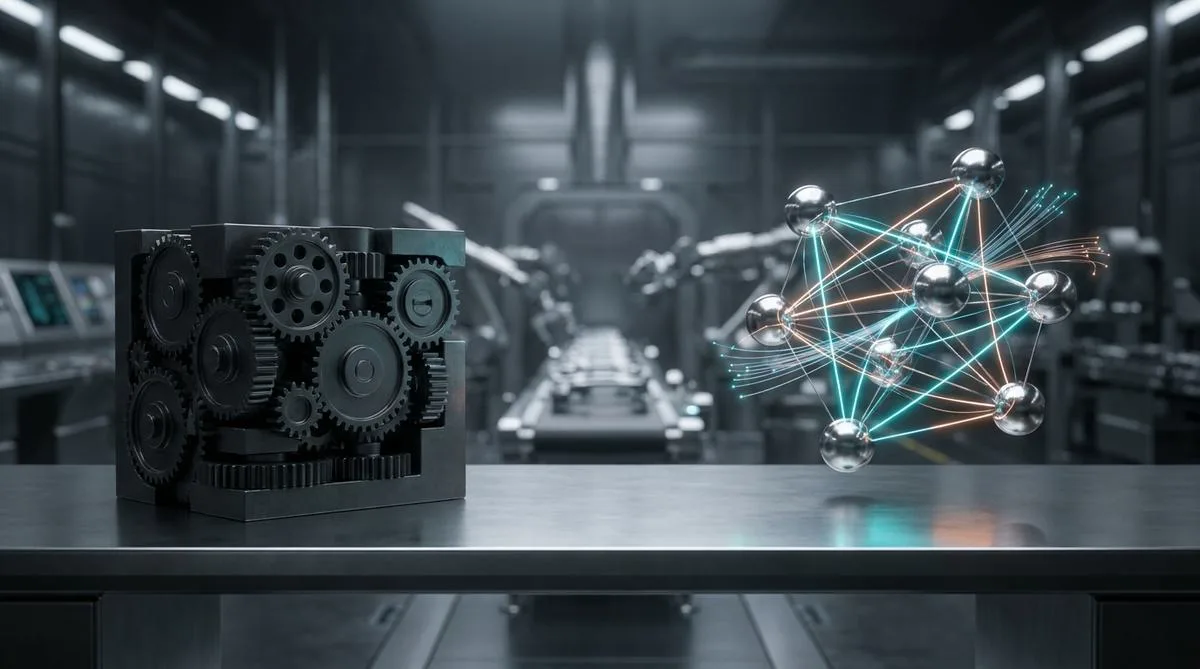
From a CFO's perspective, choosing software is above all a ruthless analysis of Total Cost of Ownership (TCO). A classic ERP system for manufacturing often turns out to be a financial trap, in which the initial implementation outlay is merely the tip of the iceberg. The traditional model for maintaining a heavily customized system generates massive, ever-growing technical debt. Who will pay for it in 2026? Unfortunately, the company's operational budget — which, instead of funding market-driven innovation, will be entirely consumed by patching an outdated architecture.
Breaking down the hidden costs of traditional software reveals a brutal truth about rigid IT solutions. First, rising licensing fees and the physical maintenance of on-premises servers place a severe burden on company finances. Second, every mandatory core system update carries a significant risk of destroying costly customizations that the organization has already paid dearly for. This forces companies to continuously maintain a dedicated team of developers, or pay expensive external consultants, simply to preserve operational continuity and prevent a business-wide standstill.
In contrast to this archaic approach stands a modern low-code platform, which offers unprecedented financial predictability in long-term budgeting. A flexible cloud model and an architecture that requires no ongoing code rewrites drastically reduce fixed maintenance costs. Advanced no-code process automation, driven by intelligent AI algorithms, empowers business analysts to independently modify workflows without engaging scarce IT resources. The hidden costs associated with endless, tedious regression testing after every minor update disappear entirely.
Operational agility and a complete absence of technical debt translate into a remarkably fast and measurable return on investment (ROI). For example, one leading electronics manufacturer, after switching to a flexible platform, achieved a full return on investment within the first year of deployment. The savings generated solely by eliminating mandatory development work were sufficient to fund the purchase of new assembly lines. Looking ahead to 2026, organizations free from the burden of technical debt will be able to reinvest their saved capital into market expansion without hindrance.
Conclusion: Make the Right Technology Decision. Build Your Advantage with AI
The rapidly approaching year 2026 represents a definitive turning point in the evolution of enterprise software. It can be stated with full confidence that this marks the end of the era of monolithic IT systems that have dictated terms to organizations for decades. The traditional ERP system for manufacturing, though it historically played its role in standardization, has today become the primary brake on innovation. The complexity of today's macroeconomic environment demands responses measured in days, not years — a reality that completely disqualifies rigid architectures.
Business decision-makers now face a fundamental choice that will determine the market position of their companies on a global scale. Clinging to outdated technology paradigms means accepting growing technical debt and a painful paralysis of IT departments. Rather than adapting unique business models to the constraints of off-the-shelf software, leaders must reach for tools that adapt to their specific DNA. Survival and growth require a radical shift in approach to digitalization strategy.
The answer to these challenges is a modern low-code platform built on business ontology. It is precisely this that enables the digital representation of a company's unique know-how without any loss of operational flexibility. Unlike classic implementations, where every change requires an army of developers, the new approach puts power in the hands of analysts and domain experts. As a result, digital transformation becomes a continuous, organic process — not a painful and risky transformational project with an uncertain end.
In this context, advanced no-code process automation becomes not merely a technological novelty, but an absolute strategic imperative. Organizations must be able to rapidly map, modify, and optimize their workflows. The use of visual interfaces and business logic that is understandable to humans permanently eliminates the communication gap between business and technology. This is the only proven path to maintaining operational continuity while continuously improving critical operational processes.
The true breakthrough that defines competitive advantage in 2026, however, is AI Agents integrated directly into the platform. Artificial intelligence is no longer merely an additional analytics module, but an active participant in decision-making processes. Autonomous Agents can analyze a company's ontology in real time, identify bottlenecks, and independently propose optimization paths. This is an unparalleled level of agility that users of classic ERP systems can only dream of.
A striking example of this phenomenon is a large automotive manufacturer that reorganized its entire supply chain in just a few weeks. Rather than waiting months for modifications to a legacy system, the company used intelligent agents to immediately redesign its logistics. As a result, business analysts independently implemented new rules, bypassing IT bottlenecks entirely and drastically reducing operational costs. Success stories like this prove that technology should serve the business — not constrain it.
The time has come to stop funding a technological museum piece and invest in solutions that genuinely build competitive advantage. The decision to abandon legacy systems is never easy, but the cost of failing to make that change will be catastrophic in the years ahead. Flexibility, speed of deployment, and deep AI-driven process insight are the foundations of a modern enterprise ready to meet the challenges of the future.
Take the first step toward an agile future
Don't let technological limitations dictate the pace of your organization's growth or hold back its potential. We invite you to get in touch for a free, substantive process audit of your enterprise. See first-hand how modern architecture and AI Agents can map, optimize, and automate your critical business processes. We will demonstrate that what takes months in a classic ERP, we can deliver in just a matter of days.


