
How to Use the Eisenhower Matrix?
How to Set Priorities in the Eisenhower Matrix?
The Most Common Mistakes When Using the Eisenhower Matrix
Is the Eisenhower Matrix for Everyone? Pros and Cons of This Method
What Is the Eisenhower Matrix?
The Eisenhower Matrix is one of the popular time and task management concepts that helps resolve issues related to priorities. It was created based on the method used by Dwight D. Eisenhower, the 34th President of the United States, as well as a general and commander of the Allied forces during World War II.
Eisenhower had to manage many tasks, each with a different level of importance and urgency. His practice of delegating and prioritizing was presented in a straightforward matrix format, which today makes it one of the most widely used task management methods in business.
The Eisenhower Matrix divides tasks into four categories, making it easy to identify which ones require immediate action and which can be postponed or handed off to other team members.
The key to this method is distinguishing between urgent and important tasks, which ultimately leads to better work organization and strategic planning. A task management system based on the Eisenhower Matrix aims to reduce chaos in daily responsibilities and focus attention on what truly matters.
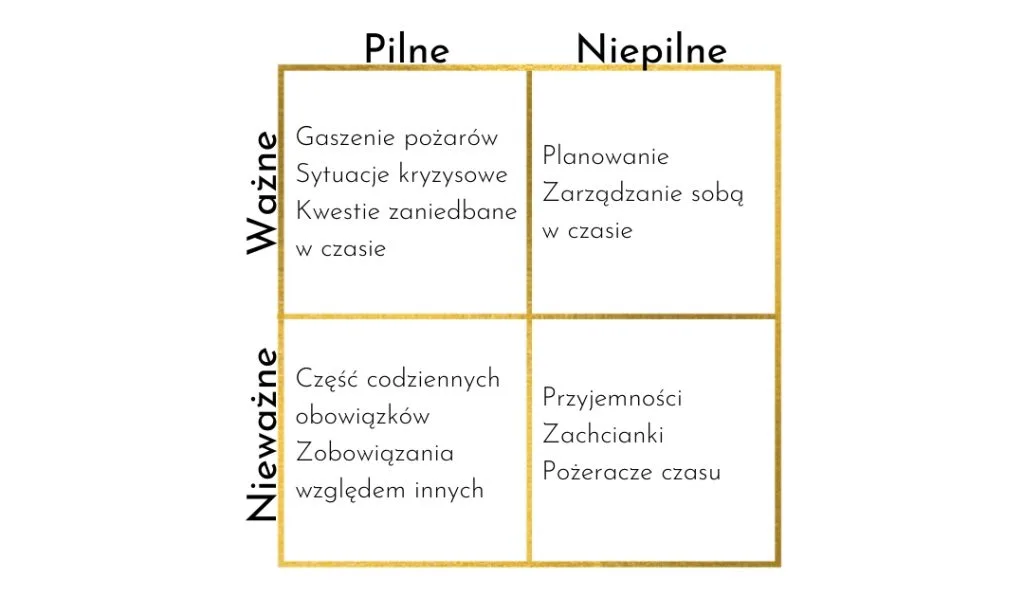
The matrix has four quadrants in which tasks can be classified according to their importance and urgency:
Quadrant I: Urgent and important – tasks to be completed immediately.
Quadrant II: Important, but not urgent – strategic tasks that can be scheduled.
- Quadrant III: Urgent, but not important – tasks that can be delegated.
Quadrant IV: Not important and not urgent – tasks to be eliminated, as they are often distractions.
The Eisenhower Matrix is a very useful tool for organizing work and managing tasks. However, to fully benefit from its advantages, it is worth understanding how to implement it correctly. Its effectiveness is based on the simplicity of setting priorities.
Step 1: Write Down All Your Tasks
Start by listing all the tasks you need to complete. This can be a list of tasks to do today, this week, or over a longer timeframe. Try to be precise – write down every task, regardless of its significance.
Step 2: Analyze Each Task in Terms of Importance and Urgency
- Now look at each task and evaluate it according to two criteria: importance and urgency. Importance relates to the task's impact on your long-term goals and the company's success. Urgency refers to deadlines and how quickly the task needs to be addressed.
Step 3: Assign Tasks to the Appropriate Matrix Quadrants
Ask yourself the following questions to properly assign tasks to the right quadrants:
Quadrant I: Urgent and important – Tasks in this quadrant require immediate action. They are critical to success and have a degree of "emergency." These may include important meetings, crises, or urgent decisions that must be made.
Quadrant II: Important, but not urgent – These are strategic tasks that are significant, but do not need to be completed right away. They should be scheduled for an appropriate time. These activities have a long-term impact on the company's development, such as project planning or strategy development.
The graphic comes from www.architekturaczasu.pl
- Quadrant III: Urgent, but not important – Typical tasks for delegation. They require quick action but have little value in the context of long-term goals. Examples include phone calls and emails that are not critical but require a response.
Quadrant IV: Not important and not urgent – Tasks or activities that are worth eliminating because they bring no value. Examples include browsing social media or performing purely recreational activities at work. These tasks should definitely be kept outside your focus.
Step 4: Act According to Your Priorities
Now that you have divided tasks across the quadrants, try to act in accordance with the priorities you have assigned.
Step 5: Be Consistent
The key to success with the Eisenhower Matrix is using it regularly and keeping your task list up to date. Review and analyze your list periodically to make sure all tasks are properly assigned and that your priorities still reflect the current situation. The Eisenhower Matrix is an effective tool that can support task management and improve productivity, but it requires consistency and regular updates.
The Eisenhower Matrix allows you to approach tasks in a more conscious and organized way, thereby helping to reduce chaos in daily responsibilities. It is also an excellent tool for optimizing business projects, as it enables ongoing problem-solving and helps you focus on what truly matters.
We have already covered what the Eisenhower Matrix is and how to use it. However, the question arises: how do you set priorities? How can you make sure that the right topics and tasks have been placed in the right positions in the matrix?
Let's apply the principle:
Four Matrix Quadrants – Four Strategies
Urgent and important – Tasks for "right now"
Something broke down in production? An important client urgently needs a problem solved? This is where you need to react immediately.
Important, but not urgent – This is the heart of smart business management
Although the pressure is not as high, this is where the most important tasks lie – those that shape the direction of your business and ensure its growth. This quadrant holds projects such as developing new products, working on long-term management strategies, or planning new business directions.
Urgent, but not important – These tasks can just as easily be done by others
For example, staffing a customer service hotline – a task that matters, but one that is perfectly suited for delegation. There will always be activities in a company that feel "urgent," even though they are not strategic – your time is too valuable to spend on actions that add little value.
Not important and not urgent – Watch out! This is the biggest "time waster."
This quadrant includes, for example, forwarding funny videos to others or spending hours checking emails for no meaningful reason. Eliminating this quadrant (or minimizing it as much as possible) is a priority.
Using the Eisenhower Matrix can be an effective tool for task management, but mistakes are easy to make and can significantly reduce the effectiveness of this method. One of the most common problems is incorrectly assigning tasks to the matrix's categories. Tasks that seem urgent are often not truly important. Conversely, strategic tasks, though less urgent, may wait too long, leading to their neglect. This is a mistake that can impact the long-term success of a company.
Another mistake is a lack of clarity in defining tasks. Without clear criteria for assessing importance and urgency, processes within a company can become chaotic and priorities poorly established. It is important to apply clear management concepts that have a real impact on the company. A good example is regularly analyzing the task management system to ensure that every assigned task delivers visible benefits.
Frequently overlooking tasks that are important but not urgent (Quadrant II) is another trap. Tasks that could develop the company in the long term or improve logistics management are often put off, while urgent but less important tasks consume the team's time. Even the best task management system will not be effective if you devote too little attention to strategic tasks.
Additionally, many people fail to build flexibility into their plans. The business world changes, so a project application or management strategy may need to be modified in response to new circumstances. Rigid competency management or excessive focus on less urgent tasks can lead to a drop in productivity.
For effective use of the Eisenhower Matrix, it is important to avoid the typical pitfalls associated with confusing urgent tasks with truly important ones. It is worth keeping in mind the role of strategic actions and introducing flexibility into the management system to respond to changes in the company's environment.
Is the Eisenhower Matrix for Everyone? Pros and Cons of This Method.
The Eisenhower Matrix is one of many time and priority management methods, but does it work for everyone?
On one hand, its simplicity and clear categories make it easy to apply in various business contexts. On the other hand, it may not meet expectations in every company, particularly those operating in exceptionally dynamic and complex environments.
It is therefore worth considering the pros and cons of this method compared to other management concepts.
Pros of the Eisenhower Matrix
The Eisenhower Matrix allows you to quickly distinguish which tasks are urgent and important and which can be put off until later. This is the primary advantage of the method, contributing to increased efficiency.
Its simplicity makes it an accessible tool for practically anyone – from beginning entrepreneurs to experienced managers. It does not require complex tools or software.
Thanks to a clear division of tasks, it helps with better time management and the elimination of distractions. It is therefore a good method if the goal is to optimize company processes and resolve daily problems.
Cons of the Eisenhower Matrix
Applying this method can be difficult in complex projects where tasks overlap between different team members.
In companies operating in dynamic environments, the matrix does not always effectively reflect the actual needs for time and resource allocation. In such cases, other management methods may be better, especially when it comes to logistics management in manufacturing or distribution companies.
Incorrectly assigning tasks to categories can introduce chaos rather than simplify matters. Particularly for those just beginning to use management methods, equating urgent tasks with truly important ones can be problematic.
Despite certain challenges, the Eisenhower Matrix is frequently chosen for its simplicity and versatility. If the user has a solid understanding of how to set priorities correctly, this tool can be extremely effective, particularly for smaller projects that require quick problem-solving. It can also be easily integrated with other management strategies to further optimize processes.


