
Introduction: Why Are You Afraid of the IT "Black Box"?
As the CEO of a manufacturing company, you are accustomed to having full control over what happens on the production floor. You understand the mechanics of your machines, you can see the flow of raw materials, and you can estimate line efficiency based on hard data. Yet when the conversation turns to digitalization, many SME leaders instinctively pull back. Why? Because IT often appears as an opaque "black box" – an area where investments disappear without any guarantee of return, and where key decisions depend on people speaking an incomprehensible jargon.
Your concern is entirely justified. For years, entrepreneurs have been told that implementing process management systems requires multi-year projects, enormous budgets, and armies of developers. You fear becoming dependent on external consulting firms that will invoice you thousands for every change made to the system. You worry about decision paralysis and about losing your greatest competitive advantage by adopting technology you don't "feel" – namely, your flexibility and speed of response to market demands.
We have good news, however: that vision is already outdated. The low-code revolution and AI-powered systems have changed the rules of the game. Technology has returned to its business roots, where what matters most is process logic, not complex source code.
Today, you don't need to know how to program a database in order to digitalize your company effectively. All you need to know is what the ideal order fulfillment or quality control process should look like. In this article, we will show you that technology has finally adapted to you – not the other way around. We will demonstrate that you can carry out a safe transformation while retaining full control and without hiring a single full-time IT specialist.
The End of the Era of Large-Scale Implementations: What Is the Low-Code Revolution?
Imagine building a new production facility. Do you start by smelting steel for the framework and assembling the machines yourself? No – you use prefabricated components and proven equipment, which you arrange into a logical production sequence. That is exactly how Low-Code technology works. It is the digital equivalent of modular furniture or LEGO bricks for business. Instead of writing thousands of lines of incomprehensible code, you assemble ready-made, tested components into a coherent whole.
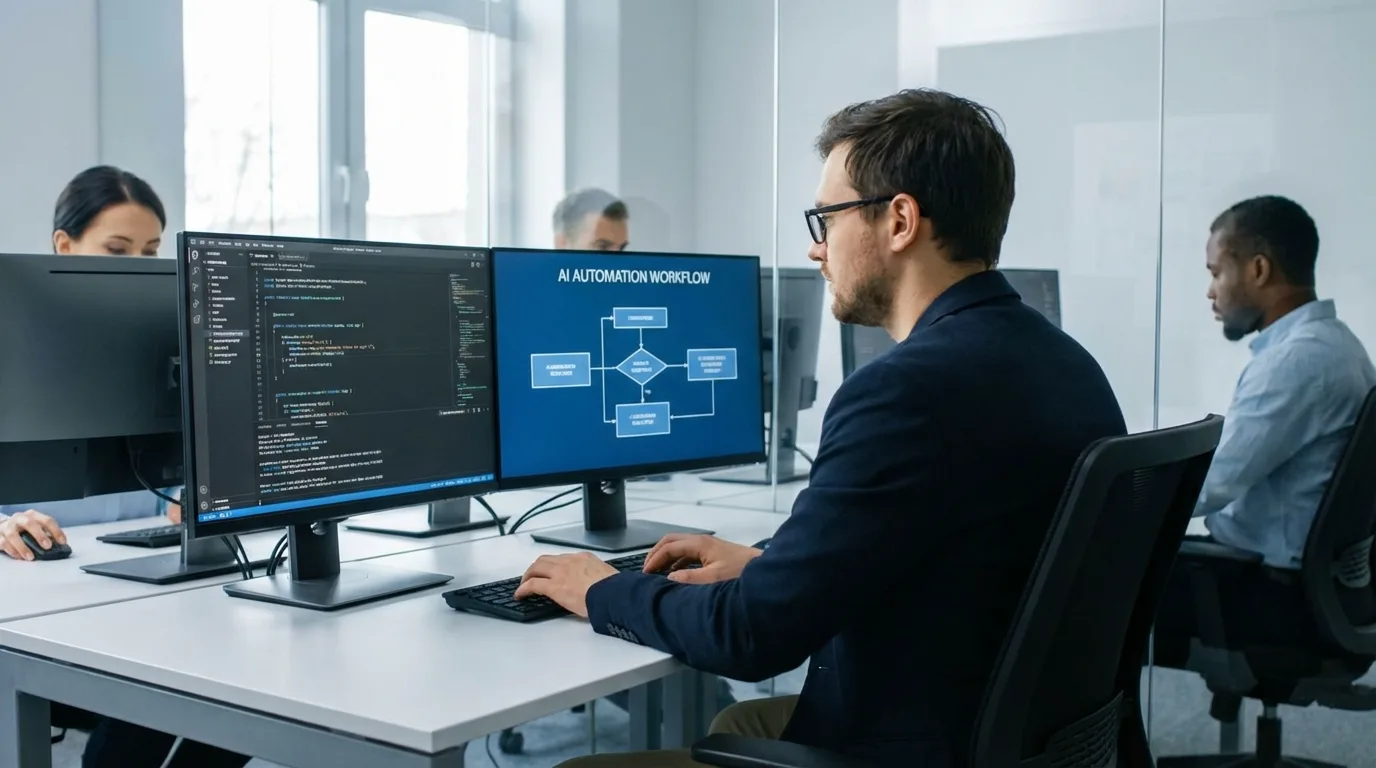
Until now, implementing an IT system was associated with laying the foundations of a skyscraper – a costly, slow, and inflexible process. Low-code platforms for operations directors, such as Process App, are transforming this paradigm. Here, building a process application is as intuitive as drawing a diagram on a whiteboard in a conference room. You see visual blocks representing "Task," "Approval," or "Send Email" and simply connect them with arrows, mapping the real workflow of your company.
The difference for your business is fundamental:
- Traditional development is a "black box" – you hand over requirements and wait months for a result that often diverges from reality. Every correction costs time and money.
- The Low-Code revolution puts power back in your hands. Changes are made via drag and drop in real time, with no need to call a developer.
For manufacturing SMEs, this is the key to independence. You don't need an extensive IT department to digitalize order processing or quality control. This technology removes the technical barrier, allowing you to focus on business logic and optimization rather than fighting with infrastructure. It is the shortest path to scalability – essential when planning expansion into foreign markets.
Artificial Intelligence as Your Personal Process Analyst
Having intuitive Low-Code tools is half the battle. The other half is knowing how to design a process that is both watertight and efficient. Many manufacturing business owners dread the moment when they sit in front of a blank screen and ask themselves: "Where do I actually begin with digitalization?" This is where the Artificial Intelligence (AI) built into Process App comes in, acting as your dedicated, always-available business analyst.
In our implementation, AI is not a marketing gimmick but a powerful engine supporting process mapping. This tool definitively eliminates the paralyzing "blank page syndrome." You don't need to be an expert in BPMN notation or spend hours designing forms. The system takes on the technical burden of building the structure, allowing you to focus exclusively on your business objectives and the specific nature of your production.
What does this look like in practice? Imagine you want to bring order to a chaotic complaints process that is holding back your expansion into Western markets. All you need to do is enter a short command: "Create a complaints handling process with quality verification and invoice correction." In just 3 minutes, Process App will generate for you:
- A logical workflow diagram that includes approval paths and escalation routes,
- Ready-made forms with all the fields needed for decision-making (e.g., defect photos, product codes),
- Automatic rules for assigning tasks to the appropriate employees.
What you receive is a solid foundation – a standardized process based on best market practices, ready to use right out of the box at 90%. Your role is limited to making adjustments specific to your company. As a result, the transformation from "firefighting mode" to a well-organized operation happens rapidly, without the need to pay for costly external audits.
Operational Independence: Process Changes Without an IT Ticket
In the traditional software implementation model, ERP systems and bespoke applications often become a "gilded cage" for the company. Every modification – even the smallest one, such as adding a new field to a goods receipt form or changing the monetary threshold for invoice approval – triggers a complicated bureaucratic machine. It requires drafting a specification, submitting a request to the IT department or an external vendor, and waiting in a queue for it to be carried out. In the dynamic world of manufacturing, this is a bottleneck that genuinely impedes business growth.
Process App completely changes these rules, placing control directly in the hands of decision-makers. Thanks to an intuitive interface, modifying a process does not require writing a single line of code. You work in drag-and-drop mode. If your new key client from France requires a scan of a specific quality certificate to be attached to every order, you don't need to call a meeting with developers. Your operations manager simply opens the process editor, adds the relevant field to the form, and clicks "Publish." The change is immediately visible to employees.
This operational independence is a critical advantage in the competition for foreign markets, where speed of adaptation to client requirements often determines whether a contract is won or lost. You eliminate the costs associated with continuous application maintenance and regain a full sense of agency. You and your management team know best what the optimal workflow should look like – the tool's only job is to enable that vision to be implemented instantly. Instead of waiting weeks for an IT ticket, you adapt your company to market realities in real time, retaining full control over your budget and change schedule.
Data Security: Why Is the Cloud Safer Than Your Own Server?
Many manufacturing business owners still hold to the principle that data is only safe when the server is physically located on company premises. This is, however, a false sense of security that, in today's business environment, is becoming the greatest threat to production continuity. Local infrastructure, often based on outdated hardware and the ad hoc efforts of a single IT person, is in reality the weakest link in your company's security chain.
Maintaining your own server carries risks that a small IT team is simply unable to fully mitigate. Disk failures, a fire in the server room, human errors when creating backups, and – above all – increasingly sophisticated ransomware attacks can paralyze your company for weeks. Process App eliminates these threats by relying on enterprise-grade cloud infrastructure. Your data is protected by teams of cybersecurity experts, multi-layered encryption, and automatic backups across geographically distributed locations.
Security in Process App also means full control over what happens within your organization. Instead of the chaotic passing around of Excel files, you gain:
- Precise access permissions: A production worker sees only what is necessary to complete their task, with no access to financial data.
- Full auditability (Audit Trail): The system records every change, indicating who made it, when, and what was modified – something impossible to achieve with traditional spreadsheets.
These features become a powerful argument in negotiations with Western partners. Counterparts from Germany or France, for whom compliance is a priority, demand process transparency. By using a certified platform, you give them a guarantee of data integrity. Instead of risking a loss of trust through amateur local security measures, you present standards that open doors to collaboration with the biggest players on the market.
Knowledge Standardization: How to Stop Being Dependent on "Irreplaceable" Employees?
The greatest silent threat to the operational stability of manufacturing SMEs is so-called tribal knowledge – a situation in which key procedures, technical nuances, or specific client requirements exist solely in the memory of a handful of long-serving employees. The departure of such a person, or an extended absence, can paralyze operations and expose the business to real losses. Digitalizing processes with a low-code platform is, in reality, a strategic transfer of know-how from human memory to the company's permanent assets.
By implementing Process App, you transform verbal handoffs and paper notes into a structured, digital workflow. The system becomes a "living manual" that guides employees step by step through every task. In this way, knowledge becomes the property of the company, not just of the individual employee.
This approach delivers immediate benefits in two key areas:
- Rapid onboarding: A new employee steps into a ready-made framework. Instead of months of training under the supervision of an experienced colleague, they receive a tool with built-in hints and instructions, enabling them to become effective almost from day one.
- Elimination of human error: The application enforces data accuracy through form validation. An employee cannot skip a critical quality control step or enter incorrect parameters, because the system will not allow it.
For the CEO, this means the end of the era of "irreplaceable" specialists who block change. You gain an organization that is resilient to staff turnover, where product quality is repeatable and guaranteed by the system – not dependent on any one person's state of mind on a given day. This is the foundation on which you can safely build your expansion into demanding foreign markets.
Hidden and Visible Costs: Investment vs. Maintaining an IT Department
Many manufacturing business owners equate digitalization with the need to build a costly IT department. This mistaken assumption is one of the main barriers holding back SME growth. In a modern business model based on low-code solutions such as Process App, technology ceases to be a capital expenditure (CapEx) and becomes a flexible operational expense (OpEx).
Hiring a team of developers is a massive fixed commitment: salaries, recruitment, hardware, and server maintenance are costs you bear regardless of market conditions. By choosing a ready-made process management platform, you pay a fraction of that amount and gain a tool ready to use right away. The financial analysis is unforgiving:
- Elimination of maintenance costs: You no longer worry about updates, server security, or your IT staff taking leave. These risks and costs are taken on by the software vendor.
- Scalable expenditure: You pay for actual usage and number of users. As your company grows and wins new markets, the system grows with you. When you need to optimize, you're not left with an oversized headcount.
It is also worth considering the opportunity cost – that is, the price you pay for the absence of digitalization. How much does a contract lost in an Excel spreadsheet cost the company? How much margin do you lose to downtime caused by a lack of information on the production floor? Traditional management methods generate hidden losses that, over the course of a year, often exceed the cost of an annual system subscription. Investing in Process App is not spending money on "technological novelties" – it is a precision tool for plugging budget leaks and recovering money that is currently draining away through inefficient procedures.
Pain-Free Integration: Connecting the New with the Old
The most common barrier to adopting modern tools in manufacturing companies is the fear of incompatibility. Will the new system "talk" to the legacy ERP the company has relied on for years? Will the accounting department be cut off from data? The answer is: your existing infrastructure is safe. Implementing Process App does not require a revolution and discarding everything you currently have – it requires an evolution based on intelligent integration.
Forget about costly, multi-month development projects creating custom bridges between systems. Modern low-code platforms use ready-made connectors and secure API protocols that operate on a plug-and-play basis. In business terms: Process App acts like a universal translator that automatically retrieves the necessary information from your warehouse, CRM, or financial systems and passes it on – without any human intervention whatsoever.
This marks the definitive end of the era of manually re-entering data from Excel into an ERP system – a process that is not only a waste of valuable working hours, but above all the primary source of costly mistakes. Thanks to the automatic flow of information, you gain:
- Elimination of data silos: Marketing, production, and finance all work from the same real-time information, preventing misunderstandings between departments.
- A single, coherent view of the company: An order enters the system, automatically reserves raw materials, and generates invoicing data – creating a unified chain of cause and effect.
The end result of this painless integration is complete managerial transparency. Instead of fragmented reports from various departments, you receive one unified management dashboard. This is your digital control panel, giving you a true picture of the company's condition at any given moment. Decisions are no longer based on intuition or spreadsheets that are a week out of date – they are grounded in hard, integrated data flowing directly from the heart of your production operation.
Case Study: From Excel Chaos to a Working App in 2 Days
To fully appreciate the potential of low-code tools, let us examine the story of a mid-sized manufacturing plant that was grappling with problems typical of many Polish SMEs. The situation before implementation resembled an operational obstacle course. Key processes relied on email exchanges, paper job cards, and manually edited spreadsheets. The absence of a central system resulted in lost orders, errors in technical specifications, and the management team constantly "firefighting." Instead of planning expansion, the CEO was spending valuable hours tracking order statuses through frantic phone calls to the production floor.
The decision to digitalize was driven by necessity, but the main obstacle was the absence of an in-house IT department. The solution turned out to be Process App. The implementation process was carried out entirely in-house, without hiring expensive external consultants or developers. The operations manager – a non-technical person – used the library of ready-made solutions and selected the "Production Order Workflow" template. In the visual builder, using drag and drop, they customized the forms to the company's unique requirements – adding fields for quality control and automatic notifications for the warehouse. The entire operation, from registration to launching a fully working application on employees' tablets, took just two working days.
The end result exceeded management's expectations. The company achieved 100% real-time status visibility. The risk of human error when re-entering data was eliminated, and order processing time was noticeably reduced thanks to the automation of routine tasks. For the CEO, this meant the end of the era of guesswork and stress. He gained access to a management dashboard that shows the truth about production performance at any given moment. This case study proves that modern technology is not a barrier but a lever – one that allows you to move from analog chaos to a scalable, digital order in just 48 hours.
Conclusion: Your Company, Your Rules, Your Technology
Many SME leaders still operate under the belief that digital transformation is the domain of large corporations with unlimited budgets and armies of developers. History shows, however, that in today's market realities it is agility and speed of adaptation – not the size of IT resources – that determine competitive advantage. Low-code tools such as Process App democratize access to technology, placing the controls in the hands of those who know the business best: yours.
As CEO, you don't need to know how to write a line of code in Python or Java. What you do need to know is what the ideal order fulfillment process should look like in your factory. Your operational knowledge is the most valuable asset, and technology is simply a tool for cataloguing, streamlining, and automating it. The Process App platform removes the burden of technical complexity from your shoulders, allowing you to focus on strategy and optimization rather than on infrastructure.
Independence from Scarce Competencies
One of the biggest brakes on growth for manufacturing companies is dependence on external IT vendors or difficulty recruiting specialists. Waiting weeks for a simple change to a reporting system or the addition of a field to an order form is a luxury you cannot afford in a dynamic environment. By implementing a Process App-class solution, you gain full operational sovereignty.
You and your managers decide when and how to modify processes. Want to introduce a new quality control procedure to meet the requirements of a demanding client from Germany? You do it in a single afternoon using the intuitive builder, with no need to send requests for proposals to software houses. That freedom translates into real savings and a lightning-fast response time to market changes.
Security Built Into the Standard
We understand your concerns. The word "experimenting" in the context of stable production can sound risky. However, modern process management systems are designed to minimize the risk of error. Thanks to built-in validation mechanisms, procedure versioning, and AI support, the system watches over the consistency of your operations. There is no room here for accidental data deletion or the chaos of permissions that so often accompanies work on shared Excel files.
The standardization you introduce becomes your digital backbone. Every employee, regardless of their tenure, operates according to the same proven workflows. It is precisely this order that gives you peace of mind and the confidence that the company runs efficiently even when you are not in the office. It is a solid foundation for audits, ISO certifications, and collaboration with major business partners.
Technology as a Lever for Expansion
Your goal is expansion into foreign markets and scaling up production. You will not achieve this by relying on the "institutional memory" of long-serving employees and paper-based document circulation. Process App is not just a tool for putting out day-to-day fires – it is a platform that grows alongside you. Standardized processes can be easily replicated across new production lines, new branches, or new sales markets.
Investing in a low-code system sends a signal to your counterparts that you are a modern, reliable partner who has a firm grip on quality and delivery times. It is a transition from a culture of "we'll manage somehow" to a culture of continuous improvement based on data. You stop guessing and start managing on the basis of facts.
Try It Before You Decide
We don't expect you to take our word for it. We know that as a pragmatic leader, you need evidence, not marketing promises. That's why, instead of pushing you toward complex blind implementations, we invite you to see how it works in practice.
We've prepared a short video that shows the app-building process from the inside — without technical jargon, in an environment any manager will understand. See how, in just a few minutes, a chaotic process can be turned into an organized workflow.
Click below to watch the builder demo, or schedule a no-obligation consultation where we'll show you how to map one of your processes in real time. See for yourself that digital transformation is simpler than you think.


