
The End of the 'Waiting for IT' Era: A New Reality for the Chief Operating Officer
Every COO knows the scenario: you identify an urgent need to optimize a process on the production floor or in logistics, you submit a request to the IT department, and you're told implementation won't happen for at least two quarters. The so-called "IT backlog" problem is today one of the biggest bottlenecks holding back business growth.
In a reality where market conditions shift rapidly, traditional, waterfall software deployment models are simply too slow. Making critical improvements dependent on the limited availability of developers generates measurable losses:
- Delayed responses to supply chain disruptions,
- Loss of competitive advantage to more agile players,
- Inability to quickly scale effective solutions.
A fundamental paradigm shift is needed. The answer to these challenges lies in low-code and no-code platforms. We define these as environments that drastically reduce the need for manual coding, replacing it with visual process modeling. This technology acts as a bridge between operational needs and technical capabilities.
With this approach, digitalization ceases to be the exclusive domain of software engineers and becomes a tool directly accessible to the business — making it easier to leverage low-code technology for managers. For the Chief Operating Officer, this means regaining full agency — the ability to implement changes and automate processes in days rather than months, without having to compete for resources in the IT department.
Why Excel and Email Are No Longer Enough: The Cost of Operational Technical Debt
For many COOs, spreadsheets and email still serve as the "digital duct tape" holding key business processes together. While Excel is an excellent tool for quick analysis, building lasting operational processes on top of it generates a dangerous form of liability: operational technical debt. The apparent savings on IT systems translate into hidden costs of operational errors that grow exponentially with the scale of the business.
The primary threat is the phenomenon known as Shadow IT. When critical data on production, inventory levels, or schedules resides in unconsolidated files on employees' local drives, the company loses control over its information. Data silos emerge, and the organization lacks a "single source of truth." As a result, reporting becomes a historical exercise rather than a tool for real-time decision-making. The COO only sees the problem when it's already too late to respond.
Another cost is the risk of human error and the lack of scalability. Manually transcribing data from emails into spreadsheets is an open invitation to mistakes that can cost a company thousands. Moreover, an Excel-based process doesn't scale — when order volumes grow by 20%, the administrative workload grows disproportionately, paralyzing the team.
Until recently, the gap between flexible-but-risky Excel and powerful-but-rigid, expensive ERP systems seemed impossible to bridge. This is where low-code technology comes in. It fills that space, offering deployment speed comparable to building a spreadsheet while providing the security, data centralization, and automation characteristic of professional IT systems. This marks the end of the era in which professional digitalization was too expensive for supporting processes.
Low-Code + AI: How Artificial Intelligence Accelerates Process Development
The combination of low-code platforms with generative artificial intelligence (GenAI) represents a turning point in operations digitalization. Previously, these platforms still required an understanding of programming logic — even if in visual form. Today, that barrier is disappearing, and the COO's role is shifting from "coding" to strategic business process modeling.
In this new model, AI acts like a skilled analyst and on-demand developer. Instead of manually designing every element of an application, the user describes their goal in natural language — for example: "I need a quality control app for an assembly line that automatically puts a batch on hold after the third failed result and sends an alert to the supervisor." Based on this, AI-powered low-code systems can instantly:
- Generate an intuitive interface tailored to the tablets used on the production floor,
- Create the complete database structure needed to capture relevant parameters,
- Propose an optimal workflow, identifying potential logic gaps that a human might overlook.
A key advantage is also AI's ability to solve integration challenges that have historically paralyzed operational initiatives. In many companies, critical data is locked in legacy systems that lack documentation or a modern API. AI engines can analyze the schemas of these systems and suggest ready-made connectors, allowing new applications to securely "communicate" with legacy software without the need for a costly overhaul of the entire IT infrastructure.
This is true democratization of technology, enabling putting technology in the hands of business leaders. Artificial intelligence acts as a translator, converting the language of business benefits and operational efficiency into working, secure code. As a result, operations teams gain full independence. They can create, test, and modify advanced business logic at the pace the market demands — bypassing the months-long IT backlog entirely.
Citizen Developers on the Production Floor: Use Cases
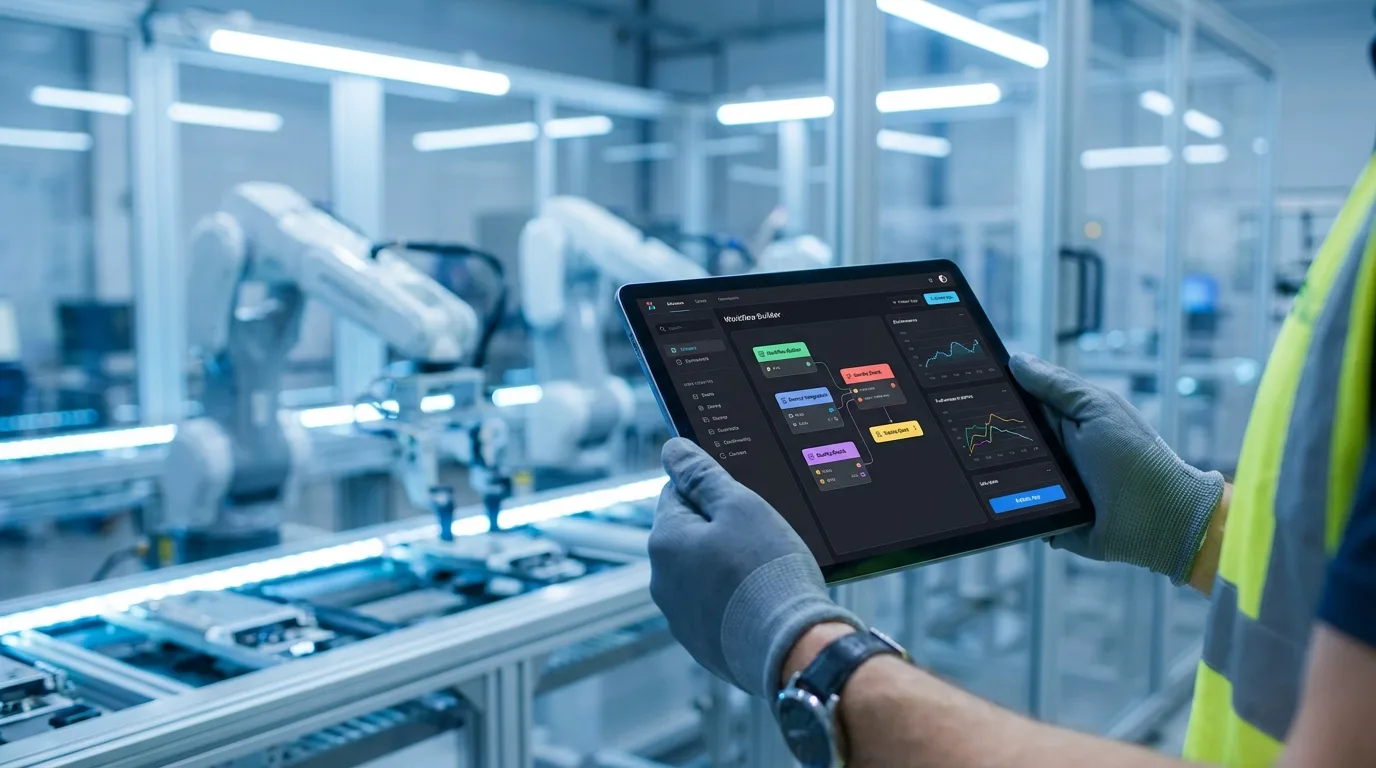
The theory of technology democratization sounds promising, but the true value of low-code only becomes apparent when it meets the realities of the production floor. When process engineers and shift managers become solution builders — so-called Citizen Developers — innovation ceases to be a months-long IT project and becomes part of everyday operational improvement (Kaizen). Where does this technology perform best?
- Digitizing quality control and health & safety audits: This is the most common "quick win." Replacing paper inspection sheets with a tablet-based app eliminates the need to transcribe data and removes the risk of errors. A quality control worker can photograph a defect, which is immediately logged in the database, and the system automatically generates a trend report for the production manager. For safety audits, geolocation and timestamps guarantee that the inspection actually took place.
- "CMMS Light" maintenance management: Full CMMS systems can be overly complex for smaller production cells. With low-code, when an operator notices a fault, they scan the QR code affixed to the machine. The app automatically identifies the equipment and allows the operator to report the breakdown to technicians with a single tap — bypassing bureaucracy and phone calls. This shortens response time (MTTR) and builds a failure history without expensive licensing fees.
- Exception management in the supply chain: ERP systems handle standard processes well but are rigid when it comes to anomalies. Low-code applications fill this gap perfectly, managing non-standard returns, urgent warehouse transfers, or claims for damaged raw material batches — processes that previously "lived" in emails and spreadsheets.
- Onboarding operational staff: With high turnover in production environments, fast onboarding is critical. Simple instructional apps guide a new employee step by step through their workstation, verifying knowledge of procedures before granting access to machinery.
All of these scenarios share one thing in common: they were deployed in days, not quarters, by the people who know the specifics of each process best. This is precisely where the competitive advantage lies — in operational agility that no off-the-shelf system can deliver.
From Idea to Deployment in 5 Days: A New Process Lifecycle
In the traditional waterfall model, digitalizing a new operational process resembled constructing a new facility: months spent writing specifications, followed by a lengthy coding phase, acceptance testing, and finally deployment. It often turned out that after half a year, the finished solution no longer matched the dynamically changing market conditions or the needs of the team. Low-code platforms radically compress this cycle, turning quarters into single days and enabling lightning-fast responses to market changes.
Instead of rigid planning and "set-in-stone" schedules, we move to rapid prototyping and iteration. The new process lifecycle in a low-code environment looks like this:
- Days 1–2: Process mapping and building a working prototype (MVP) using visual tools.
- Day 3: Testing with end users directly on the production line or in the warehouse (a Gemba Walk with a tablet).
- Days 4–5: Implementing immediate changes based on operator feedback and final production deployment.
This operational agility is critical for modern management. In a low-code environment, modifying a process does not require halting production or scheduling complex maintenance windows. If an operator reports that an extra verification step is unnecessary and is slowing down packaging, the change can be made, tested, and published within a single work shift. This eliminates employee frustration and prevents technical debt from accumulating before it even has a chance to form.
From a financial perspective, this approach means a dramatic reduction in total cost of ownership (TCO). We eliminate hundreds of hours of expensive developer time in favor of configuring ready-made, secure modules. However, the most important shift occurs in the management structure. The COO stops being a passive requester waiting in the IT queue. They become the chief architect of change — someone who, knowing the business inside and out, defines the logic of applications and reclaims full control over process efficiency, without needing a computer science degree.
Security and Corporate Governance: How to Stay in Control
In the traditional IT world, the phrase "business builds applications" often raises legitimate concerns about the emergence of so-called Shadow IT — an uncontrolled ecosystem of solutions that threaten data security. Paradoxically, deploying a professional low-code platform is the best way to eliminate this phenomenon. After all, we are replacing hundreds of unsecured spreadsheets circulating as email attachments with a single, centrally managed environment.
The key to success is a new model of collaboration between IT and Operations, known as IT Governance. In this arrangement, the IT department ceases to be a bottleneck that processes every request and instead becomes the guardian of standards. It provides the infrastructure, defines security policies, and oversees integrations, while operational teams (Citizen Developers) build business logic within predefined guardrails. This is "controlled freedom" — reconciling seemingly opposing forces: the speed of business with the stability of technology.
Modern low-code platforms offer enterprise-grade security, addressing key risks:
- Access management (RBAC): Precise definition of roles and permissions. A shift manager sees the full performance report, while a line worker sees only their own task panel — all integrated with the company's single sign-on (SSO) system.
- Elimination of data fragmentation: Rather than creating information silos, low-code applications draw from a shared database. Data entered in the warehouse is immediately visible to production planning, providing a "single source of truth" across the organization.
- Scalability: A solution piloted in one factory can be rolled out to additional locations with a single click, maintaining consistency of operational standards across the entire group.
With this approach, the COO gains the tools to optimize rapidly without exposing the company to the risk of data breaches or IT paralysis. This marks the end of the era of "guerrilla operations" on spreadsheets.
Summary: Competitive Advantage Through Operational Agility
Implementing low-code platforms in an operational environment is not merely a technological change — it is a fundamental shift in the management paradigm. For today's COO, who faces daily pressure from rising costs and market volatility, these tools are becoming a strategic asset. We are moving from a model in which business processes were "locked" in the rigid code of ERP systems to an era in which operations are fluid, modifiable, and — most importantly — fully controlled by the business.
Summarizing the benefits of this transformation, it is worth examining four key pillars that build real competitive advantage:
- Speed (Time-to-market): Reducing the change implementation cycle from months to days. Responses to new regulations or customer requirements are immediate.
- Cost: Optimizing IT budgets by freeing developers from routine tasks and reducing the hidden costs arising from errors in manual processes.
- Flexibility: The ability to iteratively refine processes (Agile methodology) without the need for costly renegotiation of software vendor contracts.
- Control: Full transparency of operations and the recovery of ownership over data that was previously scattered across unmanageable spreadsheets.
Companies that choose not to democratize process creation risk developing an "agility gap." At the moment when competitors are automating new procedures in a single afternoon, organizations that rely exclusively on traditional IT departments will spend weeks on requirements analysis alone. In today's economy, speed of adaptation is the new currency, and technological sluggishness is a business risk no COO should accept.
The Future Is Data- and AI-Driven Operations
Looking ahead, low-code platforms are an essential foundation for implementing advanced artificial intelligence. AI cannot learn to optimize based on paper forms or files sitting on employees' local desktops. Digitalizing processes with low-code creates structured datasets that can, in a subsequent step, feed machine learning algorithms. This opens the door to predictive maintenance, automated production scheduling, and intelligent supply chain management.
For this reason, rather than waiting for the perfect moment, it is worth taking action now. I encourage you to audit the single most burdensome process in your company — it might be invoice routing, fault reporting, or onboarding a production employee. Piloting a low-code platform on that one slice of reality will allow you to tangibly verify the promise of "agility without an army of developers." The low-code revolution is not a matter of "whether," but "when." For operational leaders who want to stay ahead of the market, the answer is: today.


