
Introduction: A Culture Clash — Why "We'll Figure It Out" Doesn't Work in the West
Many CEOs of Polish manufacturing companies hit a surprising wall. Your product is excellent quality, your price is competitive, and your samples passed laboratory tests with flying colors. Yet after initial enthusiasm, contact with a German counterpart goes silent or negotiations reach a dead end. Why? Because in the DACH markets (Germany, Austria, Switzerland), a low price and a good product are merely the price of admission — not a guarantee of success. What we in Poland often consider our greatest strength — flexibility and the ability to improvise in crisis situations — is, for a Western business partner, frequently a red flag of the highest order.
There is a widespread myth that product quality will speak for itself, regardless of the process infrastructure behind it. This is a dangerous illusion. For a large corporation based in Munich or Stuttgart, your company becomes a link in their precision supply chain. They expect not only that you deliver the goods, but that you do so in a predictable, repeatable manner and in accordance with procedures that are resilient to staff turnover and unexpected events. The Polish "we'll figure it out" philosophy — fighting fires through the heroic efforts of the team — stands in complete contradiction to the German love of Ordnung: order and risk minimization.
The key difference lies in the approach to operational risk. The Polish entrepreneur often builds an advantage on speed of response: "Call us and we'll sort it out." The German manager prefers to hear: "We have a procedure for that; the system automatically detects deviations and corrects the process." Operational chaos eating into margins, which in smaller companies is masked by the owner's personal involvement and hands-on management, comes to light immediately during an audit. A lack of standardized workflows, scattered documentation, or tribal knowledge stored in the heads of long-serving employees is a red flag for any foreign auditor.
If your company's processes are not transparent and documented, the counterpart assumes that the high quality of your products is the result of chance rather than a system. And you cannot build a stable international business on chance. To become a partner for Western giants, you must prove that you have mastered your own chaos — transforming it into measurable, controllable processes.
What Does a German Auditor Actually Look For? The Anatomy of Business Trust
When a representative of a German corporation steps onto your production floor, they are not simply looking for a modern machine park. Their primary objective is to verify operational stability. For a Western partner, business trust is not built on a handshake or declarations of years of experience, but on hard evidence demonstrating that you are in control of every stage of production.
The key concept that determines the outcome of an audit is traceability. The auditor will ask a simple but brutal question: "Can you reconstruct the full production history of this specific batch of goods within 15 minutes?" If the answer requires rummaging through binders, searching through emails, or relying on the shift manager's memory, the company loses credibility. Partners from DACH markets expect immediate visibility into who did what, when, using which materials, and at what parameters.
The second pillar of trust is repeatability independent of the human factor. The counterpart must be confident that success is not the result of chance or the talent of one "irreplaceable" employee who may leave tomorrow. Auditors look for evidence that quality is generated by the system and standardized procedures — not by improvisation. Operational transparency and the ability to demonstrate that processes are error-proof are, for a foreign investor, a guarantee of supply chain security.
No Digital Footprint: Why Paper and Email Are Not Enough for Modern Industry
Many Polish entrepreneurs still believe that a sophisticated spreadsheet and efficient email exchange constitute an adequate standard for production management. However, when confronted with mature Western markets, such an approach is treated not as "tradition" but as a critical operational risk. For a German or French counterpart, the absence of a digital process footprint is tantamount to a lack of control over the business.
The fundamental problem with analog management is the absence of a so-called "Single Source of Truth." When key decisions are lost in multi-threaded email conversations and production statuses are scattered across employees' local drives, the company loses its ability to respond quickly. A Western partner expects progress reporting in near real time. If preparing a quality report takes you two days because it requires manually transcribing data from paper work cards into the system, you are sending a clear signal: your organization is not scalable.
Moreover, relying on "paperwork" and team memory poses an enormous threat in the face of staff turnover. In modern industry, knowledge must be a company asset — not the private property of a specialist.
- Risk of knowledge loss: The departure of a key process engineer must not be allowed to paralyze the production line or reset quality standards.
- Communication errors: Working from an outdated version of a file called "final_v2.xlsx" is one of the most common causes of costly complaints and export rejections.
Process digitalization is therefore no longer a technological matter — it has become a sine qua non condition for business security, facilitating compliance with quality standards required by foreign partners. A foreign partner must see that your procedures are durable, auditable, and independent of whoever happens to be on shift that day.
Traceability: How Full Process Traceability Protects Against Contractual Penalties
Entering the German market comes with rigorous contracts in which penalties for delays or quality defects are the norm, not the exception. In this context, traceability is no longer technological jargon — it becomes a genuine insurance policy for your company. Process applications create a kind of "digital passport" for each order, automatically recording every step of production without the involvement of spreadsheets.
When a problem arises with a batch of goods, response time is critical. Thanks to digital process mapping, the system enables the immediate identification of the error's source. Instead of shutting down the entire line and looking for someone to blame, a few clicks reveal whether the fault lay with a specific employee, an uncalibrated machine, or a defective batch of raw material from a supplier. This precision enables surgical corrective action rather than the costly recall of an entire shipment.
A complete process history is also the most effective shield against unjustified complaints. In B2B relationships, disputes frequently arise — did the damage occur at the factory or during logistics? By possessing an irrefutable digital audit log confirming that every control procedure was carried out correctly — which in practice means leaving a digital trail in the documentation — you have hard evidence at your disposal.
Implementing Process App standards builds the image of a professional partner with nothing to hide. For a German counterpart, access to well-organized historical data is proof that your company has moved beyond "firefighting" and now operates at the level of predictable, European-grade quality. It is precisely this transparency that often determines winning a contract over cheaper but riskier competition.
Change and Incident Management: A Test of Organizational Maturity
In relationships with demanding partners from the DACH region, production incidents are inevitable. The true test of your company's maturity, however, is not the absence of problems but the way you respond to them. Is it chaotic "firefighting," where the CEO must personally intervene and manage the crisis hands-on — or a standardized procedure that activates automatically?
Traditional emergency management, based on verbal instructions and frantic email exchanges, leads to decision paralysis in stressful situations. A sudden change in order specifications within a disorganized structure creates the risk that critical information will not reach the production floor in time, resulting in an entire run of costly defects. It is precisely in these moments that the delays most frequently arise — delays that undermine an exporter's credibility.
Implementing process applications (Process App) eliminates these risks by replacing chaos with precise, digital escalation paths. Thanks to AI support and the low-code automation underpinning the agile bridge strategy in export, you gain:
- Automated deviation notifications: The system immediately detects anomalies (e.g., machine downtime) and alerts the relevant teams before the problem escalates into a crisis.
- Instant response to changes: An order update from a counterpart is automatically propagated to all departments, systemically requiring confirmation that the new version of the documentation has been reviewed.
- Elimination of decision-making bottlenecks: In an emergency, the employee receives a clear, system-generated instruction on how to proceed — without having to wait for a manager to become available.
For management, this means an end to micromanaging every incident. Instead of spending time operationally fighting fires, you gain confidence that your organization has its own "immune system." For a German counterpart, this level of process control is proof that you are capable of managing risk systematically — a key argument when negotiating long-term contracts.
Scalability Without the Pain: Proof That You Can Handle Larger Orders
The greatest concern of a large German counterpart when working with a Polish SME is rarely price — it is more often the stability of supply when order volumes spike. Foreign partners know all too well that manual production management, which works well for small batches, collapses under the weight of large-scale operations. This is why process chaos is the silent killer of many potential export contracts.
Using a low-code platform for process management becomes your hard proof that the company is ready for expansion. When procedures are embedded in an application rather than in the heads of veteran production staff, the company gains the ability to scale its human resources rapidly. A new employee does not need months to learn the trade — they are given access to Process App, which guides them step by step through their tasks, like a GPS navigation system, eliminating the risk of beginner errors.
Digital standardization provides a competitive edge in three key areas:
- Rapid employee onboarding: Thanks to clear in-app instructions, bringing an additional production shift up to speed takes days rather than weeks — guaranteeing on-time delivery even during sudden order peaks.
- Real-time performance monitoring: AI-supported systems immediately identify bottlenecks before they cause delays, enabling proactive reallocation of resources.
- Operational flexibility: Clear task assignments within the system allow employees to seamlessly cover each other's responsibilities, making production continuity independent of any particular individual's presence.
For a foreign investor, this operational model signals that your company has a "digital backbone" capable of bearing the weight of success. It is proof that scaling does not mean chaos for you — simply a greater number of repeatable, perfectly controlled operations.
Regulatory Compliance in Practice, Not Just on Paper
Having an ISO certificate framed on the wall of your office is one thing; having it genuinely reflected in day-to-day work on the production floor is an entirely different challenge. Counterparts from Germany and France are alert to procedural façades — they know that "paper accepts everything" and that employees under time pressure often look for shortcuts. That is why the key to earning their trust and entering the supply chains of large corporations is not another stamp of approval, but proof that standards are an integral part of operations — not merely a theory gathering dust in a binder.
Implementing Process App shifts the quality management paradigm from "trust and verify" to "systemic enforcement of correctness" (process enforcement). The application leaves no room for discretion or errors caused by inattention. If a procedure requires verifying a parameter or performing a visual inspection, the system will technically block any attempt to proceed to the next stage without completing that action. The procedure thus becomes a digital guardian, present at every job order, guaranteeing:
- Impossibility of skipping critical steps: The employee must enter specific data, attach a verification photo, or obtain digital approval in order to advance the process — eliminating errors caused by haste.
- Automatic generation of audit documentation: The system creates a complete, tamper-proof event history in the background (who did what, and when), which is invaluable and saves hundreds of hours during client audits.
- Full legal and operational certainty: In the event of a complaint or dispute, management has real-time hard data proving that due diligence was exercised at every stage of production.
For the CEO of a manufacturing company, this means an end to the fear of an unannounced client visit. Instead of frantically completing paperwork at the last minute, you can proudly demonstrate a system that guarantees compliance automatically. This is the strongest sales argument in Western markets — you show that your quality is repeatable, measurable, and entirely independent of any given employee's mood on any given day.
Data Integration: How to Become Part of Your Client's Ecosystem
Modern export is not merely the physical transportation of goods across a border — it is, above all, the flawless flow of information. For a German counterpart accustomed to a high standard of technical culture, a supplier operating on Excel files and email exchanges becomes a "digital island" that is difficult to manage. To join the ranks of key partners for large retail networks or manufacturing plants, your company must become a compatible element of their supply chain management (SCM).
This is where a modern approach to processes plays a critical role. Process App, thanks to its flexible architecture and ease of integration, acts as a universal adapter between your company and the advanced ERP systems of Western clients. Instead of engaging an army of developers to build dedicated bridges, you leverage ready-made mechanisms for the secure exchange of data. This is a fundamental shift in B2B relationships, delivering immediate benefits:
- Elimination of manual order transcription: Automation ensures that data from an order in the German system flows directly to your production line, completely removing the risk of typos or specification errors.
- Rapid adaptation to client requirements: Regardless of whether the counterpart requires status reporting in a specific data format, Process App allows the information structure to be adjusted without touching the source code.
- Reduction of errors at system interfaces: A consistent data ecosystem ensures that both parties see the same fulfillment status, building trust and eliminating unnecessary explanatory correspondence.
Through such integration, you cease to be merely an external supplier who can easily be replaced by a cheaper competitor. You become an integral part of the client's ecosystem — a "plug-and-play" partner with whom collaboration is smooth, secure, and low-maintenance.
Culture of Continuous Improvement: Showing That Your Company Is Growing
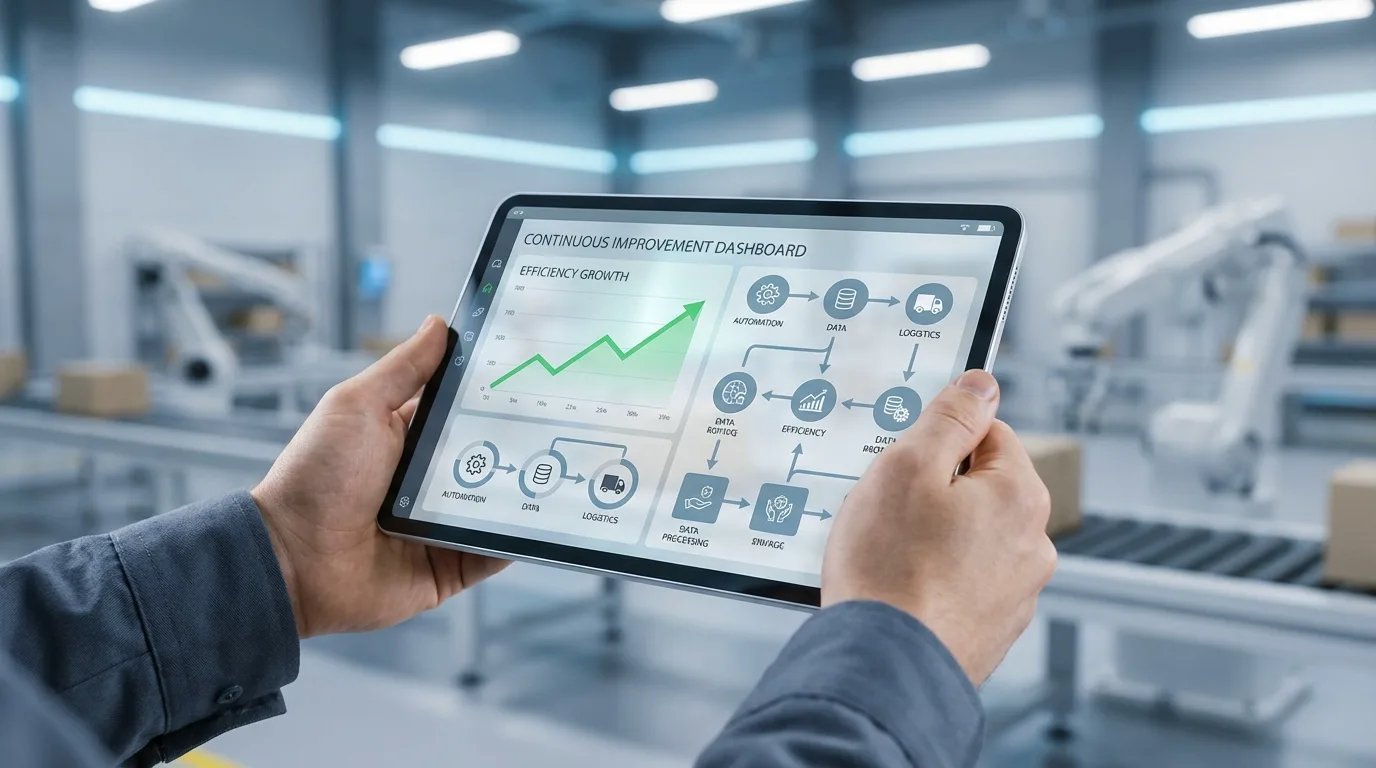
Counterparts from the DACH market (Germany, Austria, Switzerland) value not only the quality of the product being delivered today, but also the supplier's future potential and organizational maturity. They expect an approach aligned with the Kaizen philosophy — a constant pursuit of excellence. For a German partner, a static process is a process that is, in reality, moving backwards. To retain a contract, you must demonstrate that your company is systematically eliminating waste and optimizing costs.
In this regard, Process App becomes a powerful analytical tool. The system not only ensures that procedures are followed — thanks to built-in artificial intelligence (AI) mechanisms, it actively monitors every workflow. The algorithms automatically identify bottlenecks, redundant steps, and recurring delays, delivering ready-made improvement suggestions before the problem becomes visible to the client.
Leveraging this data makes it possible to build an entirely new quality of business relationship:
- Proactive identification of areas for improvement: The system indicates where cycle time can be shortened or resource consumption reduced, enabling continuous margin improvement without raising prices.
- Transparent reporting of efficiency gains: During negotiations, you can present hard data: "Through process optimization, we reduced lead time by 15% in the last quarter" — a statement that carries enormous authority.
- Building a partnership based on shared goals: You demonstrate that you are not merely an order fulfiller, but a partner who takes care of the security and efficiency of the client's entire value chain.
Implementing a culture of continuous improvement — supported by hard data from a process application — sends a signal to foreign counterparts that your company is a modern, stable, and growth-oriented organization: exactly the kind of partner Germany wants to work with for years to come.
Information Security: A Frequently Overlooked Aspect in SMEs
When entering Western markets, particularly Germany, many SME CEOs focus exclusively on product quality, forgetting an aspect that is critical for large corporations: data security. In an era of rigorous GDPR regulations and trade secret protection, sending sensitive specifications as email attachments or storing counterpart data in local spreadsheets is a red flag for a foreign auditor. Such disorder in information management often disqualifies a supplier before price negotiations even begin.
Implementing Process App eliminates this risk by replacing inconsistent communication methods with a secure, centralized ecosystem. The protection of intellectual property — both your own know-how and projects entrusted by the client — ceases to be an empty declaration and becomes a verifiable technological standard. The system allows for precise definition of who has access to which resources and to what extent.
The key functionalities that build trust in the eyes of corporate partners are:
- Granular permission controls: A production floor employee is granted access only to the work instructions they need, with no visibility into the commercial terms of the contract or the full client database.
- Full auditability (activity logs): The system records every user action — from viewing a document to editing it. This allows you to demonstrate full process transparency during a security audit.
- Protection against data leaks: Centralizing processes prevents the creation of unauthorized copies of files on employees' personal drives or USB sticks.
Data security within Process App should be treated as a significant element of the commercial offering. By guaranteeing a German counterpart that their procedures and secrets are protected systemically, you gain an advantage over competitors who still rely on risky, manual file-sharing methods.
Case Study: From Local Workshop to Certified Tier-2 Supplier
Theory is one thing, but how does process digitalization translate into real contracts? Let us look at the example of a Polish manufacturer of metal components that found itself with the opportunity to enter the supply chain of a German automotive group. Despite the excellent quality of its products, the company struggled with a problem typical of many SMEs: dependence on "tribal knowledge." Key procedures existed only in the heads of production foremen, and documentation was scattered across hundreds of Excel files and handwritten notes.
The prospect of a preliminary audit had paralyzed the management board. The German contractor demanded not just a product, but proof of process repeatability. Implementing Process App became a turning point. Instead of building a dedicated IT department, the company used the low-code platform to rapidly map its operations. In just four weeks:
- Quality control cards were digitized: Paper forms were replaced by a tablet application, eliminating data transcription errors.
- Workstation instructions were standardized: With AI support, clear procedures were created instantly and made available to every employee in the latest version.
- Automated escalation paths were implemented: The system automatically notified managers of deviations, demonstrating full process control to the auditors.
The result? During the site visit, auditors were impressed by the operational transparency that is rarely seen among smaller suppliers. Audit duration was reduced by nearly 40%, as all data was available on demand. The company not only passed the verification successfully, achieving Tier-2 supplier status, but also negotiated more favorable payment terms by demonstrating its organizational maturity. This is proof that well-ordered processes are the strongest argument in negotiations with a Western partner.
Process App as Your Ace in the Hole During Negotiations
In negotiations with contractors from the DACH market (Germany, Austria, Switzerland), operational flexibility is often more important than a marginally lower price. Western partners expect suppliers to quickly adapt to their rigorous reporting standards or specific packaging procedures. Traditional IT systems become a bottleneck here — every change requires developer intervention, which takes weeks. Process App transforms this paradigm, becoming your key sales argument.
Thanks to low-code technology supported by artificial intelligence, adapting a process to meet a client's unique requirements is no longer a technical problem — it becomes a straightforward business decision. You no longer have to say: "I'll check with IT and get back to you in a month." Instead, you can demonstrate your readiness to implement a new procedure almost immediately. This drastically shortens the Time-to-market for new contracts and builds your image as a modern, digital organization.
Using Process App in negotiations gives you three strategic advantages:
- Speed of adaptation: You can rapidly create dedicated document routing or quality control workflows tailored precisely to the specifications of a given order.
- Independence from IT resources: Your operational managers can adjust workflows themselves, eliminating external costs and delays.
- Guaranteed transparency: You show your partner that their order will be fulfilled in a standardized, digitally monitored environment — which for them is synonymous with security.
Having a tool of Process App's caliber sends a clear signal to a foreign investor: this company does not operate on chaos and chance, but has a scalable management system ready to handle large order volumes.
Conclusion: Don't Let Disorder Hold Back Your Expansion
The decision to enter foreign markets — especially ones as demanding as Germany or France — is one of the most significant moments in your company's history. You already have a product that stands on its own quality. You have a vision for growth and the determination to break free from dependence on local customers. Yet one crucial piece of the puzzle is often missing: the confidence that your organization can bear the weight of its own success. The process chaos that can still be managed on the domestic market through employee dedication and manual firefighting becomes an insurmountable barrier when confronted with German Ordnung.
You must recognize that for a contractor from the DACH region, the way you fulfill an order is just as important as the product itself. Your credibility rests not only on certificates hanging in frames on the wall, but on everyday operational reality. Can you reconstruct the production history of every batch within 15 minutes? Are your procedures resilient to employee turnover? Do you know the status of every order without having to call the production floor? If the answer to any of these questions is "no" or "it depends," you risk not only losing a contract, but also damaging a reputation that will be very difficult to rebuild.
An Investment in Credibility That Pays Back in Hard Currency
Bringing your processes into order with tools like Process App is not a bureaucratic whim or a cost to be borne "for peace of mind." It is a strategic investment that translates directly into financial results. Every error eliminated through automatic data validation, every hour saved on manually transcribing orders, and every complaint avoided through rigorous quality control procedures represents real money staying in your company. Moreover, it is capital of trust that you build in the eyes of Western partners.
Think of it this way: your processes are your business card. When you show a foreign auditor or procurement director that you have a digital, transparent operations management system, you send a clear message. You are saying: "We are predictable. We are reliable. We are ready to scale." It is precisely this argument that often tips the scales of negotiation in your favor, allowing you to compete not on the lowest price, but on the highest organizational culture.
Technology That Doesn't Require an Army of IT Specialists
Many CEOs of manufacturing SMEs are wary of digitalization, associating it with months-long implementations, dependency on external IT firms, and costs running into hundreds of thousands. That thinking is outdated. The era of low-code and artificial intelligence, represented by Process App, puts control back in your hands. You don't need an IT department to create standards. All you need is knowledge of how your company should operate — technology will take care of the rest.
With AI support, you can transform your current — often unwritten — rules into structured, digital workflows in just a matter of days. You and your managers decide what the processes look like, and the system flexibly adapts to them. The era of "the system won't allow it" is over. Now the system supports your business rather than constraining it. This agility is critical during expansion, where contractor requirements can change from contract to contract.
Take the First Step Toward DACH Markets
Don't let fear of technology or the habit of "the old ways" block your growth. The world is moving forward fast, and the competition — including from Poland — is increasingly turning to automation and standardization tools. To win in Western markets, you need to play by their rules, and one of the most important is full transparency and process repeatability.
You now know that chaos is your enemy. You also know that technology today is simpler and more accessible than ever. But where do you start? What specific procedures must you implement to meet the demanding standards of German or French corporations? You don't have to guess or learn from your own costly mistakes.
We have prepared a comprehensive knowledge resource to help you assess your company's readiness for expansion. This is not a theoretical manual, but a practical checklist based on real requirements that Western corporations place on their suppliers.
Download the Free Guide and Check Your Readiness
This is the moment to move from deliberation to action. Before you invest in expensive marketing campaigns in Germany or send sales representatives to trade fairs in Munich, make sure your "back office" is ready for it. Download our exclusive resource "DACH Market Process Requirements: A Checklist for Polish Manufacturers" and discover:
- What reporting standards are the absolute minimum for German contractors?
- How to document quality control processes to pass an audit without objections?
- How does the digitalization of document workflows affect the assessment of cooperation risk?
- What are the most common process mistakes that disqualify Polish suppliers right from the start?
Click below, download the guide, and gain the confidence that your company is ready to conquer new markets. Get your processes in order today, so tomorrow you can count your profits in euros.
[DOWNLOAD THE GUIDE: DACH MARKET PROCESS REQUIREMENTS]


