Choosing ERP for Manufacturing 2026: 5 Audit Questions
Shop floor reality diverging from your spreadsheets, and your implementation hanging by a thread? Ask these 5 questions to ERP vendors before you sign a contract and sink your budget.
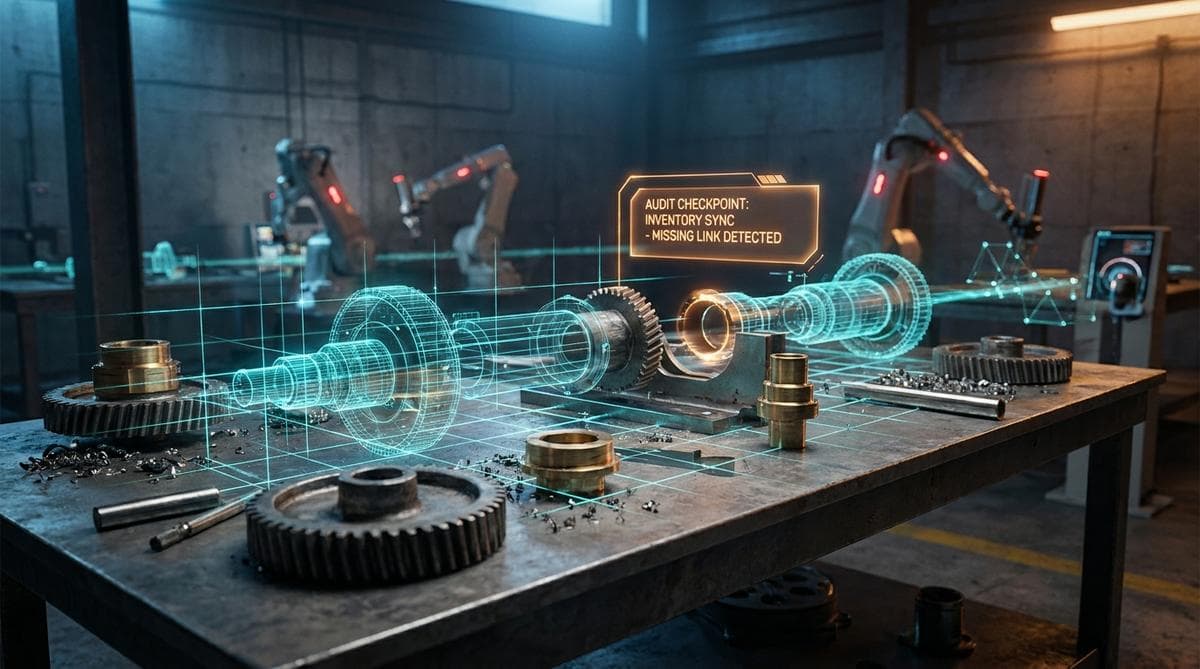
The Sales Demo Trap: Why ERP Implementations Fail in SMEs?
Many CEOs of manufacturing companies know this scenario all too well. During a professionally staged sales demo, the software looks flawless. A single click generates a routing sheet, inventory levels update in a fraction of a second, and profitability charts impress with their clarity. The problem is that sales presentations are built on ideal processes – laboratory conditions that simply do not exist in the reality of Polish SMEs.
When a generic system collides with the specifics of one-off or small-batch production, operational debt surfaces immediately. Instead of the promised automation, real barriers emerge:
- The illusion of standard modules: Rigid templates force unnatural simplifications in production routing, which in the case of custom products leads to scheduling paralysis.
- Hidden operational costs: When the interface proves too complex, shop floor supervisors revert to paper notebooks, resulting in double data entry and information chaos at the shop floor–office interface.
- Silent team resistance: An implementation imposed from above, without accounting for the daily habits of production workers, breeds immediate resentment and a drop in efficiency.
By 2026, the approach to digitalization has undergone a fundamental shift. The era of monolithic, lumbering behemoths requiring months-long adaptations costing hundreds of thousands is gone for good. Modern IT architecture favors agile ecosystems in which flexible tools integrate directly with the specifics of machines and people. True implementation success depends not on the number of features on a slide, but on a rigorous pre-decision audit. Before you sign a contract, you must confront the vendor's promises with the most challenging process exceptions on your shop floor.
Question 1: How Does the System Architecture Handle Dynamic Changes to BOMs and Routings?
In an engineer-to-order (ETO) and small-batch production environment, the product structure is a living organism. Traditional ERP-class systems were designed on the rigid assumption that the routing defined at the quoting stage remains unchanged through to the final settlement of the order. On today's shop floor, that assumption immediately leads to operational paralysis.
The Difference Between a Commercial BOM and a Manufacturing BOM
The key to maintaining profitability is understanding the fundamental difference between a Sales BOM and a Manufacturing BOM. The sales version describes the product in terms of cost estimation and customer declarations, whereas the manufacturing version must dynamically reflect shop floor realities:
- On-the-fly modifications: When a base raw material fails to arrive on time, the process engineer must introduce a substitute without having to reset the entire order and cancel previously generated production travellers.
- Routing corrections: A sudden breakdown of a critical CNC machining centre requires the immediate rerouting of operations to an alternative work cell or an external subcontractor, with automatic recalculation of overheads and labour rates.
- Accurate actual cost settlement: Every component or routing change must immediately update the cost of production, preventing a situation where accounting settles the order against fictitious theoretical rates.
The Live Test: Verifying the Vendor in Workshops
When a system lacks built-in flexibility, planners immediately revert to parallel spreadsheets, and the ERP becomes nothing more than an expensive graveyard of historical data. To avoid this, do not ask the sales representative whether the software supports substitutes – the answer will always be yes.
During technical workshops, ask the vendor to perform a live test: in a running, partially reported order, have them swap a key semi-finished component for an alternative and reassign it to a different work centre. If that operation requires closing the order, several minutes of manual recalculation, or the involvement of a programmer, you already know that this system will paralyse your engineering staff.
Question 2: How Does the System Capture Hard Data from Machines and Work Centres (MES/IoT)?
One of the most common reasons for the gap between the KPIs on management dashboards and shop floor reality is the so-called post-factum reporting syndrome. In the traditional model, operators enter completed operations into job cards or consolidated worksheets at the end of a shift. In practice, this means a planner makes decisions based on data that is eight hours old, while information about downtime, micro-stoppages, and quality defects is often smoothed over or omitted. In the reality of 2026, effective ERP–production integration requires eliminating paper-based workflows and switching to real-time hard data.
The End of Paper-Based Workflows: A Native Reporting Layer
A modern manufacturing ERP system cannot be a passive recorder of invoices and orders. It must communicate directly with the shop floor through intuitive touch panels at work centres and IoT sensors. To ensure the implementation does not trigger a workforce revolt, the operator reporting interface must be reduced to a maximum of two clicks or the scanning of barcodes and RFID tags. Only then can you be confident that an order's status reflects the actual stage of part machining, rather than a wishful declaration from a shop floor supervisor.
Practical Vendor Check: Communication Standards and API
When a vendor claims full integration with your machine fleet, verify the technical foundations of that promise. Instead of paying hundreds of thousands for bespoke, proprietary connectors, demand support for open industrial standards:
- IoT protocol support: Check whether the platform communicates natively via OPC UA, MQTT, or directly with PLC controllers from major manufacturers.
- REST API transparency: Ensure the API documentation is fully public and allows your team or independent integrators to exchange data bidirectionally without additional licensing fees.
- Data bridge maintenance costs: Ask directly how much it will cost to connect a new, non-standard work centre in two years' time when you expand your machine fleet.
The absence of a transparent and flexible API dramatically increases the total ERP implementation cost, turning a promised technological leap into a costly vendor lock-in trap.
Question 3: How Does the Algorithm Balance Safety Stock Against Actual Lead Times and Reservations?
One of the most common causes of financial paralysis in manufacturing companies is poor inventory management. The traditional approach relies on a simple mechanism: when stock levels fall below a defined threshold, the system generates a purchase notification. In the reality of 2026, such a static alert is a straightforward path to operational disaster – it leads either to a dangerous freeze of working capital tied up in excess inventory, or to a sudden stoppage of assembly work centres due to the absence of a minor component.
Static Threshold vs. Multi-Dimensional MRP Balancing
A modern manufacturing ERP system cannot treat inventory levels in isolation from order dynamics. Enterprise-class software for the SME sector must execute advanced material requirements planning (MRP), simultaneously accounting for:
- Dynamic supplier lead times: The algorithm should calculate delivery times not on the basis of catalogue declarations, but based on the historical on-time delivery performance of a given supplier and current fluctuations in logistics chains.
- Hard and soft reservations: Physically available stock is not the same as free-to-use inventory. The system must reliably block raw materials against in-progress orders, planned production runs, and quotations with a high probability of being won.
- Multi-level BOM dependencies: The calculation of semi-finished goods requirements must dynamically trigger production and purchase orders with a precisely synchronised timeline.
Live Test: A Critical Raw Material Delay Scenario
When evaluating a proposal, ask the vendor to run a specific live simulation. Suppose a key steel supplier notifies you of a two-week transport delay, while three parallel production orders with different margin priorities are queued.
Ask the sales representative a simple question: Does the system automatically identify which orders are directly at risk and recalculate an alternative schedule, or does it force the planner to manually trawl through tables in search of conflicts?
If the procurement module cannot automatically reconcile the delay against safety buffers and reservations, it lacks a real analytical engine. Such superficial digitalization merely shifts chaos from paper to expensive software.

Question 4: What Is the True TCO – Including Customisations, Maintenance, and Internal Development?
For management and the CFO, the initial licence and implementation quote is merely the tip of the iceberg. The Total Cost of Ownership (TCO) over a 5-year horizon can easily be three times the figure in the original integrator's proposal. The main sources of budget drain rarely stem from the software installation itself. They typically lie in a rigid licensing model, unforeseen technical support fees, and an endless cycle of process modifications.
The Named User Licence Trap vs. the Reality of Shift Work
Many vendors push a named user licensing model. In a production facility operating a three-shift system, this means purchasing a separate access licence for every lathe operator or assembly worker, even if they report operations for just 15 minutes a day. In a plant employing 150 production workers, subscription costs grow rapidly. Before signing any contract, verify the availability of:
- Concurrent licences or dedicated reporting kiosks billed per workstation rather than per employee.
- Hidden volume thresholds: Clauses that tie fee levels to the number of orders processed, database records, or warehouse documents generated.
- Annual maintenance fees: Update costs that typically consume between 18% and 22% of the initial licence value each year.
Why Minor Customisations Consume 80% of the Post-Implementation Budget?
The real threat to financial liquidity is vendor lock-in. When every report modification, adding a field to a routing, or changing a validation rule at a quality control gate requires paid involvement from the integrator's developers, hourly rates immediately escalate. Market experience shows that as much as 80% of post-implementation expenditure goes on minor changes driven by market demands.
Protect the company's interests at the contract negotiation stage: include an SLA clause in the agreement guaranteeing a maximum cap on hourly rate increases (e.g., tied to the inflation index) for a minimum period of 36 months.
An architectural alternative for 2026 is modular low-code/no-code platforms, which allow an internal engineering team to configure forms, statuses, and automations without writing a single line of code.
Question 5: What Does the Operational Adoption Path Look Like – from Pilot Implementation to Full Autonomy?
Even the best-configured technology platform will prove useless if the workforce rejects the new tool within the first week after go-live. In the reality of a manufacturing plant operating on tight margins and rigorous delivery deadlines, the moment of switching to a new system carries significant operational risk. Before you sign the contract, you must establish precisely with the vendor how they intend to guide the factory through the critical transformation period without paralysing ongoing finished goods shipments.
The Big Bang Strategy Trap vs. a Process Pilot
Many implementation consultants still promote the Big Bang approach – simultaneously switching off the old spreadsheets and launching the complete system across the entire company on the first day of a given month. For an SME manufacturing company, this is Russian roulette. A minor error in a BOM structure or a delay in registering a raw material batch in the warehouse is enough to bring an entire line to a standstill for dozens of hours, generating painful contractual penalties.
A safe SME ERP implementation in 2026 should be based on an iterative model:
- Pilot implementation (Proof of Concept): Launching the full data flow exclusively on a single critical work centre or production department. This allows the interfaces and operator ergonomics to be tested in a live environment.
- Procedure calibration: Identifying bottlenecks in communication between the warehouse and the production line before scaling the system to other areas.
- Phased migration: Adding further departments only once the pilot process has achieved full operational stability.
Knowledge Transfer and Independence from External Consultants
True digital business process transformation is complete only when the organisation achieves internal autonomy. Ask the vendor for a formalised knowledge transfer plan for your key users. Your process engineer, planner, and maintenance manager must be able to independently modify routings, diagnose reporting errors, and train new operators without having to commission expensive post-implementation support hours.
The ERP Selection Decision Matrix: How to Translate Vendor Responses into Hard Metrics?
Choosing an enterprise management system too often resembles a marketing popularity contest. A sales representative's slick presentation and smooth assurances of seamless integration can lull even the most experienced management team into a false sense of security. To ensure that an ERP implementation in an SME does not become a months-long budgetary nightmare, subjective impressions must be replaced with rigorous mathematics. The tool that protects the capital of a manufacturing company is a formalised, scored vendor evaluation matrix.
Criterion Weightings: Process Flexibility vs. Vendor Stability
When constructing the audit framework, management must assign precise percentage weightings to individual areas, reflecting the real operational risks. A common mistake is placing excessive focus solely on the integrator's financial health at the expense of the software architecture itself. A balanced matrix for the Polish manufacturing sector should place emphasis on:
- Process modelling flexibility (weight 35%): The system's ability to represent non-standard routings, multi-machine work centres, and dynamic engineering changes without the need to write bespoke code.
- Architecture openness and API (weight 25%): The ease with which ERP–production integration with CNC machines or external WMS systems can be carried out in the future.
- Industry experience and integrator stability (weight 20%): The number of documented implementations in a comparable production profile and the partner's financial standing.
- Actual TCO (weight 20%): The five-year total of licensing, implementation, and post-implementation expenditure.
The "Show, Don't Tell" Principle – Testing in a Live Environment
The fundamental rule of a mature technology audit is the absolute rejection of generic demonstration presentations. Instead of watching prepared slides, provide vendors with anonymised but authentic data from your plant: a complex BOM structure, an order involving external subcontracting, and a sudden priority change at a machining work centre.
If an integrator cannot replicate your real process in a test environment within 48 hours and demands a letter of intent in exchange, treat that as a red flag.
Effective digital business process transformation requires hard evidence of the planning engine's capabilities. To help the project team conduct an objective analysis, we have prepared a practical audit worksheet ready for immediate use.
Download the supporting resource: "The 5-Question Matrix Before Choosing an ERP for Manufacturing — a Vendor Evaluation and Process Audit Worksheet" and protect your profitability before signing any binding agreements.
The Decision That Will Protect Your Margin for Years: How to Start the Process Without Risk?
Choosing and implementing an ERP-class system in 2026 is one of the most critical strategic decisions facing the management of a manufacturing company. What is at stake is not merely the purchase of modern software or the digitalization of documentation, but above all long-term financial liquidity, operational predictability, and supply chain resilience in the face of market fluctuations. When the system functions correctly, the factory becomes a synchronised mechanism in which every production order is precisely costed, inventory levels reflect the actual state in real time, and the profitability of individual product lines is no longer a matter of guesswork.
Why Automating Chaos Only Produces Faster Chaos?
Many managers succumb to the temptation of treating technology as a universal remedy for organisational problems. This is a fundamental cognitive error that leads to catastrophic financial consequences. If internal production routings are inconsistent, BOM structures are incomplete, and responsibility for shortfalls is unclear, then transferring these problems into a sophisticated IT tool will produce only one outcome: significantly faster and more expensive error generation on a massive scale.
This was learned the hard way by a Polish steel structure manufacturer that decided to purchase a costly Western ERP system without first putting its warehouse management in order. As a result, the system generated production orders for materials that were physically out of stock, causing assembly paralysis and contractual penalties amounting to millions. True digital business process transformation does not begin with server installation, but with eliminating bottlenecks, standardising reporting practices, and simplifying shop floor procedures.
An Independent Process Audit: Your Insurance Policy
Before management commits to a multi-year contract with an integrator, a thorough, impartial pre-implementation analysis is essential. Software vendor sales representatives will always assure you that their platform addresses every challenge specific to your plant. An independent audit is designed to rigorously verify those promises against your real operational processes.
A professional diagnostic allows you to answer the following questions precisely:
- In which areas of the plant will digitalization deliver an immediate return on investment (ROI), and which procedures first require organisational simplification?
- Which machine and system integrations are critical to maintaining continuous production reporting and avoiding manual data re-entry?
- Do the organisational culture and competencies of middle management allow for smooth adoption of new tools without the risk of passive resistance?
Signing an implementation contract without a prior process maturity audit is like building a skyscraper on unprepared ground. The cost of fixing the foundations mid-construction will far exceed any initial savings.
Secure Your Factory's Profitability – Take the First Step Without Risk
You do not need to make binding investment decisions based solely on intuition or sales presentations. Effective implementation requires a methodical approach that prioritises protecting your margin and ensuring continuity of order fulfilment.
Find out where to begin the transformation in your company. Request a free digitalization diagnostic: https://processapp.pl/diagnoza-cyfryzacji. Our experts will analyse the key touchpoints in your business and identify real areas for optimisation. Only in the next step, with a complete picture of your organisational readiness, should you explore the available tooling capabilities and schedule a dedicated demo (https://processapp.pl/demo), tailored precisely to the specifics of your production environment.


