
Optimizing Services with Artificial Intelligence

Are you an entrepreneur in the services sector? Have you ever wondered whether the current obstacles in your company could be solved with modern technologies? Artificial intelligence may be the key to opening new doors in your organization. Discover how AI can impact the optimization of your services, even before you decide to make any changes.
How to start using AI in services?
Examples of AI applications in service companies
What are the real pros and cons of using AI in services?
How to convince employees to use AI?
Examples of AI tools in services
Artificial intelligence is making major inroads across various sectors of the economy, including the service sector. It is worth leveraging its capabilities to improve the functioning of your organization. Making the most of its potential requires the right steps and preparation.
The first step is to thoroughly understand what AI actually is and how it applies in the context of your company. To this end, it is worth conducting an analysis of your company's needs and requirements.
Key questions include: What problems can be solved with artificial intelligence? and Which processes can be optimized?
Next, you should focus on identifying the right tools that may be useful in your company. It is worth starting with small pilot projects before implementing larger, more complex systems. This way, you can minimize risk and gradually introduce the necessary changes. Testing and adaptation are key elements of this process.
Equally important is understanding and analyzing the data that will form the foundation for an effective AI implementation. Digitizing your company's data is a fundamental step in this process. You need to be sure that you have the appropriate IT infrastructure and that your data is well organized and easy to analyze.
Furthermore, defining key performance indicators (KPIs) will help you track the quality of the implemented solutions.
Taking all of the above steps into account, engaging the right specialists is also essential. Both experts in business management and those responsible for day-to-day operations should be involved in the AI implementation process. Otherwise, the implementation may encounter numerous difficulties.
Finally, it is worth remembering to train your employees. Even the best technologies can prove insufficient without a properly trained workforce.
Introducing artificial intelligence technologies into service companies may seem like a demanding task. However, understanding exactly how these technologies can be applied allows you to see the benefits of artificial intelligence. Examples of AI use in services show that it is worth investing in this area of business management.
Service personalization – Online stores use AI to analyze customer behavior. AI helps create product suggestions tailored individually to each person's needs. This increases sales and leaves customers more satisfied with the services.
Customer service automation – Artificial intelligence also finds application in customer service. AI bots capable of answering frequently asked questions are a perfect example of AI use in the service sector. They reduce response waiting times and improve the quality of customer service.
Optimization of operational processes – Service companies also use AI to optimize their operational processes. Examples include logistics systems that, with the help of AI, can plan deliveries. This reduces costs and order fulfillment times, which directly translates into customer satisfaction.
Data management – Effective data management is important in the service sector. AI technologies enable the analysis of large datasets, which facilitates strategic decision-making. Companies can thereby better understand market trends and customer needs.
Fraud detection – In industries such as finance and insurance, using AI for fraud detection has become the norm. Artificial intelligence analyzes transaction patterns to detect anomalies and potential fraud. Companies can thus significantly reduce the risk of financial losses.
Artificial intelligence in services offers a wide range of possibilities. Automation, personalization, and operational efficiency are just some of them. According to predictions, business management using AI will become the standard. Implementing these technologies may be crucial to the future of your company.
The use of artificial intelligence in services brings many benefits, but also certain challenges worth considering before implementation.
Pros of using AI in services
Automation of routine tasks – An AI application can automate repetitive processes, significantly increasing operational efficiency. This allows employees to focus on more valuable tasks.
Service personalization – The use of AI enables customer data analysis, allowing for better tailoring of offers and services to individual needs. For example, AI-powered chatbots can provide personalized customer service 24/7.
Cost reduction – Digitizing business management processes using AI can lead to significant savings. Automating administrative tasks speeds up company operations and reduces the number of errors.
Cons of using AI in services
Implementation costs – The initial investments associated with implementing AI can be high. We emphasize… they can be, but don't have to be. Depending on the chosen solution, costs will vary. It is therefore worth considering different proposals and carefully verifying which one is most optimal for your business.
Less flexibility in unforeseen situations – Although an AI application is excellent at performing routine tasks, it may not be able to handle sudden, atypical problems requiring human intuition and experience. Again, everything depends on the chosen solution and the scale of implementation.
Employee hesitation – One of the biggest challenges is convincing employees to use new technology. People are often wary of new solutions and unsure whether they will be able to cope in new circumstances. For this reason, it is worth investing in training and educating teams about what AI actually is.
Ethical issues and privacy – The use of artificial intelligence involves collecting and analyzing large amounts of personal data. Ensuring an appropriate level of privacy and data security is crucial to avoid legal and ethical problems.
Making the decision to implement artificial intelligence in services is a step that requires careful consideration of the pros and cons. AI can transform business management, improving efficiency and reducing costs. However, ethical issues and potential implementation challenges must not be overlooked. It is certainly worth observing how other companies successfully use AI in order to draw lessons for your own organization.
Introducing technology such as artificial intelligence (AI) can raise concerns among employees. So how do you convince your team that implementing AI is a step in the right direction?
Below we present several tried-and-tested methods:
Education and transparency – A key step is educating employees about AI. Inform them of how AI works, what the applications of artificial intelligence are, and show them real-world examples. Transparent communication builds trust and reduces concerns. Tell employees that AI is designed to support their work, not replace it.
Training and workshops – Organizing regular training sessions and workshops that demonstrate specific AI applications in everyday tasks is essential. This way, employees will gain the skills they need to use new technologies effectively. It is also a good opportunity to answer questions and dispel any doubts.
Highlighting the benefits of artificial intelligence – Explain what benefits AI brings to the team and to individuals. Talk about increased productivity, the reduction of monotonous tasks, better company management, and improved customer service. By highlighting these benefits of artificial intelligence, it will be easier to convince employees to embrace it.
Engaging leaders and technology ambassadors – Identify people in the organization who have a positive attitude toward technology. Help them become AI ambassadors. Opinion leaders can influence the rest of the team by sharing their positive experiences and demonstrating real successes resulting from the use of AI.
Small steps and quick wins – Introduce AI gradually to allow employees to adapt and see the first results. Show quick wins—rapid and visible benefits from using AI. Presenting such tangible results can significantly boost the team's motivation.
Open communication channels – Maintaining open communication channels between management and employees is extremely important. This way, questions can be answered promptly, concerns can be addressed, and suggestions can be acted upon.
In today's dynamic world, the use of artificial intelligence is gaining ever-greater importance across various service sectors. AI-based tools have the potential to tremendously streamline the operations of many companies.
Let us take a look at a few of them and see how they can transform business management and improve the quality of services offered.
Data Analysis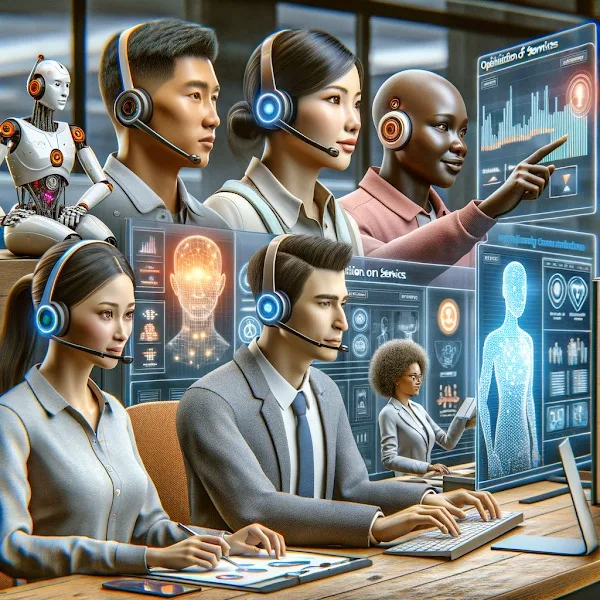
One of the most valuable applications of AI is data analysis. AI applications can process enormous amounts of data, identifying patterns and drawing valuable conclusions.
Thanks to this, companies can:
Optimize operational processes – E.g., predicting demand for products or services.
Personalize their offering – Tailoring services to individual customer needs.
Make better business decisions – Based on predictive analyses.
Chatbots
Chatbots are another tool that leverages artificial intelligence. They are particularly useful in business management, especially in customer service.
Chatbots can:
Automate responses to routine inquiries – Relieving human staff of everyday tasks.
Serve customers – Raising the level of customer satisfaction and loyalty.
Collect feedback and suggestions – Enabling continuous service improvement.
Interestingly, chatbots successfully imitate human language, making interactions more natural. Do you think your customers would be satisfied with this form of communication?
Recommendation Systems
Recommendation systems are tools that can significantly improve the customer experience by suggesting appropriate products or services. Their applications are wide-ranging:
Improving sales – Recommending products based on a customer's previous purchases.
Better resource management – Suggesting more efficient methods of resource use.
Increasing customer engagement – More personalized offers.
Marketing Automation

Marketing automation also plays a key role. AI tools can automate marketing campaigns, which allows for:
Better ad targeting – More precise reach to the right audience groups.
Marketing budget optimization – More efficient use of resources.
Monitoring and analysis of results – Continuous improvement of marketing strategy. Thanks to AI, marketing becomes more effective and less time-consuming.
Sentiment Analysis
The last, but no less important, tool is sentiment analysis. AI applications can process comments, reviews, and social media posts, enabling companies to:
Monitor public opinion – Better understanding of customer needs.
Respond quickly to negative feedback – Improving the company's reputation.
Adjust their offering – More precise implementation of changes to the offer.
Artificial intelligence offers a wide spectrum of tools that can significantly improve service quality across many industries. From data analysis, through chatbots and recommendation systems, to marketing automation and sentiment analysis—the possibilities are virtually limitless. It is worth investing in these technologies to increase the competitiveness and efficiency of your company.


