
Document Management: From Paper to Digitalization

Is your company struggling with challenges related to traditional document management? Storing and managing paper-based documentation can be time-consuming and error-prone. Digitizing this process offers the opportunity to increase efficiency and accuracy in day-to-day operations. Let's take a closer look at how transitioning from paper to digital documentation can change your organization for the better.
-
What challenges does traditional document management pose?2. Why is digitizing document management crucial?3. A guide to successful digitalization of company documentation
-
Pitfalls of digitalizing document management
What challenges does traditional document management pose?
Traditional paper-based document management in companies comes with numerous challenges.
Managing paper documentation is time-consuming – Manually searching through physical archives requires unnecessary hours of work. A paper archive demands actual physical effort, for example when reorganization or relocation is necessary.
Paper documentation means limited access to information – With traditional documents, access is restricted. Whenever specific data needs to be reviewed, the physical document must be made available. This is only possible on-site, in a given location, unlike a digital archive.
Paper documents are vulnerable to damage, such as water damage, fire, or fading – Of course, digital data also carries risks of damage; however, backup copies can be created quickly and easily in case of issues with the original files. With paper documentation, creating each additional backup copy entails additional costs (every copy means expenses for both materials and storage).
Traditional document management requires greater financial investment – It demands ongoing investment in office supplies and storage space.
Traditional document management can also negatively affect internal collaboration within the company – Documents must be physically delivered between departments, which delays the flow of information, hinders swift decision-making, and increases the likelihood of documents being lost or damaged.
In the context of document management, digitalization does not solve all problems; however, it represents an important step toward increasing the efficiency of business processes. Let's therefore explore how technology can change the way a company manages its documents, transitioning from a standard, traditional paper-based flow to modern, digital information management.
Why is digitizing document management crucial?
Digitizing document management is a key change that can radically improve the way information is managed within a company.
Why? Let's take a look at the main aspects below.
Introducing digital document management significantly reduces the time needed to transmit and process information – In traditional workflows, employees often have to search through physical archives, which is time-consuming and can lead to errors. Technology, on the other hand, enables near-instant access to the required data. As a result, processes become smoother and more efficient.
Digitizing document management also increases accuracy – Users can easily update data, which reduces the number of errors. Electronic documents can also be automatically verified for compliance with defined standards. This minimizes the risk of irregularities occurring. Additionally, digitalization enables greater process transparency, which in turn allows for better quality control of tasks performed.
Introducing digital document management also has an impact on the security of company data – Documents in electronic form can be protected by numerous security mechanisms, including encryption, permission systems, and backups. This ensures that only authorized individuals have access to them, minimizing the risk of misuse. In this way, a company can effectively protect its assets and customer data.
Cost savings resulting from moving away from paper documentation – Companies that transition to digital document management save on paper, ink, and physical document storage. Over the long term, these savings can be significant and can be reinvested in other areas of the business.
In summary, digitizing document management is not only beneficial but also necessary in today's dynamic business world. It increases the speed and accuracy of processes, improves data security, and delivers measurable cost savings. It enables companies to compete more effectively in the market. As such, investing in technology becomes a strategic decision.
A guide to successful digitalization of company documentation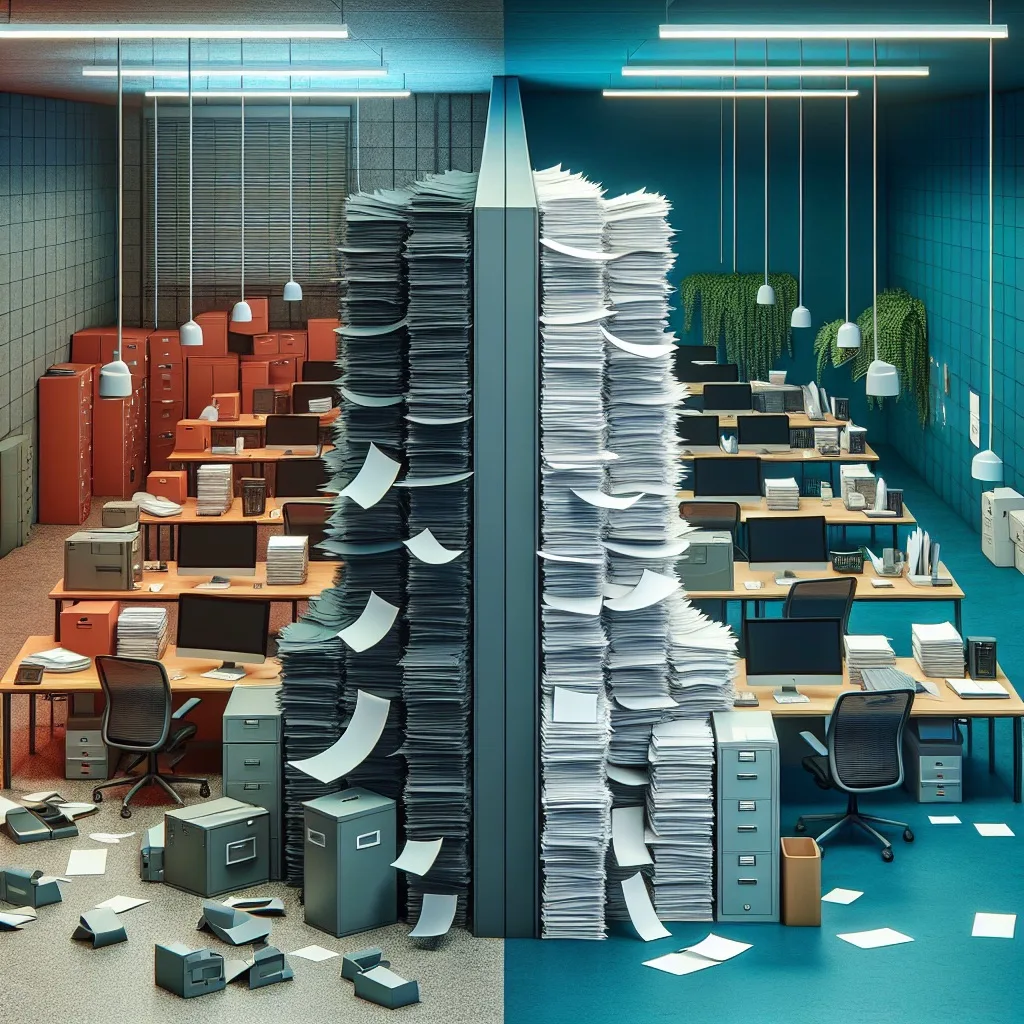
Digitalizing company documentation is a step that can revolutionize the way business processes are organized. To carry out this process effectively, it must be approached systematically.
First, it is worth identifying all stages of the document workflow that can be optimized. This allows the company to see exactly which areas of its processes are most in need of improvement. It is also essential to define the goals the organization aims to achieve through digitalization.
The next step is selecting the right technological tools to support the digitalization process. The tool must meet the company's requirements in terms of functionality and usability. It is important that these solutions are flexible and scalable, allowing them to be adapted to the organization's future needs.
Next, the implementation process should be planned carefully to avoid disruptions to the company's daily operations.
Another key element is training employees so that they have a thorough understanding of the new systems and procedures. Without this, even the best tools will not be used effectively. It is worth prioritizing collaboration and regular communication with the team, which will ensure a smooth transition to digital document management. Employees should be able to obtain technical support quickly whenever needed.
A crucial aspect is also monitoring progress and regularly evaluating whether the changes being implemented are delivering the expected benefits. This allows strategies to be adjusted on an ongoing basis and further improvements to be introduced. Periodic reviews also make it possible to identify problems at an early stage.
Pitfalls of digitalizing document management
Although digitalizing document management brings a range of benefits, the implementation process may encounter certain challenges along the way.
The first of these is over-complicating the system. Selecting complex technological solutions that are not tailored to the company's actual needs can lead to employee frustration and wasted time. It is important that solutions are intuitive and easy to use.
The second pitfall is insufficient team training. Without adequate knowledge of the new systems and procedures, employees may struggle to use them effectively. This leads to a drop in efficiency, despite the available technology. It is worth remembering that deploying new tools without support and training is quite a risky decision.
Another aspect is the challenge of integrating existing systems. Companies using various tools may encounter difficulties connecting them. A lack of cohesion can result in data loss or unclear processes. Consequently, this can have a negative impact on the smooth running of the company.
Security considerations must not be overlooked either. While digitalization enhances data protection, inadequate safeguards can lead to information leaks. It is essential to maintain regular updates and apply the latest data protection solutions.
A key element is understanding the various potential risks involved. Proper preparation and a clear understanding of the technology implementation process can significantly mitigate these risks. It is worth remembering that maintaining security throughout the entire process is a priority for every company. We encourage you to consider a range of tools in order to maximize the benefits of the process.


