
Introduction: The Illusion of Control in the Paper-Based World of B2B Operations
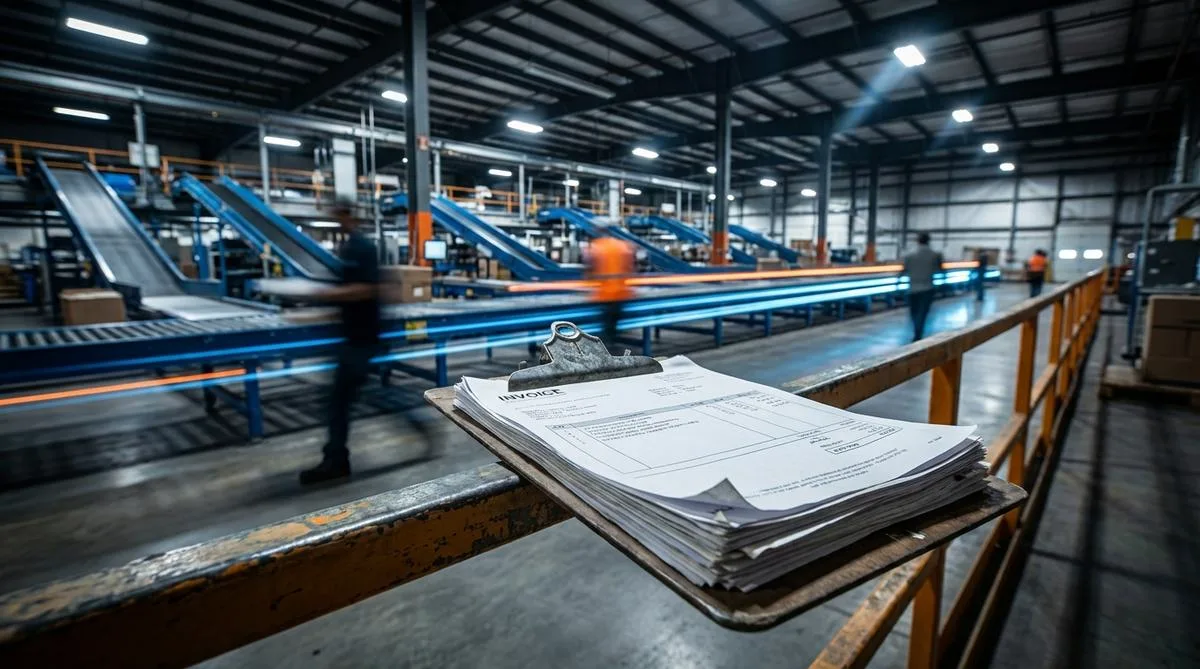
Modern B2B enterprises frequently operate across two parallel realities, creating fundamental management challenges. In corporate offices and on the screens of senior leadership, sophisticated ERP systems, interactive Business Intelligence dashboards, and cloud-based CRM solutions reign supreme, projecting an image of modernity. Yet stepping through the doors into the warehouse or production floor is like travelling back two decades. There, in what is still often an "analogue" operational back-end, critical processes rely on clipboards, printed spreadsheets, and handwritten notes that are easily lost, damaged, or misread.
This dichotomy creates a dangerous illusion of control. Management makes strategic decisions based on system data, unaware that the picture they see is often incomplete or drastically out of date. The result is a critical digital gap. When a warehouse worker ticks off a goods issue on a piece of paper, that information remains "dead" to the rest of the organisation until someone — often hours or even a full day later — manually enters it into a computer. During this critical window, the sales team may sell stock that no longer physically exists, while production planners work from historical rather than actual raw material levels.
This is precisely where the concept of "last-mile" digitalisation becomes essential. It is the process of closing the information loop by equipping frontline workers with intuitive applications that eliminate the paper intermediary. One fundamental premise must be understood: paper in a company is not merely a material cost or a trivial administrative burden. It is, in reality, the primary barrier to business scalability. As long as operations depend on the physical circulation of documents, every attempt to increase order volume will result in a disproportionate surge in operational chaos — one that no central system, however expensive, can fix.
The Hidden Costs of Analogue: Why a Sheet of Paper Costs More Than You Think
Many business owners still view paper as the cheapest and most reliable information carrier — a ream costs next to nothing and a pen never needs charging. This is, however, a deceptive saving that generates enormous losses in operating margin over the course of a year. In reality, the cost of maintaining paper-based document circulation in logistics or production processes does not stem from the purchase of office supplies, but from the inefficiency that this medium imposes on the entire organisation.
The fundamental financial problem is the phenomenon known as re-keying — the manual transcription of data from paper forms into digital systems. This process not only duplicates human effort but is also highly susceptible to errors, and it is precisely here that the hidden costs of spreadsheet errors most commonly arise. Statistics show that manual data entry carries an error rate of between 1% and as high as 4%. Across thousands of operations per month, this translates into dozens of incorrect records that contaminate databases and lead to flawed purchasing or sales decisions.
Added to this is the opportunity cost tied to the physical nature of a document. A paper record can only exist in one place at a time. When a manager needs to verify the status of a work order and the job card is somewhere out on the production floor, valuable time is lost to physical searches or phone calls to employees. Instead of analysing results and optimising processes, management becomes archivists, spending hours on tasks that a digital system would handle in fractions of a second.
A lack of transparency is yet another hidden tax. Paper makes real-time performance analysis impossible — data arrives with a delay, making it impossible to respond to bottlenecks as they occur. To illustrate the scale of the problem, consider the following straightforward example:
Imagine a mid-sized distributor of spare parts. A warehouse worker filling out a paper goods-issue confirmation writes a product code illegibly. A member of the administration team reads the digit "3" as "8." The result? The customer receives the wrong item. The cost of that single mistake is not simply the price of a return courier. It includes the time spent by the customer service team handling the complaint, the time spent by the warehouse operative processing the return and re-picking the order, and a credit note correction by the accounts department. Worse still, the company risks losing the customer's trust — which, in terms of Lifetime Value (LTV), can represent losses running into the tens of thousands.
Maintaining analogue processes therefore means accepting a constant drain of money — one that is difficult to spot in any single transaction, yet devastating at scale.
What Is the "Last Mile" in Process Digitalisation — and Why Is ERP Not Enough?
In logistics, the term "last mile" refers to the critical, final stage of delivering a shipment into the customer's hands. In the context of enterprise digital transformation, the concept carries an analogous, fundamental meaning. It denotes the moment at which a company's digital strategy meets the physical execution of a task by a frontline worker — a warehouse operative, a machine operator, or a field service technician. It is precisely here, at the intersection of people and technology, that the digital value chain most frequently breaks down. Many organisations mistakenly assume that implementing a powerful Enterprise Resource Planning (ERP) system automatically resolves the digitalisation challenge for the entire company. In practice, however, ERP is primarily a central record-keeping system — a kind of "brain" for financial and accounting operations — that rarely reaches the "hands" of the organisation: the workers carrying out operational tasks.
Due to their architecture and complex interfaces, ERP systems are designed with office-based employees, planners, and analysts working at desktop computers in mind. They are not suited to the dynamic environment of a production floor or warehouse, where mobility, simplicity, and speed of data entry are paramount. The result is a technology gap: head office sees data in the system, while the worker on the production line still relies on paper job cards, because no digital tool is available at the point of task execution (on-the-job). It is within this gap — outside the core IT system — that dangerous "information silos" take hold. Data recorded on a sheet of paper or in a shift manager's private spreadsheet is invisible to the rest of the organisation until it is manually transcribed, delaying the flow of information and hindering decision-making.
The solution to this problem is not to extend ERP with additional, costly modules, but to deploy dedicated process applications (Process Apps). These act as an intelligent interface connecting the worker to the company's digital ecosystem. Complex procedures are transformed into simple, step-by-step instructions accessible on a tablet or smartphone. This kind of "last-mile" digitalisation means the system does not merely record events after the fact — it actively guides the worker through the process, enforcing quality standards and eliminating ad hoc operational workarounds in real time.
The Paperless Warehouse: Accelerating Throughput and Eliminating Errors
Implementing digital tools in internal logistics — built around a strategy such as a zero-downtime digitalisation rollout plan — is the fastest way to regain control over the operational chaos that naturally emerges as order volumes grow. The traditional model based on printed goods-issue documents and paper pick lists is not only outdated; it is fundamentally static — by the time a document is printed, the data it contains may already be stale. Replacing these with mobile applications fundamentally changes the dynamics of warehouse operations. The picking and packing process no longer depends on an employee's memory or their ability to decipher handwritten notes.
Instead, a worker equipped with a tablet or handheld terminal receives precise, step-by-step instructions generated by the system. The application indicates the exact location of the goods and requires verification via barcode scan. If the warehouse operative reaches for the wrong product, the system immediately blocks the process and displays an error message. This source-level validation eliminates errors almost entirely, before the goods ever reach the packing area. Furthermore, digitalisation enables a shift away from the burden of periodic stock counts towards a model of continuous inventory management. Every warehouse movement is recorded in real time, giving management complete confidence in stock levels and eliminating the phenomenon of "ghost stock" — items that appear in the sales system but no longer physically exist.
It is worth citing the example of a mid-sized automotive parts distribution centre that was struggling with delays during peak season. Following the implementation of digital checklists and the elimination of paper-based document circulation, the company reduced its average order fulfilment time by nearly 30%. A key — and frequently overlooked — aspect of this transformation was a dramatic acceleration in onboarding new employees. Because the process is embedded in the application and the system provides digital prompts and product images, a new warehouse operative reaches full productivity within days rather than weeks, which is critical during periods of high staff turnover.
Production and Quality Control: From Chaotic Notes to Standardised Data
In a manufacturing environment where operational repeatability and strict compliance with standards are paramount, paper-based documentation represents one of the greatest hidden threats to process stability. Traditional job cards, station-level instructions kept in ring binders, and paper quality reports are inherently passive — they are frequently ignored, become soiled, and in the worst cases are simply out of date. Digitalising this area through dedicated process applications introduces a fundamental shift in paradigm: static paper is replaced by an interactive tool that actively enforces quality standards (QA/QC).
The key aspect of this transformation is a guarantee of execution consistency that no printed document can provide. A digital instruction on a workstation terminal does not allow the worker to "cut corners" or rely solely on memory. The system can require the entry of specific measurement parameters, the scanning of a component, or the sign-off of critical control points before allowing progression to the next stage of assembly. This gives management — such as operations directors — the assurance that every batch has been produced in an identical manner, regardless of whether the shift was staffed by a long-serving expert or a newly onboarded employee. It eliminates the quality variance introduced by human variability.
Equally important — particularly in the context of growing regulatory requirements — is audit readiness and change management. In organisations relying on paper-based processes, rolling out a new procedure means physically replacing documents on the shop floor, which always carries the risk of errors and the inadvertent retention of superseded versions. In a digital environment, updates are instant and universal. During an ISO audit or a rigorous customer inspection, the organisation can demonstrate within seconds that operators were working from the correct, currently applicable version of the specification. The change history is fully transparent, building the company's credibility in the eyes of its business partners.
The role of visual documentation and information flow speed in maintenance processes must not be overlooked either. Reporting a machine breakdown on a paper form that does not reach the manager until the end of the shift means losing valuable production hours. Mobile applications enable the immediate reporting of downtime or anomalies — including a photograph of the damaged component — directly from the shop floor. This real-time visual record not only dramatically accelerates the response of technical services but also constitutes irrefutable evidence in the event of quality disputes with raw material suppliers, replacing guesswork with hard data.
Low-Code and AI: How to Implement Change Fast — Without an Army of Developers
In a world where market dynamics shift from week to week, the traditional approach to IT system implementation has become the primary brake on operational development. Conventional custom software development typically means multi-month production cycles, complex technical specifications, and budgets that spiral with every minor change in business requirements. For an operations director who needs to close a gap in a logistics process immediately, such inertia is simply unacceptable. A business cannot afford to wait three quarters for a modification to a quality control form while the competition acts here and now.
The answer to this decision-making paralysis is low-code platforms, which radically change the rules of enterprise digitalisation. This technology enables the building of sophisticated process applications through intuitive visual interfaces, eliminating the need to write thousands of lines of code by hand. Its greatest value lies in a shift in agency: it is operational managers and business analysts — the people who best understand the specifics of the business — who can shape digital tools directly. As a result, adapting procedures to new regulations or implementing an improved order workflow happens without engaging an overstretched IT department and without accumulating costly technical debt.
Speed of implementation is, however, only half the story; the other half is system intelligence. Process App-class solutions go a step further by embedding artificial intelligence (AI) algorithms directly into the operational fabric. In this model, AI ceases to be a theoretical concept and becomes an active participant in the process: it analyses workflows in real time, automatically categorises requests, and intelligently assigns tasks to the least-loaded employees. Moreover, these systems can predictively flag potential bottlenecks before they cause actual delivery delays.
This synergy of low-code flexibility and AI precision means that a full process transformation takes days, not years. Rather than risky, multi-million-pound implementation projects, companies gain the ability to model their operations with agility. Process App makes it possible to turn rigid, paper-based procedures into dynamic applications that grow and learn alongside the organisation, delivering lasting competitive advantage and scalability — without the need to hire an army of developers.
The Human Factor: How to Win Your Team Over from Paper and Pen
Implementing new technology accounts for only twenty percent of a successful digital transformation; the remaining eighty percent comes down to psychology and effective change management. Even the most sophisticated low-code application will become a digital "shelf-warmer" if frontline workers see it as an adversary. The most common barrier in manufacturing and logistics companies is not a lack of digital skills among staff, but a deep-rooted fear of losing autonomy. A warehouse operative or production line worker often perceives a tablet not as a support tool, but as an instrument of permanent surveillance designed to "catch" mistakes and automatically penalise even the slightest deviation from the norm.
The key to overcoming this natural resistance is a radical change of narrative combined with careful attention to user experience (UX) design. Business applications can no longer resemble the clunky, complex ERP systems of the nineties. They must offer the kind of intuitive experience found in the consumer apps that team members use in their personal lives every day. If reporting a machine breakdown is as simple and quick as ordering a ride in a popular taxi app, resistance fades almost immediately. Technology must justify itself through usefulness — instead of laboriously completing three paper forms, the worker taps the touchscreen twice and the system automatically populates the date, time, and location.
The most effective way to "sell" the change, however, is to involve employees directly in the process of building digital procedures. Rather than imposing ready-made solutions from the top down, it is worth asking forklift operators and quality control specialists what frustrates them most about the current paper-based workflow. When an employee sees that their suggestion for simplifying a form has been implemented in Process App within a matter of hours, they gain an invaluable sense of ownership. They become an ambassador for the system rather than a passive opponent of it.
The final argument must be framed in terms of personal benefits for team members, not just gains for the company. Digitalisation means an end to illegible handwriting left by a colleague on the previous shift, an end to the frantic search for mislaid goods-issue documents, and an end to the stress caused by unclear procedures. The system guides the worker step by step, eliminating the risk of error and relieving them of the burden of remembering dozens of exceptions. The result, instead of chaos and constant fire-fighting, is a calm working environment in which rules are transparent, responsibilities are clearly defined, and job satisfaction directly and measurably improves.
Conclusion: Digitalisation Is Not an Option — It Is a Condition for Survival
Looking at the current dynamics of the B2B market, the conclusion is inescapable: the era of treating digitalisation as a "technological novelty" or an optional add-on is definitively over. In an economic reality where margins are under inflationary pressure and customer expectations are growing exponentially, clinging to analogue, paper-based processes is tantamount to a slow withdrawal from the game. Traditional document workflows — built on ring binders, manual data entry into spreadsheets, and verbal agreements — have become the most expensive possible way to run a business. These costs arise not merely from paper and toner, but above all from missed opportunities, wasted employee time, and errors that, over the course of a year, can cost an organisation tens or even hundreds of thousands.
The combined benefits of implementing tools such as Process App extend far beyond a simple time saving. We are talking about a fundamental shift in the management paradigm. Digitalising the operational "last mile" creates a coherent data ecosystem, eliminating the information silos that paralyse decision-making. When every procedure — from goods receipt in the warehouse, through quality control, to the approval of supplier invoices — takes place in a digital environment, management gains something priceless: full transparency and real-time analytics. Instead of guessing where bottlenecks are forming, you see them on a management dashboard. Instead of reacting to crises after the fact, you can anticipate them by analysing performance trends across individual teams.
The costs of inaction must also be stated plainly. Competitors who more rapidly adopt low-code solutions and AI-assisted automation will gain a decisive operational advantage. These companies will be able to handle more orders with the same headcount, bring new products to market faster, and offer customers a standard of service that an organisation operating "on paper" simply cannot match. In the longer term, a failure to digitalise means margin erosion: the cost of manual processing will continue to rise in line with wage pressures, while efficiency remains stuck at a consistently low level.
Scalability is also a critical consideration. Many SMEs fear growth because, in the traditional model, more orders mean more chaos, more paperwork, and the need to hire additional administrative staff. Digital processes scale with the business in an organic and painless way. What works for ten orders a day in Process App will work equally well for a thousand, without generating organisational disorder. Technology becomes the backbone that stabilises the business during rapid growth, rather than a brake on it.
Don't let outdated working methods hold back your company's potential. Transformation doesn't have to be a painful, multi-year enterprise system implementation. Thanks to the flexibility that Process App offers, you can start with a single, most critical process and gradually extend digitalization to other areas. We encourage you to conduct an honest audit of your own procedures. If paper folders are still circulating around your company and key information is getting lost in email chains, it's a sign that the time for change has come. Contact us to schedule a free consultation or system demo. We'll show you how to go from chaos to full digital control in just a few days — freeing up resources for what matters most in business: strategy and growth.


