
How to Optimize Production Using AI?
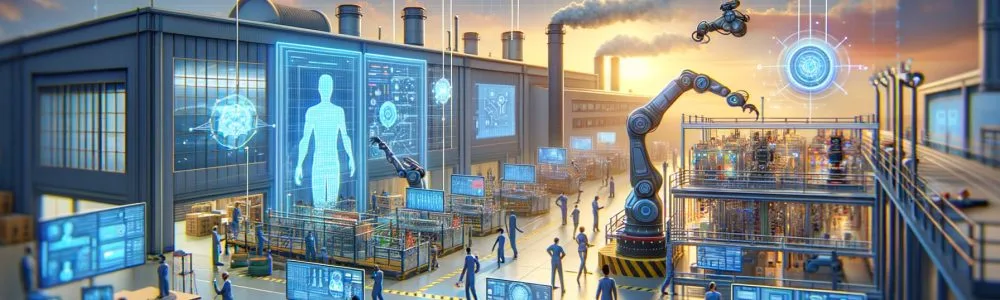
Are you wondering whether the production processes in your company could be more efficient? Is your company facing challenges related to excessive production costs, downtime, or operational errors? AI technology offers solutions that can revolutionize the way your company operates, minimizing losses and maximizing efficiency. Let's take a look at how the right tools can help solve these problems.
What are the key challenges in production management?
5 ways to use AI to optimize processes
Examples of AI applications for use in production
3 benefits and challenges associated with implementing AI
How to get started with AI in your company?
Production management is a challenge that requires constant oversight of many processes and variables. One of the key elements is ensuring high product quality while simultaneously reducing costs. In the era of globalization, customer requirements are constantly rising, and operational efficiency is becoming a priority.
Key challenges in production management are:
Setting appropriate work schedules – Effective task planning and human resource management is essential to minimizing production downtime. Schedules must be flexible enough to adapt to dynamic changes in demand. On top of all this comes the difficulty of handling variable production batches, different volumes, and of course make-to-order production — where the number of parameters, variables, and constraints grows, making the production plan increasingly difficult to set manually. Scheduling also involves analyzing machine load, personnel availability, knowledge of sequence times, raw material securing, quality gates, deadlines, and much more…
Maintaining production quality – Quality control is crucial to avoid costly errors and product returns. Employees must be properly trained, and verification processes precisely defined. As a business owner, you have certainly heard of — or indeed champion — the model of quality built into the workstation. However, reaching that stage is a time-consuming process whose level of complexity varies greatly between industries.
Cost optimization – This encompasses both material costs and operational costs. High costs can significantly impact profit margins, which is why monitoring them is important. And more in-depth control can become a production and cost optimization plan.
Supply chain management – Coordinating the delivery of raw materials and components on time is crucial for smooth production. Supply problems can lead to delays and unplanned downtime.
Implementation of modern technologies – Tracking the latest manufacturing technologies and integrating them into processes can bring great benefits. However, the implementation itself can be costly and time-consuming. Examining and addressing these challenges is necessary in order to improve production efficiency and market competitiveness. What strategies can be applied to leverage artificial intelligence to optimize these processes?
Production management is a complex task that requires the coordination of many key aspects. Artificial intelligence is becoming an increasingly popular tool for optimizing various issues within production processes. Let's now take a closer look at how AI can help you and your employees optimize processes.
The application of artificial intelligence is not merely a futuristic trend, but a practical tool that is revolutionizing production management. Thanks to AI technology, companies can significantly improve the efficiency of their operational processes.
Let's take a look together at how AI contributes to production optimization, assuming its application within systems and software:
Failure prediction and predictive maintenance
AI enables monitoring of machine condition and prediction of potential faults before they become serious problems. Thanks to algorithms that learn from accumulated data, companies can plan maintenance proactively, which in turn minimizes downtime and increases production efficiency, while also reducing repair costs. Moreover, artificial intelligence can provide support in decision-making processes by offering suggestions about which machines are most failure-prone, or for which machines the consequences of faults are cyclical in nature. By linking machine management with overall production, it can also provide precise information regarding shifts, production batches, materials, and operators — who participated in or were used during the process.
Production schedule optimizationAI algorithms help optimize production schedules by taking into account resource availability, product demand, and delivery deadlines. As a result, production processes become better coordinated, and companies can manage their resources more effectively.
Inventory managementAI technology is also extremely useful in managing deliveries and inventory. By analyzing sales data and market forecasts, AI models can more accurately predict demand for raw materials and finished products. This allows for the reduction of excess inventory and minimization of shortages.
Production quality controlAI can be applied to analyze and monitor production quality in real time. Learning algorithms recognize defect patterns, enabling rapid problem detection and immediate corrective action. In this way, companies can maintain high product quality while simultaneously reducing costs.
Automation of repetitive tasks
Treating this point as a bonus, many companies choose to purchase robots (cobots) that can be programmed to perform tasks. This also creates scope for artificial intelligence to take over repetitive tasks such as assembly or packaging, allowing employees to focus on more advanced and creative work. This not only increases efficiency but also raises employee satisfaction levels.
Introducing these methods to your company can significantly increase its operational efficiency. As you have probably noticed, the benefits of using AI are numerous:
from reducing downtime to improving production quality through predictive systems,
through key elements such as automation and data analysis, which increase flexibility and precision of operation, and thus competitive advantage,
reaching a state in which the use of AI means employees can engage in more complex work with a lower risk of making errors.
From this, we can confidently conclude that artificial intelligence is the key to modern, efficient production.
You are probably wondering what specific AI applications can be used in production. Let's work through this topic together.
Introducing artificial intelligence (AI) into production opens up new possibilities and innovative solutions for companies. Let's go through a few examples of how AI is already being used in the sphere of production, as well as in company management itself.
ShortwareThis is a solution for managing your email inbox. It allows for better organization of its structure and, most importantly, suggests message content. Assuming internal communication, as well as customer service, sales processes, and complaints handling — it can provide support in the process of drafting replies, saving the team's time.
WarehouseWe will use our standard application as an example. It has basic functionalities such as a goods receipt and issue register, real-time inventory, automatic orders, space mapping, and data analysis. On top of this come AI features. One of them is predictive inventory analysis, where artificial intelligence analyzes historical data and predicts when a specific product may sell out, enabling optimal order planning. Another option is warehouse space optimization, where based on data analysis, AI suggests changes to the warehouse layout in order to increase its efficiency.
View the "Warehouse" app!
Production reportingAgain, we will use our standard application as an example. In its base modules, beyond reporting itself, it naturally includes real-time production progress tracking, reports, and data visualization. Its AI functionalities include suggestions for a production optimization plan based on report data, as well as, among other things, predictive alarms that can support dynamic response and decision-making in the event of potential process disruptions.
View the "Production Reporting" app!
Implementing artificial intelligence (AI) in production processes can bring significant benefits, but it also comes with certain challenges. Understanding these aspects is crucial for the effective deployment of AI in your company.
Benefits:
Increased operational efficiency – AI can analyze and optimize production processes in real time. Through automation and precise analytics, a company can reduce downtime and significantly improve productivity.
Better product quality – AI algorithms help identify and eliminate production errors. As a result, finished products achieve a higher quality standard, which in turn leads to increased customer satisfaction.
Reduced production costs – AI allows companies to manage resources and materials more effectively. By minimizing waste and improving production planning, a business can save on operational costs.
Challenges:
High initial costs – Investment in AI technologies can be expensive. Purchasing the appropriate software and hardware, as well as training employees, requires financial outlay and, above all, a significant commitment of time (which, as we know, also costs money).
Data security risks – Implementing AI involves collecting and analyzing large volumes of production data. Protecting this data from cyberattacks and unauthorized use is a key challenge.
Integration with existing systems – Connecting new AI technologies with already operating production systems can be complex. It requires precise planning and testing to ensure smooth and error-free integration. Understanding these benefits and challenges is crucial for anyone planning to implement AI in production.
Implementing AI in production offers significant benefits, such as increased operational efficiency, better product quality, and reduced production costs. However, it also comes with challenges that include high initial costs, data security risks, and the complexity of integration with existing systems. The key to success is a thorough understanding of these aspects and adequate preparation for implementation. AI can revolutionize your company, but only when the implementation process is well planned and carried out.
Are you wondering how to start using AI in your company? The first step is understanding the various possibilities and choices available. AI can transform many aspects of your operations, from optimizing production to intelligent resource management. Examining current processes and identifying areas that could benefit from automation and data analysis is an essential stage.
Assessing needs and goals – To successfully implement AI, you need to determine which processes are the most costly or time-consuming. This will help you achieve the highest return on investment. Also identify the business goals you want to achieve, such as increasing efficiency, reducing costs, or improving product quality. Formulating clear goals will make it easier to monitor progress and evaluate the effectiveness of the AI implementation. Do you know which of your processes could benefit most from automation?
Securing resources – before proceeding with further steps, you must confirm that there is room in the budget for introducing new solutions. Securing resources also applies to your time and your employees' time. To ensure a successful implementation, you must account for time set aside for joint communication, training, and learning during the rollout.
Choosing the right tools and technologies – The AI market offers many tools and technologies that can support your processes. Conduct a thorough analysis of the available options, taking into account the specific needs of your enterprise. It is best to consult with AI experts, who will help select the best solutions. It is also worth paying attention to scalability and integration with currently used systems. Do you know which technologies could best serve your company?
Training the team – Your employees must be properly prepared to work with new technologies. Investment in training and educational programs is indispensable. This way, both managers and line workers will be able to use AI effectively and with confidence. Training the team is the foundation of every successful AI technology implementation.
Pilot test and evaluation of results – Rather than deploying AI on a large scale right away, it is worth starting with a pilot project. Testing on a smaller scale will allow you to identify potential problems and assess the effectiveness of the new solutions. Analyzing the results of the pilot will provide valuable insights before full deployment. A pilot test is a crucial step in minimizing risk and maximizing return on investment.
Monitoring and Adjustment – After deploying AI in your company, continuous monitoring of its operation is essential. Regular reviews and analyses will enable the necessary adjustments to be made so that the system operates optimally. Remember, AI is a dynamic technology that requires constant supervision and updates. Monitoring and adjustment are indispensable elements of every effective AI technology implementation. Regular reviews allow you to respond on an ongoing basis to changing needs and challenges.
AI can revolutionize your production processes, but only when you establish solid foundations through needs assessment and goal setting. Choosing the technology and training the team are critical to a successful implementation. Pilot projects will allow you to test the effectiveness of new solutions before their full deployment. Continuous monitoring and adjustment will ensure that AI operates as efficiently as possible. This is not yet a complete project plan, but these milestones will help you better harness the potential of artificial intelligence in your company.


