
How much do complaints cost a company?

Have you ever wondered how much customer complaints are really costing you? In any company, a high volume of complaints brings additional expenses that can affect overall business profitability. Addressing product defects and optimizing quality control processes can significantly reduce these unwanted costs.
If you want to learn how to effectively solve this problem and what benefits it can bring to your business, we invite you to read this article:
Complaints: A hidden cost challenge
How to effectively identify the root cause of problems?
How to reduce the number of complaints?
Effective corrective and preventive actions
Complaint management – improvements
Customer complaints are often viewed as a marginal issue in a company's operations, yet their actual costs can be far higher than they appear.
Every individual complaint represents not only a loss of profit, but also a loss of time, resources, and customer trust. It is also a moment that tests the customer's confidence in a given organization or brand. If a company handles this test well, customer trust will likely increase; however, if the business fails to rise to the occasion in a similar situation, it may even result in losing that customer and giving rise to so-called "negative word-of-mouth PR."
Complaints can lead to a range of unexpected expenses, such as the costs of repairing or replacing products, additional logistics operations, and customer service. It is therefore important to thoroughly understand where the root causes of problems lie in order to eliminate them effectively.
Important cost-related aspects associated with complaints include:
Administrative costs – These include complaint documentation, processing of submissions, and communication with the customer — in other words, staff time and involvement.
Logistics costs – Transporting non-conforming products, warehousing, and subsequently shipping repaired or replacement products.
Production costs – Increasing output to replace defective stock, or costs related to servicing, repairs, and quality control.
Costs of lost production opportunities – The time of people and machines, energy and material usage, etc., that is allocated to post-complaint units instead of planned, budgeted production.
Costs of lost sales opportunities – Negative feedback from dissatisfied customers can significantly impact future sales and the company's reputation.
Every complaint is not only a logistical and financial challenge, but can also negatively affect team morale. The need to deal with complaint-related issues diverts attention from other, often more productive activities.
We should also consider that in an era of widespread social media adoption, users frequently post reviews directly on their own accounts, meaning that both positive and negative information about our products and services reaches potential customers at an extraordinary speed. Hippocrates said that prevention is better than cure. These words are highly relevant in the context of bringing products or services to market that are reviewed by users very shortly after their launch.
In the next step, we will look at how to effectively identify the sources of problems that can lead to complaints. Are you ready for a more detailed analysis?
Effectively identifying the source of problems is critical to minimizing the number of complaints and their associated costs. To achieve this, a systematic approach to monitoring and analyzing production data must be implemented. Entrepreneurs often skip this step, unaware that thorough analysis can identify critical failures before they develop into costly problems.
So how is this done?
The first step is the regular collection and processing of data from various stages of production. This should encompass information on raw materials, production processes, and finished products. Key performance indicators (KPIs) may include production cycle time, the number of defects on the production line, and machine efficiency metrics.
The second essential step is statistical analysis of the collected data. This makes it possible to isolate the most frequently occurring problems as well as those with the greatest impact on final product quality. Tools such as the Pareto chart, cause-and-effect analysis (known as the Ishikawa diagram), and the 5 Whys method can prove extremely useful here.
The third step is implementing an early warning system. In practice, this means monitoring key indicators in real time and triggering automatic alerts when irregularities are detected. This enables swift preventive action to be taken before a problem becomes serious.
Most important of all, however, is a systematic approach and the continuous improvement of processes.
Regular quality reviews and audits, staff training, and the engagement of the entire team in the process of identifying and resolving problems create a solid foundation for effective quality management. Only in this way can optimal product quality be achieved and the risk of complaints minimized.
Let us move on to the next section, where we will discuss practical solutions for reducing the number of complaints.
Reducing the number of complaints in a manufacturing company is key to improving efficiency and lowering operational costs. To achieve this, it is worth focusing on several fundamental steps:
Optimization of production processes
A thorough analysis of each stage of production makes it possible to identify the points where errors most frequently occur.
Introducing automation at critical points in the process can significantly reduce the risk of human error.
Regular employee training ensures that the entire workforce is familiar with the latest procedures and quality standards.
Use of quality monitoring tools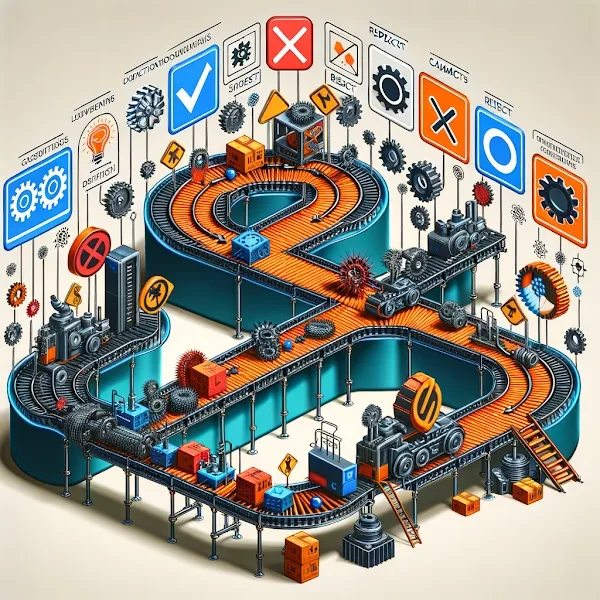
Modern quality control tools enable continuous monitoring of production parameters.
Data from monitoring can be analyzed in real time, allowing for immediate response to deviations from the norm.
Monitoring tools also make it possible to identify trends and early signals of potential problems.
Better data managementCentralized collection and analysis of product quality data enables the identification of patterns and problematic areas.
The foundation of effective quality management is regular reporting and improvement based on the insights uncovered.
Historical data can be used to predict future problems and address them proactively.
Implementation of early warning systemsThese systems are designed to detect potential problems before products leave the production line.
Automated alerts sent to the relevant departments enable rapid intervention and minimization of losses.
Customer feedback
Regularly gathering feedback from end customers provides valuable information about product quality.
Analyzing this feedback can reveal recurring problems and highlight areas for improvement.
Actively listening to customers builds their trust in the brand and demonstrates that the company is committed to delivering high-quality products.
Reducing the number of complaints is an ongoing, multi-faceted process; however, the right tools and approach can significantly accelerate it. When optimizing production and improving quality control, it is worth asking: what effective corrective and preventive actions can be implemented to eliminate errors entirely?
To manage complaints effectively, it is essential to implement efficient corrective and preventive actions. These two categories of action are critical not only for resolving current problems, but also for preventing future complaints.
What steps should therefore be taken to reduce the number of complaints in a company?
Rapid response to submissions – Fast complaint handling is a priority. The sooner a customer's problem is resolved, the greater the likelihood of maintaining their satisfaction.
Root cause analysis – To prevent the same errors from recurring, an in-depth analysis of their causes is essential. Data monitoring tools can be invaluable here.
Process correction – Once a problem has been identified, the necessary changes must be made to production processes. This may involve modifications to the production line or employee training.
Tracking the effectiveness of changes – Regular monitoring of results after corrective actions have been implemented allows for an assessment of their effectiveness and the introduction of further improvements.
But what would corrective actions be without the support of preventive processes?
What preventive actions can therefore be introduced?
Quality control at various stages of production – Implementing multi-stage quality controls enables early detection and removal of defects before the product reaches the customer.
Employee training – Continuous development of staff skills and keeping their knowledge of modern technologies and production procedures up to date is essential.
Process automation – Modern technologies, such as low-code applications, enable the automation of many processes, minimizing the risk of human error.
Regular audits and reviews – Conducting routine inspections and audits of production processes enables the early detection and correction of potential problems.
Why are corrective and preventive actions so important? The well-being of your company depends on their effectiveness. Effective corrective and preventive actions allow not only for a reduction in the number of complaints, but also for cost savings. Improving production processes is an investment that yields long-term benefits. From identifying problems, through fixing them, to implementing preventive measures — every step matters and can contribute to the better performance of the entire enterprise.
Find out how to automate problem-solving in your company!
Complaint management – improvementsEffective complaint management is essential for any company striving to reduce additional costs and increase customer satisfaction. Proper handling of complaint submissions not only enables the swift resolution of problems, but also streamlines internal processes, translating into better financial results.
Why is it worth investing in complaint management?
Cost reduction – Optimal complaint management contributes to a significant reduction in operational costs. Complaints can generate additional expenses such as servicing, returns, and additional quality testing.
Quality improvement – Analyzing complaint data helps identify the most common problems and sources of defects, enabling rapid changes to be introduced in the production process.
Customer satisfaction – Fast and effective problem resolution increases customer loyalty and improves the company's reputation.
What complaint management methods can be applied?
Process automation – Implementing technological solutions that automate the submission and analysis of complaints increases process efficiency.
Employee training – Regular training for staff in complaint handling and quality control is indispensable.
Monitoring systems – Using modern systems to track complaint submissions in real time helps reach the source of the problem more quickly.
Good complaint management not only eliminates additional costs but also improves the overall efficiency of the company. If you would like to learn more about how a structured problem-solving process leveraging automation translates into an improved complaints process, take a look at this brief use case in the AI application.


