The Common-Pool Syndrome: Why Team Piecework Destroys Crew Morale
In many mid-sized manufacturing plants, team piecework was introduced with the intention of building solidarity and mutual support on assembly cells. In practice, however, this mechanism too often degenerates into what is known as the common-pool syndrome. When paper work cards lack precise reports tied to a specific workstation or operator, responsibility for the final output volume and any defects is spread across the entire team.
This model directly penalizes the most committed employees. Top performers who consistently achieve 120% of the standard quickly notice that their above-average effort is being "consumed" by weaker or less motivated colleagues on the same line. Instead of healthy competition, frustration, burnout, and a deep sense of injustice emerge. Skilled operators begin levelling down, concluding that going above and beyond simply does not pay off.
The problem reaches its peak at the end of the month during the group bonus review. Instead of a smooth settlement, the production supervisor's office turns into an arena for exhausting disputes:
- Lack of transparency: The supervisor must arbitrarily decide who was at fault for a stoppage or a batch of damaged material.
- Mutual accusations: Team members pass the blame for missing targets among themselves, destroying the team atmosphere.
- Erosion of authority: Management loses the crew's trust, coming across as an unfair judge in financial disputes.
Traditional piecework settlement based on paper collective work cards does not build a team — it rewards passivity and systematically drives the most valuable production talent out of the factory.
The Pitfalls of Paper Collective Work Cards on the Assembly Cell
The classic documentation workflow on an assembly cell typically relies on a single physical sheet that travels between workstations along with the production order. In a plant employing dozens of operators, one paper work card often serves five to eight workstations. This model makes it entirely impossible to exercise reliable control over dynamic personnel shifts. When a worker moves to another line, takes a break, or covers for a sick colleague, the paper remains static, failing to record the actual time each individual spent on a given operation.
The absence of real-time operation reporting leads to the widespread practice of filling in data "from memory." Rather than precisely logging every cycle, operators add produced units and hours worked in bulk at the end of the shift — sometimes only just before heading to the locker room. As a result, the boundaries between successive process stages become blurred, and the collective work card effectively conceals micro-stoppages, machine breakdowns, and waits for components. Time lost to technical faults is simply "stuffed" into piecework labour hours, distorting the actual OEE figure.
True decision-making paralysis sets in when the completed, often oil-stained card reaches HR and controlling. An arduous phase of cross-referencing then begins:
- Hours-long investigations by foremen: The production supervisor must verify why the total labour hours on paper exceed the time recorded at the time-and-attendance gates.
- Clashes between declarations and the HR system: The payroll department cannot process bonuses because the paper reports show a surplus of completed operations relative to the semi-finished goods issued from the warehouse.
- No audit trail: Establishing who is responsible for a faulty batch assembled during an 8-hour shift becomes impossible to resolve.
Manual paper-based reporting forces compromises that cost the plant hundreds of hours spent on unproductive disputes instead of on optimising manufacturing processes.
Dynamic Allocation Matrices: How to Digitally Quantify Individual Contribution to an Order
Traditional team-based settlement often fails due to the lack of precise tools for evaluating individual engagement. The answer to this problem is dynamic allocation matrices, which shift piecework calculation from the level of subjective estimates to the level of indisputable digital data. In a modern production environment, an algorithm calculates the earned order pool in real time, drawing on hard operational parameters.
The key to a fair distribution is a weighted algorithm based on working time and a skill matrix. Instead of splitting the pool equally, the system analyses the exact time a given employee was logged into the order at the terminal and multiplies it by their job-grade coefficient. An experienced operator with a master-level rating who resolves complex technical problems receives a proportionally higher rate per minute worked than an operator who is still being onboarded. Everything happens automatically, which motivates the workforce to develop their professional qualifications.
Crucially, this model finally resolves the age-old dilemma of support roles on the production line. In the traditional approach, the work of a machine setter, changeover technician, or logistics assistant was a constant bone of contention — assemblers felt they were "giving away" part of their earnings, or conversely, specialists felt underappreciated. The digital system makes it possible to define transparent rules:
- Support pools: Automatic allocation of a fixed or variable percentage of the order value to auxiliary staff without reducing the assembly base.
- Dynamic multi-person login: The setter logs into the order only for the duration of the machine adjustment, and the system immediately recalculates the allocation weights and proportions without stopping the cell's work.
- Real takt-time recording: Exclusion of technological downtime from the direct piecework pool for assemblers.
Switching to automated system rules completely eliminates arbitrary decisions by the supervisor and shift leader. When the rules of the game are written into the production system's code, suspicions of favouring certain employees come to an end. Replacing discretion with an algorithm rebuilds trust in management and creates a culture of accountability grounded in facts.
The Process App Workshop Kiosk: Attendance and Task Registration on the Cell
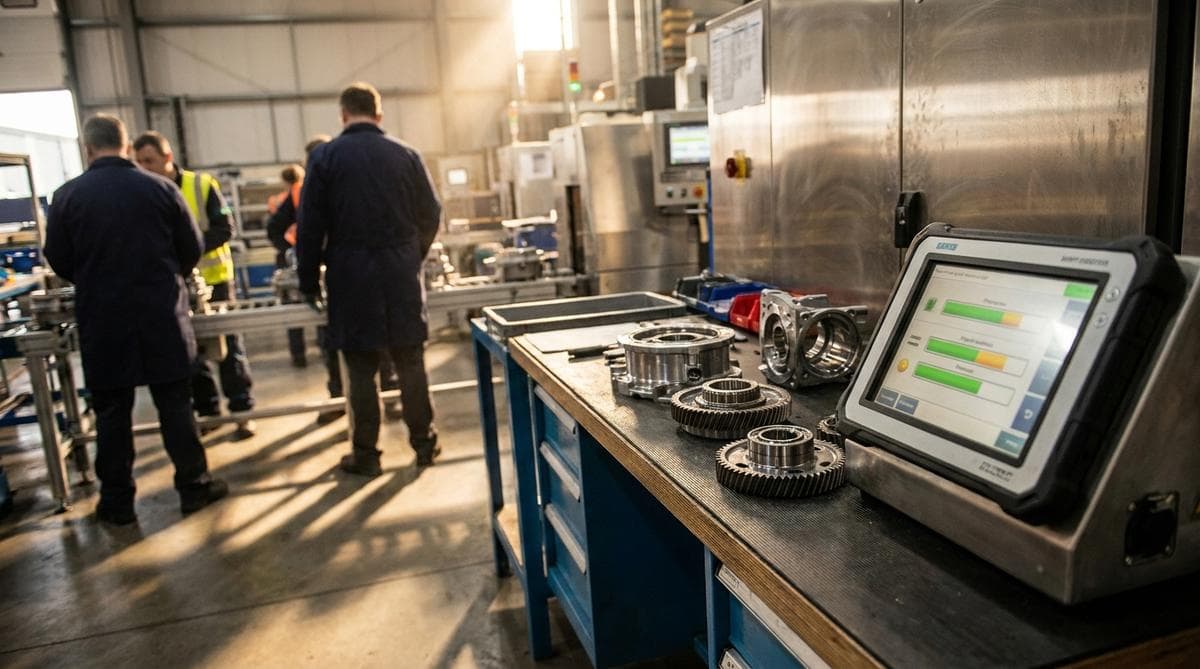
The answer to information chaos and the paper fiction of settlements is the Process App workshop kiosk, an integral part of the Production Execution module. Instead of filling in forms by hand, each workstation is equipped with an intuitive industrial touchscreen terminal. This is where the digital data flow begins — one that eliminates the margin for error and relieves supervisors of the burden of tedious bureaucracy.
The cornerstone of the system is the instant login of workers using RFID cards or barcode scanners. Starting a production cycle no longer requires entering names or employee numbers — a single tap of the badge against the reader assigns the operator to a specific cell, technological operation, and order. In this way, the system automatically records workstation attendance, with no discrepancy between data from the entry gates and the shop floor.
Dynamic Team Composition Management
Production reality demands flexibility, which is why the workshop kiosk supports smooth, dynamic reassignment of operators during an active shift. When the line needs an emergency replacement due to absence or a technological bottleneck:
- The supervisor or the worker themselves joins the ongoing order in just 3 seconds by tapping an RFID card.
- The system immediately recalculates the weights and time proportions, splitting the piecework pool precisely according to each team member's actual contribution.
- The line does not need to be stopped, and the entire rotation is recorded precisely without any need to correct paperwork.
The terminal also enables instant production reporting: operators continuously enter good units and assign defects to predefined causes. Most importantly, workers can see a live view of the accrued piecework pool in real time on the screen. This transparency completely eliminates disputes about pay amounts and builds motivation grounded in facts rather than estimates.

Handling Exceptional Events: Rotations, Team Defects, and Line Slowdowns
Production reality rarely matches ideal technological assumptions. The true test of settlement efficiency is not standard shifts but emergency situations, in which paper work cards immediately generate conflicts. When a line slows down, raw materials run short, or a sudden personnel rotation occurs, manual reporting leads to misunderstandings between the workforce and the supervisor.
A key challenge in team-based work remains distinguishing material defects from assembly errors. In the traditional model, a faulty batch burdens the entire cell's results, causing justified frustration among diligent operators. Integrated production reporting in Process App eliminates this injustice through precise defect classification. The system enables the immediate recording of a supplied component's fault as a supplier error, or isolates a mistake at a specific assembly workstation, protecting the earned piecework rate of the remaining team members.
Equally critical are unplanned machine stoppages. In the paper-based scheme, a breakdown of an upstream cell often means lost earnings for the crew or the need for lengthy negotiations over a downtime entry. The digital system resolves this problem at a systemic level:
- Automatic switch to a downtime rate: Reporting a machine fault immediately suspends piecework accrual for the associated cell, switching operators' working time to a downtime rate or maintenance tasks without unnecessary delay.
- No supervisor discretion: The moment of stoppage and resumption of takt is derived directly from telemetry or an unambiguous status on the terminal, eliminating disputes during the monthly close-out.
The final piece of the puzzle is the fair-joining algorithm for workers seconded from other departments. When an operator arrives on the line from another area, the system dynamically distributes tasks and time on-site. The supporting worker receives remuneration proportional to the minutes spent at the cell, taking their adaptation coefficient into account, without detriment to the permanent assembly team.
Transparent rules for settling incidents build employees' trust in system data and permanently remove accusations of unfair pay calculation.
The Shop Floor–HR–Finance Triangle: Team Piecework Data Flow Without Spreadsheets
In the traditional production model, the exchange of information between the shop floor, the HR department, and controlling resembles a game of broken telephone. Data from handwritten notes is transferred to spreadsheets, from which it travels — after further manual verifications — to payroll and accounting systems. Implementing a unified single-database architecture in Process App permanently eliminates this siloed division, meaning that a single report from the shop floor feeds all key business processes in parallel within a fraction of a second.
The most tangible effect of this automation is the complete disappearance of the so-called "black week" of month-end reconciliation in HR and payroll. Previously, payroll specialists spent the first days of every month laboriously deciphering damaged work cards, entering data manually, and resolving discrepancies with shift managers. With Process App, an operational report from a workstation instantly becomes a ready payroll component in HR, cutting payroll processing time from dozens of labour hours to just a few clicks.
An equally revolutionary change takes place in operational controlling. Instead of waiting weeks for the accounting close, the finance module receives an immediate feed of the actual labour cost per unit from a given cell:
- No more estimating: Instead of averaged overhead labour ratios, you know the precise cost of manufacturing each part based on actual execution time and the operator rate matrix.
- Real-time margin monitoring: Order profitability is verified during production (WIP), not after the fact, enabling immediate process corrections.
- Better commercial pricing: The sales team gains access to reliable historical data, eliminating the risk of underpricing quotes.
All of this is underpinned by a complete audit trail for every monetary unit paid out as a piecework bonus in Process App. Management, an auditor, or the employee themselves can trace the journey of any pay component at any time: from a specific RFID card tap at the kiosk, through the batch number, all the way to the posted payroll. Full transparency eliminates employee disputes and builds a culture of trust founded on indisputable facts.
Implementation Case Study: A Wire Harness Manufacturer and Zero Payroll Complaints
The theoretical benefits of digitisation are best validated by industrial practice. A Polish manufacturer of wire harnesses for the automotive and white goods sectors, employing 140 production workers, discovered this first-hand. Before the modernisation, the plant faced a recurring paralysis at the end of every month. Manual piecework settlement for assembly cells relied on paper work cards, which regularly generated crew frustration. Teams raised complaints about unfair bonus distribution, payroll closing was delayed, and skilled assemblers left for competitors due to a lack of trust in the calculations.
Rapid Transformation: 6 Cells in 3 Weeks
Management decided to implement the Production Execution module within the Process App platform. The project covered 6 key assembly cells, in which touchscreen workshop kiosks integrated with RFID readers were installed. The entire implementation took just 3 weeks, causing no stoppages in the ongoing fulfilment of orders. Operators immediately gained visibility into accruing rates and the ability to register completed operations in real time.
Hard Business Results
The deployment of a modern piecework settlement system delivered immediate operational and financial results:
- Payroll complaints dropped to zero: Full transparency of real-time calculations completely eliminated piecework disputes between employees and HR.
- Payroll processing time reduced by 80%: The HR department stopped manually transcribing hundreds of paper cards, closing the monthly statements in a matter of hours rather than days.
- Cell productivity increased by 18%: Real-time visibility of accrued bonuses directly boosted team motivation and stabilised the work takt.
- Defect rate decreased by 14%: Transparent reporting of material and assembly faults enabled rapid elimination of process errors without penalising innocent operators.
As a result, the plant completely halted the turnover of key specialists, and management regained full control over order profitability.
Audit Your Factory's Piecework Fairness and Book a Free Demo
Pay calculation transparency in a modern manufacturing plant is not merely a matter of peace in the HR department — it is above all the foundation of operational stability and workforce trust. In the reality of cell-based work, where results depend on the synchronisation of multiple operators, subjective assessments and paper summaries become a breeding ground for constant conflict. When workers begin to question the accuracy of their calculated piecework, it directly impacts morale, OEE indicators, and the turnover of skilled personnel. How do you recognise that the current settlement model has exhausted its potential and is generating hidden losses?
5 Symptoms Indicating That Paper Piecework Is Sabotaging Your Company's Productivity
Many managers treat payroll disputes as an unavoidable feature of the industry. Market practice shows, however, that this is a direct consequence of the absence of an automated single source of truth. Implementing a digital production settlement system becomes a necessity when the following phenomena are present in an organisation:
- Monthly pilgrimages to the supervisor's and HR office: The first days after payday are spent explaining discrepancies between operators' handwritten notes and the official payroll, paralysing the work of management.
- Concealment of assembly defects at the end of a shift: For fear of losing the piecework rate, workers push faulty components into subsequent cells or blame the quality of supplied raw materials.
- Resistance to rotation and bottleneck support: Experienced operators refuse to move to other workstations or to onboard new employees, fearing that their individual results will be diluted and reduced.
- The "hoarding" of production reports: Workers hold back the reporting of completed batches on paper cards, manipulating reporting deadlines to even out targets on weaker days at the expense of planning accuracy.
- Discrepancies between controlling spreadsheets and HR reports: The actual labour cost per unit remains a mere estimate, because no one in the company can precisely link technological stoppages to specific orders.
If even one of the above symptoms is present in your factory, the piecework settlement process is generating financial losses and eroding team cohesion from within.
Download the Free Checklist: Production Settlement Audit — 5 Flashpoints in Your Piecework Process
Before making decisions about fundamental system changes, it is worth thoroughly diagnosing at which points in the data flow distortions and interpersonal friction occur. We have prepared a comprehensive verification tool for Production Directors, Plant Managers, and business owners employing between 50 and 250 workers.
By downloading our free resource Checklist: Production Settlement Audit — 5 Flashpoints in Your Piecework Process, you gain a ready-made framework for evaluating shop-floor processes. The document allows you to precisely verify procedures in terms of reporting integrity, transparency of cell bonus distribution, downtime classification, and data integration between the shop floor and the payroll department. It is a practical guide that will identify areas for immediate savings.
See Cell Settlement Live in Process App
Theory and spreadsheets are no substitute for flexible software built with the realities of the industrial shop floor in mind. If you want to permanently eliminate paper work cards, automate data transfer to HR, and restore a sense of fairness among operators, see the solution in action.
We invite you to a 20-minute free demo of the Production Execution module in Process App. During this concise, substantive presentation, we will show you:
- How intuitive reporting panels eliminate manual errors right at the workstation level.
- How the system automatically distributes time and piecework rates across variable teams without any involvement from the supervisor.
- How to generate complete, indisputable payroll data ready for import into the HR system in a single click.
See for yourself how digitalising production reporting brings calm to your organisation and translates into a real increase in order profitability.