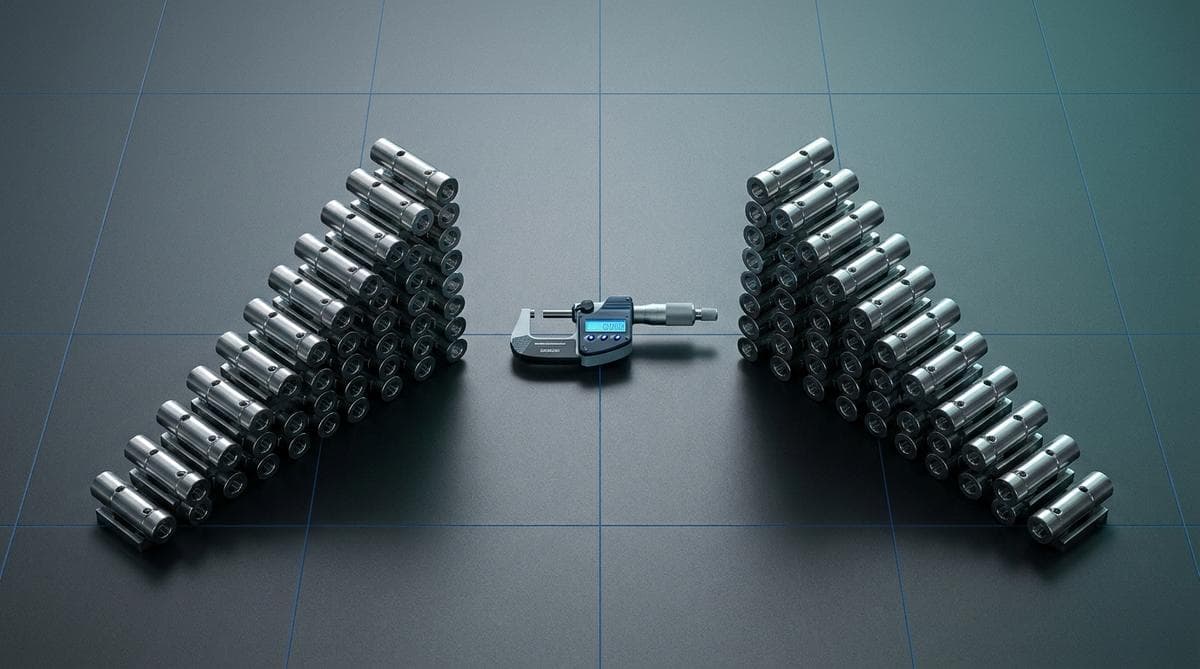
The Piece-Rate Trap: Why Traditional Pay Structures Breed a Quality War
Traditional piece-rate manufacturing pay rests on an apparently simple logic: the more units a worker reports, the higher the wage received. In reality, rigid, linear unit rates create a dangerous conflict of interest. An operator focused solely on maximising volume treats quality procedures as unnecessary obstacles slowing down the work. The result is a negative feedback loop — a sharp increase in assembly or machining speed almost immediately drives up the Scrap Rate, draining the company's margins.
When a system rewards quantity alone, the workforce's natural defence mechanism becomes concealing defects. On production floors, so-called defect dumping between shifts is rampant. Faulty parts are pushed to the bottom of transport containers or passed on to the next workstation in the hope that responsibility will dissolve further down the line. This practice inevitably leads to sharp friction between production and the quality control (QC) department, paralyzing collaboration and destroying team morale.
The greatest threat, however, is the hidden cost of rework, which conventional paper job cards simply do not capture. In the traditional model:
- Time spent repairing an incorrectly produced component is recorded as a standard labour hour or hidden within downtime;
- The next operator must perform the same work twice, generating double the labour cost for a single finished product;
- The absence of precise identification of who caused the error makes it impossible to accurately apportion piece-rate pay or adjust base rates.
As a result, management loses control over the true cost of production, and the apparent savings from high piece-rate output disappear beneath a pile of scrapped waste and inefficient labour hours.
The Rate-and-Quality Matrix: How Progressive Piece Rates Differ from Simple Ones
Classic simple piece rates apply a fixed rate for every unit produced — a model that, in a plant employing 50–250 workers, quickly leads to the quality crisis described above. The answer to this impasse is a progressive piece rate integrated with quality gates. In this mathematical-operational model, the unit price is not a fixed constant but a dynamic variable that rises with volume — but only on the absolute condition that technological standards are maintained.
Defining Baseline and Bonus Thresholds
The foundation of a fair system is a precisely defined technical standard. Up to 100% of standard attainment, the base rate applies, ensuring cost stability. Only after exceeding this level are progressive tiers activated, in which each successive batch of parts is priced higher (e.g. +15% on the rate for the 101–115% range and +30% above 116%). This mechanism effectively motivates the most productive operators without requiring foremen to make arbitrary rate adjustments.
Quality Weighting Mechanism and the FTR Indicator
Output quantity alone, however, is not enough. Modern production management requires linking the progressive multiplier to the First Time Right (FTR) indicator, which measures the proportion of products completed correctly on the first attempt. In practice, this means applying quality weightings:
- FTR above 98%: the operator receives the full progressive rate together with a performance bonus;
- FTR between 95–97.9%: progression is frozen and settlement is made at the base rate;
- FTR below 95%: a reduction to the base rate is triggered, or the material cost of the generated scrap is deducted.
Spreadsheets vs. Shop-Floor Reality
Many production directors attempt to implement these algorithms in spreadsheets. In a medium-sized furniture factory or machining plant, trying to manually link quality control reports with job cards ends in paralysis for the HR department at month end. For a rate matrix to build workforce trust, quality compliance data must enter the system automatically, directly from measurement stations or reporting terminals.
Defect Caused by the Worker or Defective Raw Material? A Digital Discrepancy Protocol
The most contentious point in the relationship between management and operators is the moment a defect is classified. Traditional production job cards require entering a bare count of rejected parts, which invariably triggers disputes at month end. The worker claims the casting cracked due to micro-fractures in the metallurgical material structure; the foreman suspects an overly aggressive tool feed rate. Without immediate verification, the situation becomes a classic he-said-she-said conflict in which either team morale or the plant's budget suffers.
Distinguishing Causes: Material Defect vs. Operational Error
A reliable piece-rate settlement system must unambiguously separate operational errors from process-related defects. If a batch of sheet metal has a hidden rolling defect, suspending piece-rate accrual for the press operator is a clear injustice. Modern production management requires clear event categorisation at workstation level:
- Process-related defects: hidden component flaws, power supply parameter instability, CNC machine software errors, or cooling system failure — in these cases the worker retains the right to the base rate or downtime rate;
- Operational errors: incorrect part referencing, imprecise fixture clamping, ignoring sensor alarm signals — resulting in the part being deducted from the piece-rate tally.
Terminal Validation and Automatic Support Escalation
The introduction of workstation terminals solves this problem at the source. The moment an irregularity is detected, the operator does not wait until the end of the shift — they select the Report non-conformance option directly while logging the work order. The system generates a digital discrepancy protocol and automatically sends a PUSH notification to the process engineer or quality controller. The authorised person arrives at the machine within minutes, assesses the condition of the raw material, and authorises the cause using their RFID card.
This creates an irrefutable digital audit trail of the decision. When payday arrives, the HR department does not need to conduct investigations or correct handwritten records — real-time production reporting creates a transparent history that eliminates pay disputes entirely.
Data Architecture: From Workstation Terminal to Pay Slip
Manually transcribing data from paper forms into spreadsheets is the bottleneck in most medium-sized manufacturing plants. Implementing a coherent digital architecture makes it possible to eliminate this inefficient process entirely, replacing it with an automatic, real-time flow of information. A modern piece-rate settlement system directly integrates events from the shop floor with payroll and accounting modules.
Instant Event Capture at the Workstation
The starting point of the entire information chain is production reporting carried out directly at the workstation. The operator does not fill in a paper job card; instead, they authenticate using a contactless RFID card or scan their individual barcode. The reader then captures the production order code and the assigned technological operation number.
The key element of this stage is the immediate quality parametrisation of the completed batch. The system records:
- The exact number of units accepted as conforming (with the appropriate quality class assigned);
- The number of identified defects with a precise rejection-cause code;
- A timestamp for the start and end of the operational cycle.
One Relational Database Instead of Information Silos
The traditional approach relies on three separate environments: foremen's registers on the shop floor, HR tables, and the finance and accounting system. A modern production software platform breaks with this fragmentation. All data flows into a single relational database, in which the reporting record is automatically linked to the employee's profile in the HR module and to the cost order in controlling.
Eliminating the "Month-End" Syndrome
With this architecture, the phenomenon of HR departments spending several stressful days closing out the month disappears. The calculation of piece-rate entitlements — incorporating progressive rate matrices and quality indicators — happens in the background after each individual shift is closed. The production manager has immediate visibility of the real work-in-progress (WIP) cost, and the employee gains full transparency over their accruals with no risk of transcription errors.

Shop-Floor Transparency: Operator Dashboards That Eliminate Workforce Suspicion
Even the most mathematically refined incentive model will fail if the workforce perceives it as a tool for manipulation. In plants employing between 50 and 250 workers, introducing new settlement rules frequently triggers psychological resistance. Operators accustomed to informal arrangements fear hidden "rate cuts" and arbitrary deductions for defects. The key to neutralising these concerns is shifting the focus from after-the-fact control to full real-time transparency.
The Employee Self-Service Dashboard as a Trust Guarantee
The answer to team distrust is a workstation terminal functioning as an employee self-service dashboard. Rather than waiting for a statement from HR, operators can monitor their progress continuously. After each operation is completed, the screen immediately displays the recalculated indicators:
- Current earnings status: the amount accrued during the current shift, including progressive thresholds;
- Batch quality status: the number of units approved and the number flagged for verification;
- Current unit rate: dynamically adjusted to the level of the First Time Right indicator.
Eliminating the "Pay Slip Shock" Syndrome
The greatest source of conflict in traditional factories is the disappointment that surfaces 30 days after completing a job. When a worker receives a wage lower than their own subjective estimate, a sense of injustice sets in and engagement drops. A modern production software platform closes this information gap. The worker finishes an 8-hour shift with precise knowledge of the result they have achieved, eliminating the need to keep private "tally notebooks".
A Sense of Fairness Grounded in Machine Telemetry
When the data source is not a foreman's subjective assessment but direct telemetry from PLC machine controllers and barcode readers, disputes lose their basis. Objective production reporting creates an environment of transparent fairness. The workforce gains the confidence that honest effort translates directly into earnings, and any deductions stem from hard, verified facts rather than management decisions.
True Cost of Goods Sold (COGS) Including Piece Rates and Losses
For CFOs and manufacturing plant owners, piece-rate settlement rarely comes down purely to closing the payroll on time. The key business challenge remains the precise calculation of the cost of goods sold (COGS). In the traditional model, based on averaged labour-hour rates, true unit costs remain invisible until the quarter is closed.
Dynamic Direct Labour Costing (Job Costing)
A modern production software platform enables the shift from estimate-based calculation to dynamic job costing. When production reporting captures in real time not only the duration of an operation but also the associated piece rates and generated scrap, the system immediately charges the appropriate production order with:
- The actual variable rate: reflecting the varying work pace of individual operators and their performance bonuses;
- The cost of lost raw material: linked to the specific technological workstation where the scrap was generated;
- The cost of rework operations: required to restore the part to the correct quality standard.
In this way, piece-rate pay ceases to be an anonymous plant-wide overhead and becomes a precisely assigned variable in the routing cost calculation.
No More Hiding Losses in Averaged Margins
The absence of detailed shop-floor data leads to the dangerous phenomenon of cross-subsidisation. In many businesses, profitable, repeatable products cover the hidden losses generated by complex parts with high scrap rates. Implementing an integrated system immediately reveals the indices where theoretical profit is being consumed by rework and an understated piece-rate standard.
Transitioning to digital production management makes it possible to identify products that generate volume while draining the plant's operating margin.
Armed with hard data on actual COGS, the sales team gains a powerful negotiating tool. Quotes for end customers no longer rest on intuition — they are grounded in the true technological performance of the machinery and the workforce.
Transformation Roadmap: Implementing Quality-Linked Piece Rates Step by Step
Moving from traditional, error-prone volume-based settlement to an advanced quality-linked model requires precise change management. In a medium-sized manufacturing company, rushing is the greatest risk — imposing new rules overnight breeds workforce resistance and operational paralysis. The success of the transformation depends on maintaining a strict sequence of process and technology steps that build credibility for the new solution.
Phase 1: Review and Recalibration of Time Standards
The foundation of the new system is rigorous standardisation. Many plants rely on historical, long-outdated standard time tables, which leads to glaring disparities in earnings between workstations. The first step is to carry out a technology audit and time study in close collaboration with foremen and area team leaders. It is the shift supervisors who have direct knowledge of actual changeover times, micro-stoppages, and raw material difficulties. Jointly establishing updated cycle times eliminates suspicions of arbitrary "tightening the screws".
Phase 2: Reporting Pilot Without Changing Pay Rules
The most important stage of building trust is deploying the terminals and reporting procedures in shadow-run mode. For a period of 4 to 6 weeks, workers log their operations directly in the system, but their wages continue to be paid according to the existing rules. This stage achieves three key objectives:
- Building a data benchmark: collecting real performance indicators and actual scrap levels without financial pressure;
- Familiarising the workforce with the technology: eliminating the stress associated with operating the workstation interface;
- Simulation comparison: showing workers on test pay slips how much they would gain from bonuses tied to a high quality indicator.
Phase 3: Automated Settlement Module and Anomaly Detection
The final step is the full activation of the payroll module connected to automatic verification rules. The integrated production software platform immediately flags statistical deviations — such as declarations exceeding the machine's technical throughput or unnatural drops in reported defects at the end of a shift. This makes production management fully predictable and settlements beyond dispute.
Summary and Audit: Assess Your Factory's Readiness for the New Model
Traditional piece-rate settlement based on paper job cards and manual data entry into spreadsheets is today one of the main barriers to profitability growth in plants employing between 50 and 250 workers. Every illegible field, every subjective foreman's entry, and every delay in passing documentation to HR generates hidden financial losses and escalates tension within the production team. Replacing this outdated mechanism with an integrated digital platform is not merely a step towards automation — it is, above all, a fundamental shift in the operational culture of the business.
A Hard Assessment of the Benefits: Finance, Quality, and Peace on the Shop Floor
Implementing an integrated model in which production reporting connects directly to HR and payroll records and to the controlling module delivers immediate results at both the operational and strategic level. The experience of manufacturing plants that have abandoned spreadsheets points to three key pillars of transformation:
- Complete elimination of pay disputes: Full transparency of rates and real-time reports means operators finish work with precise knowledge of the wages they have earned, permanently removing the monthly cycle of claims and suspicions about calculation errors.
- A 20–35% reduction in the scrap rate: Linking piece rates to quality indicators (such as First Time Right) and immediately identifying defective batches effectively prevents operators from prioritising quantity at the expense of part quality.
- Automation of HR and payroll settlement: The HR department receives verified, consistent data directly from workstations, reducing payroll processing time from several working days to just a few minutes and eliminating the risk of arithmetic errors.
As a result, piece-rate pay ceases to be a source of friction between the workforce and management, becoming instead a precise motivational tool that drives performance across the entire organisation.
Download the Free Audit: 7 Checkpoints Before Your Digital Transformation
Transitioning to a digital settlement model requires the right organisational preparation. To help management teams make a thorough assessment of their plant's process maturity, our experts have developed a practical implementation resource: Checklist: Audit of the Piece-Rate Work Settlement Process — 7 Checkpoints Before Implementing a Digital System. This is a concise diagnostic tool that precisely identifies bottlenecks in your current information flow.
Using the checklist, you can verify, among other things, whether your time standards reflect actual technological routings, how responsibility for defects is verified, and whether your current production software guarantees a reliable allocation of variable costs per order. The document serves as an invaluable basis for discussions with senior management and helps avoid the typical mistakes made in the early stages of digitalisation.
Book a Dedicated ProcessApp System Demo for Production Directors and Executive Teams
Theory only gains real value when tested against the realities of a specific manufacturing plant. If you would like to see how digital workstation terminals, automatic operator dashboards, and advanced production job cards work in practice, we invite you to a dedicated ProcessApp system demonstration.
During a 45-minute online session, we will configure the process based on the specifics of your plant and show you how to eliminate paper-based document workflows without disrupting day-to-day factory operations. Contact our team of implementation consultants, book a convenient time, and discover how modern production management permanently protects your company's margin.


